President Donald Trump took another stab at restricting automatic citizenship for people born in the United States after the Supreme Court rejected his earlier attempt.
In two executive orders signed Thursday, Trump reached for different legal maneuvers to test the limits of the 14th Amendment’s guarantee of birthright citizenship.
The first order said children would be ineligible if born to “alien enemies,” members of foreign terrorist organizations, or foreign lobbyists. The second order said children of people who fraudulently request tourist visas for the purpose of giving birth in the U.S. would not become citizens.
Trump harshly criticized the Supreme Court’s June decision reaffirming that the 14th Amendment grants citizenship to nearly everyone born on U.S. soil, including the children of undocumented immigrants, striking down his executive order from the first day of his second term.
The new orders marked a fresh effort to overcome that setback and deliver on a campaign promise by expanding the categories of people who the administration argues fall outside the constitutional guarantee. Constitutional scholars broadly agree that the president lacks the authority to eliminate birthright citizenship unilaterally.
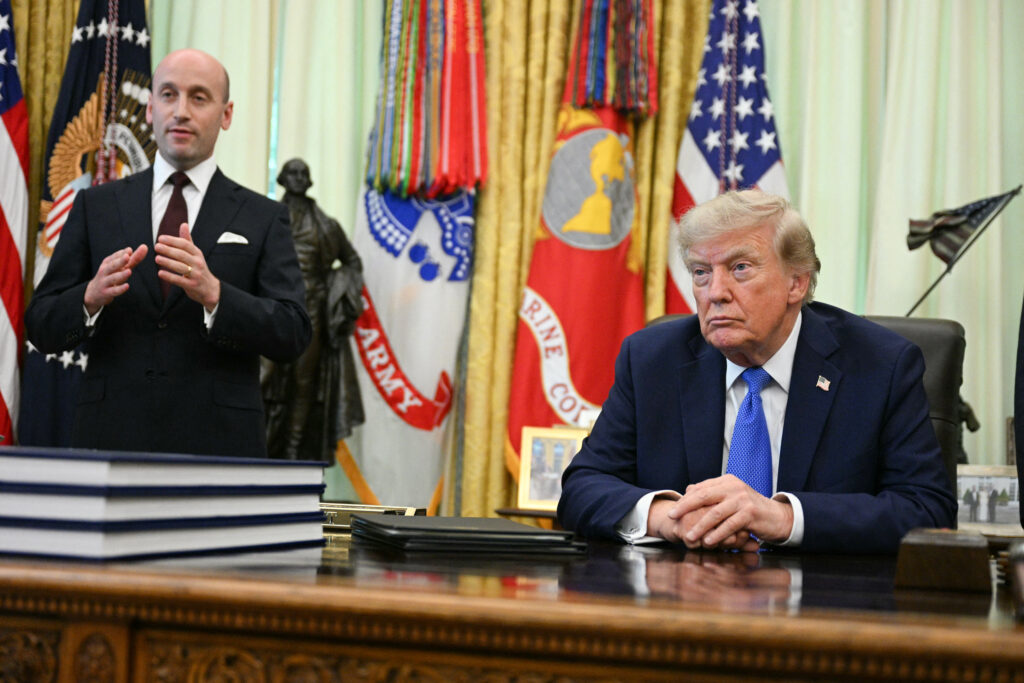
“We had a bad decision, very unfair decision,” he told reporters in the Oval Office on Thursday. “Our country suffers because of it, and we’re ending it a different way.”
The new orders were certain to face legal challenges, and if they survive, would affect far fewer people than the original. An estimated 15 million undocumented immigrants live in the U.S., while only a few thousand people are foreign lobbyists registered with the Justice Department.
No significant populations of U.S. residents are designated as alien enemies or foreign terrorists, making that provision largely symbolic. The administration faces ongoing litigation over whether it can deport alleged gang members by treating them as alien enemies.
The second executive order draws on the president’s authority under the Immigration and Nationality Act to control international travel, according to White House Deputy Chief of Staff Stephen Miller, who appeared with Trump at the signing.
“People come here, pretend to be a tourist, pretend to be a visitor, say they want to go to Disneyland, they want to go visit a monument or go to a national park. But the real reason they’re here is to have a child, to make that child automatic citizen, leave our country and then have a U.S. citizen child,” said Miller, arguing that lying on a visa application amounts to fraud and invalidates the visa.
There is no official data on “birth tourism.” In 2024, fewer than 10,000 babies were born in the U.S. to people with foreign addresses, out of 3.6 million total live births, according to data from the Centers for Disease Control and Prevention analyzed by the nonpartisan Migration Policy Institute.
A divided Supreme Court upheld birthright citizenship in June in one of the most closely watched cases of the recently concluded term. Writing for the 5-4 majority, Chief Justice John G. Roberts Jr. said the framers of the 14th Amendment, ratified in 1868, intended to extend citizenship to virtually all people born on U.S. soil with limited exceptions for the children of diplomats and others.
“Citizenship, then and now, was the right to have rights — to freely participate in our political community. The Framers of the Fourteenth Amendment extended that promise to ‘every free-born person in this land,’” Roberts wrote. “We keep that promise today.”
The Trump administration argued for a narrower reading of the amendment, saying its language did not apply to people in the country illegally or temporarily because they had not demonstrated the necessary political allegiance to the country.
Amanda Frost, an immigration law professor at the University of Virginia, said significant parts of Trump’s new orders appear largely unconstitutional and at odds with the Supreme Court’s decision.
“This is my very clear legal take: He cannot issue an executive order that saying that children of birthright tourism — even if the mother violates immigration law to come to the United States — are not U.S. citizens,” Frost said.
Likewise, David Bier, an immigration expert at the libertarian Cato Institute, said Trump cannot credibly argue that undocumented immigrants in the U.S. who are declared by his administration as “enemies” of the country are not subject to the jurisdiction of the U.S. government.
“None of the [Supreme Court] justices adopted the logic that illegal immigration is an invasion or any of those types of thing,” Bier said “None of the conservatives used that line of argumentation.”
Bier added that the president’s efforts on birthright tourism are “pretty obviously contrary to what the Supreme Court just ruled and are likely to get no further than the prior order did.”
The post Trump tries new tack against birthright citizenship after Supreme Court snub appeared first on Washington Post.