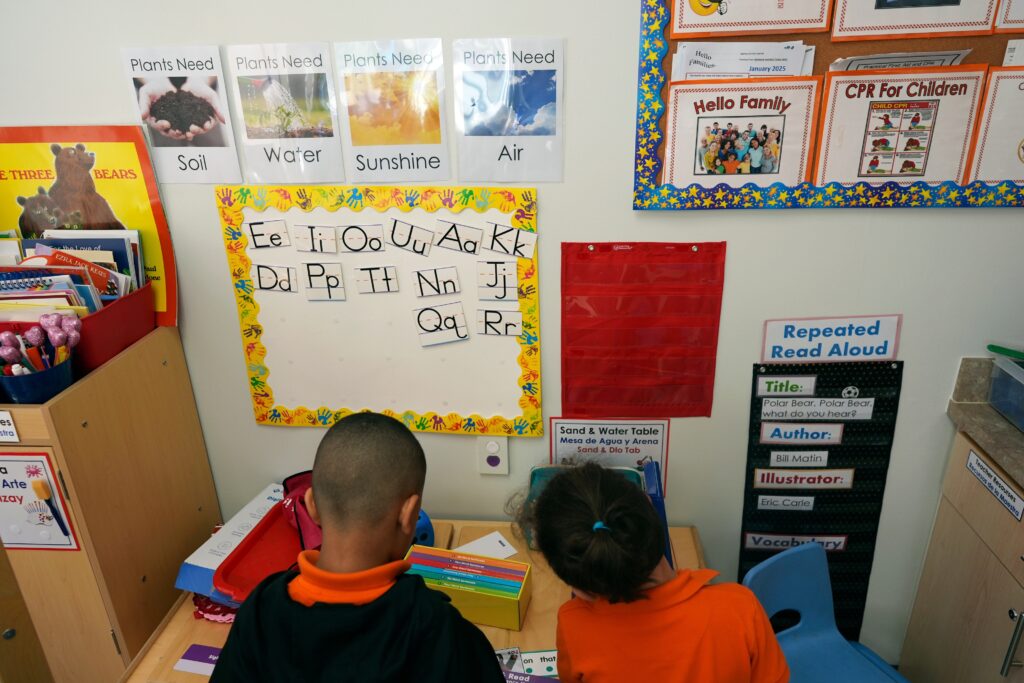
The Trump administration unveiled a proposal Thursday to overhaul the regulations for Head Start, the early-education program that serves roughly 700,000 children across the country.
The proposal would eliminate many existing federal rules, shifting some authority to states and local authorities; add new dietary and physical fitness requirements for students; and cap administrative overhead payments. The changes could free up $2.2 billion to serve as many as 268,000 more children, administration officials said.
“It’s a program that works for the most vulnerable, of course, kids in our society,” Health and Human Services Secretary Robert F. Kennedy Jr. told reporters. “And it’s really important we protect it.”
Over the past few weeks, reports that the administration planned to eliminate many federal regulations have alarmed some Head Start advocates about the future of the program. In June, a report from the conservative Heritage Foundation called on the administration to deregulate the program and eventually eliminate it altogether. And an early draft of a White House budget last year reportedly proposed zeroing out the budget for Head Start, though the final version maintained funding for the program after widespread pushback.
Also last year, the Government Accountability Office found President Donald Trump’s administration improperly withheld about $825 million from Head Start for months.
The Trump administration, however, said the latest proposal is intended to eliminate red tape, cut administrative costs and create more flexibility for programs.
“We built this rule around trusting local leaders to make the decisions that are best for their local communities,” said HHS Assistant Secretary Alex Adams, who leads the Administration for Children and Families.
Administration officials said the proposal would also strengthen dietary regulations to “provide nutrient-dense, whole foods” for children and require sites to give students at least 30 minutes of physical activity for every 3.5 hours in the classroom.
They also said they hope to free up enough money to serve more children by eliminating other regulations and reducing the cap on administrative costs from 15 percent to 5 percent.
“If we get this proposed rule right, we will grow the number of Head Start spots,” Adams said. Officials said the proposal would preserve requirements that programs involve families in children’s learning and recognize parents as children’s primary teachers.
Sen. Patty Murray (D-Washington), a longtime advocate for Head Start, immediately blasted the proposal to remove many federal regulations.
“After Congress and the nation forcefully rejected Trump’s efforts to destroy Head Start, this administration now wants to quietly gut Head Start by eliminating the basic health and safety standards our kids rely on,” she said in a statement.
Khari Garvin, who oversaw the Head Start program during the Biden administration, said he was deeply concerned by the Trump administration’s plans to eliminate many regulations, including those governing class size and teacher compensation.
“It’s the health, safety and quality benchmarks that the federal standards bring,” Garvin said. He said the HHS proposal would “take the program backwards significantly.”
The American Civil Liberties Union said in a statement that doing away with the regulations would violate the laws governing Head Start.
“This proposed rule is an illegal attempt to dismantle the Head Start program by removing the very standards that Congress required to be in place to ensure children receive high-quality early education and comprehensive services,” said Ming-Qi Chu, deputy director of the ACLU Women’s Rights Project. “The administration cannot defy the laws that Congress wrote simply because it disagrees.”
The administration said it plans to formally publish the proposal in the Federal Register on Friday, kicking off a 60-day public comment period. Administration officials would then need to review the comments and issue a final rule, a process that can take months. Any changes could be delayed even further if the ACLU or another organization challenges the move in court.
“This will take a lot of time to implement,” said Tommy Sheridan, deputy director of the National Head Start Association, a nonprofit that advocates for Head Start.
The Head Start program was started more than 60 years ago as part of President Lyndon B. Johnson’s War on Poverty. Local sites typically provide free early education, child care, health screenings and other services for children up to 5 years old from low-income families. Though it has an educational component, Head Start is overseen by HHS, not the Education Department.
Research on the program has found mixed results. A federal study of the modern Head Start program, released in 2010, found most of the benefits faded by the end of first grade. But another study in 2022 found the children of former Head Start participants saw meaningful increases in wages and graduation rates as adults, suggesting the program may have a positive impact across generations.
Some conservatives have long sought to eliminate the program, saying it hasn’t produced enough tangible results to justify the annual $12 billion cost.
“While the program should sunset, it is reasonable at this point to deregulate the program and provide more autonomy to local operators,” said Jonathan Butcher, acting director for the Center for Education Policy at the Heritage Foundation, the conservative group behind Project 2025, the policy blueprint that called for the government to “eliminate the Head Start program.”
Trump administration officials also noted that Head Start has gradually shrunk over the years, including a reduction of roughly 100,000 slots for children during the Biden administration.
Sheridan of the National Head Start Association said many sites have been forced to shrink over time because they haven’t received enough money to keep up with inflation. Garvin, the former director of the Office of Head Start, also noted that the Biden administration allowed some Head Start programs to add more infants and very young children, who require smaller class sizes. And some programs needed to spend more on compensation to help attract and retain instructors.
Both the National Head Start Association and the First Five Years Fund, an advocacy group for early-childhood education, said they plan to review the Trump administration’s proposal closely and submit formal comments.
correctionA previous version of this article said Health and Human Services projected its proposal would create 236,000 new slots. That number was based on draft projections provided to The Post. HHS updated its projections to 268,000.
The post HHS proposes cutting many federal education and health guidelines for Head Start appeared first on Washington Post.