It is time to stop whatever you are doing, purchase a jar of nutritional yeast and get in the kitchen with a chef who looks like the cousin of the Berzatto family whom nobody speaks to because he once ordered the Italian beef without bread. You are a Kennedy. You live in a time of great divide, but you know who the real enemy is. The enemy is seed oils.
Wake up, betas. It’s time for “The Real Food Show.” Where is it airing? PBS. No, HA HA HA, sorry, that was a joke. Obviously. It’s airing on YouTube. It’s about real food. Those things you were eating before? Those were not food, you coastal-elite coloring book. Those were thumbtacks and pillowcases and the fetid rubber of an old iPhone case, and you should have realized it when your dinner tasted like metal and sent you to the ER. It’s time to —
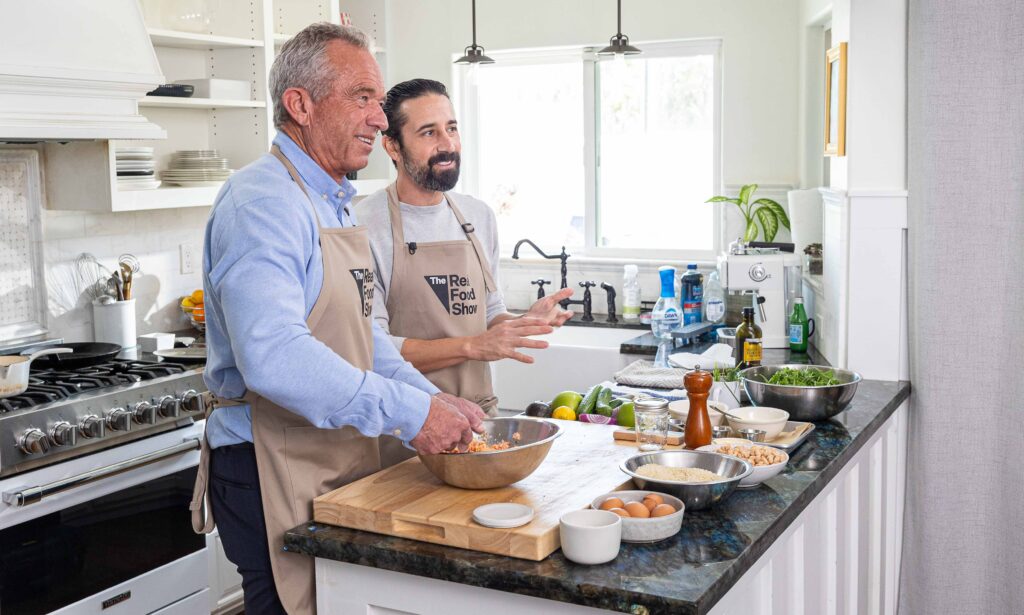
Eh, you know what, never mind. Hi, it’s Monica! Here in this column, Health Secretary Robert F. Kennedy Jr. and I have a little tradition: He makes a weird video, I write a weird parody, then we wait a few months and do it again. But his most recent project, whose first episode premiered last week, is a fairly standard-issue cooking show. It’s based on the premise that America’s diet is crap (true) but that RFK Jr., with the help of a series of special guest chefs, can teach us “how to cook delicious, nutritious meals with real ingredients, all at affordable prices.”
He later reiterates, “a very, very affordable price”; in this episode, we’re making crispy salmon cakes and an arugula salad with celebrity chef Andrew Gruel, and the recipe will work out to $4.91 a serving.
Fab. What’s next?
Well, some politics is next: RFK Jr. complains about President Joe Biden’s dietary guidelines, which he says basically “put Fruit Loops at the top of the food pyramid.” And also, based on the content of this cooking show, I am made to understand that if a seed oil moves into the neighborhood, it should be forced to report itself to the police and stay 500 yards from the elementary school.
But there’s also real cooking: Gruel bakes the salmon, forms it into patties, makes a homemade vinaigrette. He teaches us that Dijon mustard is a natural emulsifier, that lemon peel contains gut-supporting pectin, and that the best way to get kids to eat healthily is to enlist them as sous chefs. Early on, Gruel promises that he is going to take it easy on us with this recipe: “Nothing overly intellectual.”
And here is when my mind started to both wander and wonder. I love cooking shows. I’m cool with a Cabinet official hosting a cooking show (still waiting for Transportation Secretary Sean P. Duffy’s promised “Great American Road Trip”), especially if it means the Cabinet official has found an activity in which he will do more than calisthenics in jeans.
But something was nagging at me about “Real Food,” and what that was didn’t start to gel until I performed math. At which point I started to feel like this was a cooking show about what rich people don’t understand about how poor people eat.
The second time I watched the episode, I concurrently opened the online shopping option for my nearest chain grocery store. Every time “Real Food” brought in a new ingredient, I added it to my virtual cart: $2.99 for a packet of fresh thyme, a dollar for a lemon. I selected the cheapest option every time and did not include items such as cooking oil, salt or pepper, given that these are considered pantry staples. (Though if you usually use canola or corn oil, you’re directed to buy olive or beef tallow.)
My final total, to provide groceries for this one meal, was $73.46.
Which works out to a little more than $18 per person, which is — none of us majored in math here, right? — higher than $4.91.
In the show, an itemized screenshot illustrates how RFK Jr. got to the promised number. The cost of the nutritional yeast, for example, is listed at 20 cents; the cost of the avocado mayo is listed at $1.04. In other words, not the price of the container but the price of one serving from the container. This is a perfectly standard practice in pricing out a recipe, and RFK Jr. has suggested we do what feels entirely reasonable to a financially flush shopper: Buy the $14 jar of avocado mayo, use one scoop to make salmon patties, save the rest for other recipes.
But that kind of practical thinking is not helpful to a parent who has $20 in cash to get them to tomorrow’s paycheck. Safeway does not let you walk in, scoop some mayo out of a jar and pay one dollar at the cash register. You have to buy the whole thing. That parent needs to feed their family with a meal that actually costs $20, not $20-plus-an-additional-$53.
And I’m not sure that meal planning in advance is the solution: Yes, a mom with a $150-per-week grocery budget could afford the $73 grocery haul this meal requires. But then she’s left with $77 to spread out over 20 additional meals. The salmon, beans and arugula all got used up in the crispy salmon cakes, so now we’re in for one extremely healthy meal plus a whole bunch of peanut-butter-and-nutritional-yeast sandwiches.
There is, as it happens, a wealth of food influencers already working in the space of teaching cash-strapped cooks how to stretch their budgets as much as humanly possible.
My favorite, Rebecca Chobat, goes by “Dollar Tree Dinners,” and she regularly posts series with titles such as, “Making four dinners for a family of four with a budget of $20.” She approaches her meals with surgical precision and militaristic planning: She might instruct viewers to use only a third of the bag of frozen bell peppers for the Cajun sausage skillet, because the other two-thirds will be required for the bean enchiladas and the breakfast casserole; she might tell you to pick up a couple of free mustard packets from the grocery store’s deli counter so you don’t have to allot funds for a whole bottle.
Are Chobat’s meals as healthful as wild salmon cakes and arugula salad? Probably not. (Not for nothing, but I am old enough to remember when President Barack Obama was seen as elitist for remarking on the price of arugula.) Her meals are certainly not organic, and she definitely employs canned sauces and boxed mixes. But Chobat tries to make sure each meal has a protein and a vegetable; she does what she can to achieve balance.
More importantly, she operates with a vast knowledge and lived experience of what it feels like to navigate the American food ecosystem. An ecosystem in which maybe the beans are cheaper today at Food Lion, but if it takes half a gallon of gas to get there and back, is $2 in gas worth saving 30 cents in legumes? If the farmers market sells inexpensive chives, but it’s only open Thursdays, and you work Thursdays, how much good does that do you?
It feels churlish to be nitpicking like this. Or defeatist, maybe — as if I’m saying that we don’t all deserve wild Alaskan salmon and arugula. I vote arugula for everyone.
But there’s something that feels slightly off with the assumption baked into the premise of this show. The assumption is that typical Americans don’t eat healthily because they don’t know how — because they don’t know that salmon is a smarter choice than a Happy Meal, or that a salad with a squeeze of lemon juice is lower-calorie than a bucket of ranch.
People do know this, though. And people who have to budget their groceries are often ingenious cooks, creative and resourceful, finding ways to stretch odds and ends into sustenance and joy.
It’s not that recipes are “overly intellectual.” It’s often the fact that food is 33 percent more expensive than it was seven years ago — a massive jump compared with prior decades. This is not a political or policy-oriented column, but we could all feel free in our own time to Google whether, in the past few years, the federal government has begun providing more or fewer Americans with SNAP assistance to buy healthier food.
“The Real Food Show” is not nefarious. In this episode, Gruel comes across as personable and sincere. But the show still felt as though it was coming from a place of superiority — you’re not cooking salmon because you don’t know that you should — rather than a place of empathy or curiosity.
So, I hope the concept grows, Mr. Secretary.
Have Chobat on next. Have a mom of three from Mississippi show you how she does things on her budget. Learn what America can teach you about the way it eats. I would watch those chefs and that show in a heartbeat.
As for the food itself: Looked great. No objections.
I had to skip the salmon patties because, while researchers have made many wondrous developments in the field of food science, a palatable vegetarian fish substitute is not one of them.
But the white bean/arugula salad was delish. I made it in 10 minutes. I ate it with a lentil burger, served on a soft white hamburger bun, so heavily processed and anti-intellectual and frankly heavenly that I will probably go straight to hell, or possibly to a seed oil factory, which I have been assured is the same thing.
The post RFK Jr.’s cooking show is a rich person’s solution to a poor person’s problem appeared first on Washington Post.