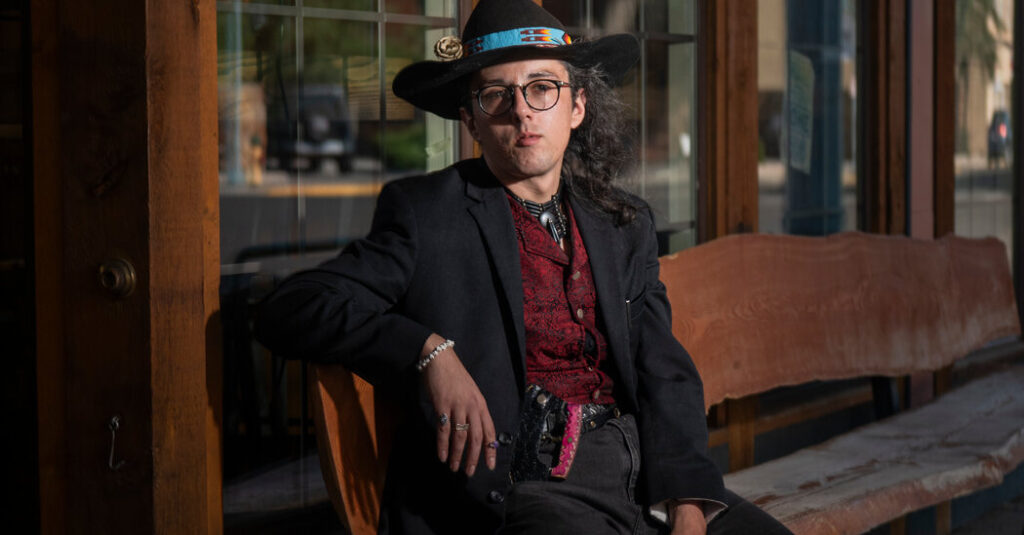
When Rihanna Kelver goes on road trips or ventures out alone to photograph the rural night sky, she often packs a small teal handgun. Being a transgender woman in Wyoming is not easy, she said, but owning a gun sure seemed like it would be.
Then one night last September, Ms. Kelver, 28, drew her gun after she had been pushed down in the street during a brief confrontation with three men in the college town of Laramie, according to police reports and surveillance video. Wyoming’s “stand your ground” law is supposed to offer legal protections to gun owners who draw in self-defense, yet Ms. Kelver was arrested and charged with aggravated assault and possession of a deadly weapon with unlawful intent, charges that carry up to 15 years in prison.
The case has touched off an impassioned debate in one of the country’s most gun-friendly, staunchly Republican states about whether the Second Amendment applies when the person holding the gun is transgender.
“I had to defend myself,” said Ms. Kelver, who transitioned as a high schooler in Laramie and has been an outspoken activist for trans rights. “I don’t know how it wasn’t reasonable, given the dangers and threats trans people hear every day.”
The county attorney in Laramie said gender and sexual orientation had played no part in his decision to prosecute the case, and a judge found there was enough evidence to take it to trial.
Ms. Kelver says she would not have been charged if she had been a biological female shoved to the ground by a group of men.
Interest in guns and firearms training soared in L.G.B.T.Q. communities after President Trump’s 2024 election win, as Americans who had never previously considered owning a gun worried about political violence or losing their rights to a more aggressive second Trump presidency.
Then last August, a 23-year-old trans woman killed two children in a shooting spree at a Minneapolis church, prompting a wave of right-wing figures to call transgender people mentally ill and violent, and question whether they should be allowed to own guns at all.
Ms. Kelver said she grew up around guns and went target shooting with her grandfather in Colorado. A friend gave her the .380 subcompact pistol that fit neatly into a hip pack a few years ago after some men in a pickup truck harassed her as she took photos at night in a deserted stretch of Wyoming.
Wyoming’s permissive gun laws made that simple. Wyoming does not require gun owners to register their weapons and allows people to carry firearms concealed or in the open without a permit. The state’s Firearms Freedom Act declares that guns made and kept within state lines are exempt from federal regulations, and its “stand your ground” law allows people to use force to defend themselves if they reasonably believe their safety is threatened. The law says they do not have a duty to retreat if they are not the initial aggressor.
Laramie, a city of 30,000 where bike shops and galleries put rainbow stickers in their windows and Pride Fest fills a park every year, is still living in the shadow of Matthew Shepard. In 1998, Mr. Shepard, a gay University of Wyoming student, was brutally beaten by two men and left tied to a fence in a field, bringing an avalanche of outside scrutiny and soul-searching crashing down onto Laramie.
Ms. Kelver’s supporters around town worry that the case could divide the town anew, undercutting years of progress and reopening old wounds.
“They’re charging Rihanna because she’s a trans woman,” said Nichol Bondurant, a high school teacher who dressed in white as a wide-winged angel in the wake of Mr. Shephard’s murder to thwart anti-gay protesters who flocked to Laramie then. “Gun rights don’t say you have to fit a political affiliation.”
The divisions preceded Ms. Kelver’s case. Wyoming’s Republican-dominated Legislature has passed a law restricting bathroom use by transgender people, curtailed gender-related health care and required parental notification if a student wants to use a different name or pronouns. But many elected leaders in Laramie — including the county prosecutor — are Democrats and have opposed such measures.
Ms. Kelver said she did not usually carry her gun in Laramie. She moved there when she was 11, went to high school there, ran for the local school board at 18 and now works at a local bar and grill.
Trump Administration: Live Updates
Updated
- A Senate panel, in a party-line vote, holds Fauci in contempt of Congress.
- Fauci and senators disagree on his refusal to testify. Here are the legal issues involved.
- The C.I.A. has set up a secret task force as Trump pressures Cuba.
But on Sept. 13, she had felt uneasy after being harassed by an acquaintance, she said, so she tucked her gun onto her hip when she left for a night shift at the Crowbar and Grill, a pizza-and-beer spot where banners for Black Lives Matter and L.G.B.T.Q. rights hang beside the American flag.
Ms. Kelver said she had two shots at the bar, then went outside to smoke a cigarette before her shift at about 10 p.m. One man in a group of three shouted a profanity directed at the Crowbar, according to court records, and Ms. Kelver said that the man, Scott Durham, also yelled an anti-gay slur, though he denied that to the police.
Ms. Kelver, upset, walked up to the men and asked, “What did you just say?” according to police reports. Surveillance video from a downtown camera shows her walking into the street toward the men, one hand on her hip by the pack that held the gun. Seconds later, Mr. Durham pushed her away, and Ms. Kelver stumbled and fell onto her back.
The moment she hit the pavement, she drew and racked the gun and pointed it. She did not fire. The three men walked away, and Ms. Kelver got up and collected her belongings that had scattered in the street. The encounter was over in about 10 seconds.
The confrontation occurred in the tense atmosphere just three days after Charlie Kirk’s assassination. Mr. Durham blamed her for inciting the confrontation, telling a police officer, “I’m not trying to start a fight,” according to body camera videos. None of the men were charged, and they were allowed to leave after giving their accounts to the police.
Mr. Durham is listed as the victim in police reports. In a brief telephone interview, he said the episode had been “mis-portrayed and misconstrued” in news coverage that began with an article in The Laramie Reporter and quickly spread on social media. He declined to comment further.
Ms. Kelver said she injured three vertebrae when she hit the pavement and had to walk with a cane for months.
Her lawyer, Andrew Holcomb, has filed a motion to dismiss the case based on Wyoming’s “stand your ground” law.
“She doesn’t pull a gun till she’s on her back with three guys around her,” Mr. Holcomb said of Ms. Kelver. “She only used the force that was necessary to stop the attack.”
Ms. Kelver also faces a misdemeanor charge for initially telling the police that she had brandished a knife, not a gun. In an interview, she said she had been shaken up and confused immediately after the confrontation and had misspoken.
As news of the incident spread online, critics blamed Ms. Kelver for inciting the conflict, saying she was wrong to approach the men in the first place. Some derided her appearance and gender identity. But Ms. Kelver has also found support in Laramie, where friends held a benefit concert to raise money for her legal defense.
Ms. Kelver said she rejected a plea deal that would have spared her from jail time but stripped away her gun rights. She is set to go to trial in November.
“I’m not going to roll over,” she said. “I’d rather lose fighting.”
The post A Trans Woman Pulled a Gun and Started a ‘Stand Your Ground’ Debate appeared first on New York Times.