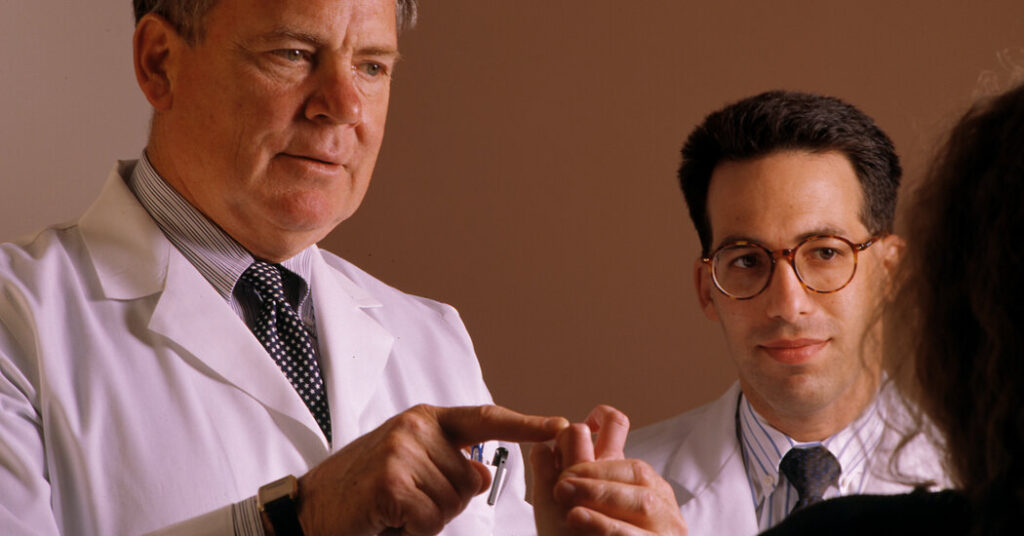
The use of surgical microscopes was still in its infancy at Duke University when Dr. James R. Urbaniak received an emergency phone call in June 1974.
The right thumb of a 17-year-old water skier had been pulled off by a tow rope, and had fallen to the bottom of a lake in south-central North Carolina. About six hours later, the thumb was retrieved by the victim’s older brother.
“Before the fish and turtles got to it,” Dr. Urbaniak (pronounced er-BAN-ik) recalled decades later.
His thumb packed in a cup of ice, the teenager was flown in a helicopter about 100 miles to Duke, in Durham, N.C., where Dr. Urbaniak and his surgical team performed their first thumb reattachment — under a microscope, using sutures narrower than a human hair.
The achievement was widely reported at the time, and Dr. Urbaniak even received a mention in The Water Skier magazine.
“We’ve done 150-something thumbs since then, and none worked better than this boy’s,” he said in a 2025 interview with the American Society for Reconstructive Microsurgery, of which he once served as president.
While Paul Stewart, the teenager, who died in 2021, did not regain full use of his thumb, his family considered Dr. Urbaniak a hero. His brother, David Stewart, the one who retrieved the digit and later became an internist, said in an interview that Dr. Urbaniak “was a very personable fellow who gave Paul a chance.”
Dr. Urbaniak died on July 18 in Durham. He was 90. His death, in home hospice, was from complications of cancer, his son, Michael Urbaniak, said.
During an innovative career in microsurgery and orthopedic surgery, Dr. Urbaniak helped revolutionize techniques that facilitated the mending of tiny nerves and blood vessels in the reattachment of severed fingers, hands and limbs. He also developed a grafting procedure to save the debilitated hips of young adults as an alternative to artificial hips.
“I think he was probably the greatest orthopedic microsurgeon of our time,” Dr. L. Scott Levin, the chairman emeritus of orthopedic surgery at the University of Pennsylvania’s medical school, said in an interview.
Self-taught in microsurgery, Dr. Urbaniak was not the first surgeon to reattach severed appendages, a practice that began in the 1960s. But he initiated microsurgery at Duke in 1970; performed the university’s first replantation surgery in 1974; conducted vital research; and, according to the university, reattached more than 1,200 severed body parts during his career.
He popularized a technique called the wraparound, in which part of a toe is built into a thumb, and, early on, used medicinal leeches on occasion to help restore blood flow, several surgeons who worked with him said in interviews.
In those early days, he had to wheel his operating microscope, which was about six feet tall and four feet in diameter, across the street to the Duke University Hospital from his lab at a V.A. hospital. Many of his patients had lost fingers working in the furniture and textile industries. Several were rodeo cowboys. One was a 25-year-old electrician, whose hand, reattached by Dr. Urbaniak, regained normal function.
“To repair a vessel and watch the blood flow through it,” Dr. Urbaniak said in the 2025 interview, “was more fun than swinging a golf club.”
He added: “I never lost that thrill.”
An inveterate storyteller with the folksy lilt of his native West Virginia, he said that he once amputated a rabbit’s ear and placed it in a refrigerator overnight in an experiment to determine how long an appendage could survive on its own before being successfully reattached. The ear was sewn back on and his lab crew entered the rabbit in the North Carolina State Fair, where it received a prize and finished fourth in best-in-show.
“One of its ears was a little drooped, but the judges never picked it up,” he recalled.
In 1979, with the help of drills that he bought at Sears and had modified for surgical use, Dr. Urbaniak developed a technique to treat younger patients with a hip condition called avascular necrosis, caused by the use of steroids and alcohol, as well as fractures, dislocations and other factors. The disease occurs when the ball-shaped top of the thigh bone, or femur, which fits into a socket of the pelvis to form the hip joint, lacks sufficient blood flow. Without treatment, the dead bone can crumble, leading to the collapse of the joint.
Dr. Urbaniak’s solution was to take a roughly four-inch piece of the fibula — the non-weight-bearing bone in the lower leg — and graft it, with its attached blood vessels, to the top of the femur, restoring blood flow and stimulating new bone growth.
He and his surgical team performed some 3,500 of these microsurgical operations, called free vascularized fibular bone grafts, to avoid the need for artificial hips. The procedure was particularly helpful to younger people — the average age of his patients was 33 — whose artificial hips might have needed to be replaced two or three times during their lifetimes, Dr. Urbaniak told the website Duke Today in 2003.
“The more active the patient is, the faster the artificial hips wear out,” he said.
James Randolph Urbaniak was born on May 15, 1936, in Fairmont, W.Va. His father, Cecil Urbaniak, was an immigrant from Poland and a coal miner who became a district president of the United Mine Workers of America; his mother, Patricia (Morgan) Urbaniak, ran the household.
James graduated as valedictorian of his class at Fairmont Senior High School and was named all-state in football. Like his father, he played football at the University of Kentucky, recruited by the storied coach Bear Bryant. In 1957, his senior season, he finished among the top four receivers in the Southeastern Conference, but would go on to gain far wider acclaim with his hands as a surgeon.
He graduated from Duke’s medical school in 1962 and was in the Navy from 1963 to 1965, serving in the office of the attending physician to Congress and the Supreme Court. He joined Duke’s orthopedic faculty in 1969; directed the hand surgery program from 1975 to 2005; and was chief of the division of orthopedic surgery from 1985 to 2002.
In addition to his son, he is survived by his wife, Martha (Shawger) Urbaniak, a registered nurse whom he married in 1969; a daughter, Kathi Urbaniak; two grandchildren; and a sister, Cecily Urbaniak Winchell.
Dr. Urbaniak often liked to tell the story of a college student whose thumb and little finger he reattached after they were lost in an accident on a highway job. At a hospital emergency room in South Carolina, the student and his family, on the verge of giving up and having the digits discarded, caught sight of a newspaper tossed in a wastebasket. In the paper was the story of the young water skier whose thumb had been reattached by a certain Dr. Urbaniak only a few weeks before.
But the story didn’t end there. That fall, while Dr. Urbaniak was attending a Duke football game, his team made a long punt return that was nullified by a penalty. The chief referee, however, waived it off, Dr. Urbaniak said. The referee was the father of the student he had recently operated on.
Dr. Urbaniak considered the waived penalty an unspoken favor. “That’s kind of been my greatest reward in microsurgery,” he said with a laugh in the 2025 interview. “True story.”
The post James R. Urbaniak, Master of Stitching Back Fingers, Dies at 90 appeared first on New York Times.