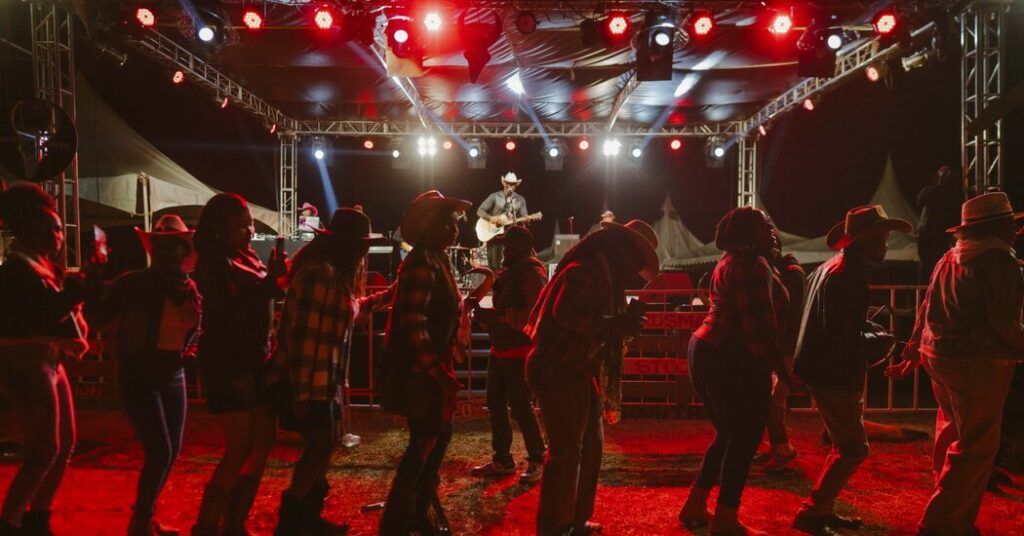
The country music fans sang along to classic hits, drinking beer and whiskey as they tried to keep their line dancing synchronized.
No memo was needed on the dress code. The Ngong Racecourse, a horse track on the outskirts of Nairobi, Kenya, was packed with cowboys and cowgirls wearing their best western styles.
“Hats and boots!” said Amish Gupta, one of the attendees.
The crowd was there to celebrate International Cowboys and Cowgirls Day, a festival in Kenya held on the last Saturday of July. For the second year in a row, the audience kicked up dust, danced and ate barbecue, celebrating a musical genre born far away but that more Africans are coming to appreciate.
Country has long been played on radio stations across the continent and has drawn increasing interest from local artists over the years. It is particularly popular among Afrikaners in South Africa, where artists like Bobby Angel and Lance James first became stars.
Purity Melubo and Fatuma Isaack, both in their 20s, wore matching beige hats to the horse track. They were both newcomers to the festival this year.
Ms. Melubo said she knew she was a country fan when she first heard Kenny Rogers’ “The Gambler” on the radio as a child. She is also Maasai, a pastoral community in Kenya that she said is essentially “cowboy.”
“We have cows and ranches,” she said. “The only difference is that we don’t wear hats and boots and leather jackets.”
Many in the audience did indeed wear leather jackets in the chilly evening air, but they ditched them when the event’s main act, the Nigerian country singer Ochiora Okogeri, known as The Country Man, took the stage.
Wearing a fringed brown leather jacket and black pants, he fired up the crowd by thrashing his guitar as his soft baritone belted out covers of classic country songs like Don Williams’s “I Believe in You.”
The Country Man’s energy flowed into the crowd as it eagerly geared up for another round of line dancing. “Are you having a good time?” he yelled.
Days earlier, sitting outside a shop selling cowboy outfits in Nairobi, the singer said playing in Kenya would be like performing “on easy mode,” compared to playing in his home country.
Nigerian audiences were “mostly primed for Afrobeats,” an upbeat genre that combines jazz, funk and traditional African folk sounds, he said.
He and Elijah Manyeki, the festival’s main organizer, hunched around a cable reel table, shared oranges and tangerines, and talked about how they fell in love with country, which crooned in the background at the store.
Mr. Manyeki said he grew up listening to the genre and watching westerns. He once visited Texas and was attracted to the cowboy shops he saw there, eventually opening this one in Nairobi.
He later ventured into events after he noticed “country music was only played in bars and clubs” around Kenya. “I saw that the best way to have everyone enjoy country music was to do a family country event,” said Mr. Manyeki.
He said the festival had welcomed more than 5,000 cowboys and cowgirls last year. He has plans to hold tours across the continent in future, he said.
Last year’s festival only featured local acts and was dominated by a home crowd. This year, a good number of country fans flew in from abroad.
“I flew in from Ireland just to be a part of this,” said Krzysztof Gwozdzianski, 43, who said he had seen videos of last year’s festival on YouTube.
The local country scene in Kenya is still heavy on cover songs, but performers are remaking classic tunes in local languages. At the festival, Ythera the Wildflower sang a rendition of Dolly Parton’s “Coat of Many Colors” in her native Kikuyu language.
“Kikuyu renditions bring country music closer to home and our language gets to be appreciated internationally,” she said.
Country is particularly popular among the Kikuyu, Kenya’s most populous ethnic group. Some say Mugithi, a folk genre in the Kikuyu community that features a lone singing guitarist, is similar to country.
The Country Man said he “hated” country music as a boy. But his father played the genre in his car as he took him to school. “Somehow it slipped into my conscience,” he said. Later he found one of his father’s old memory cards and began to enjoy songs by Don Williams, Kenny Rogers and Elvis Presley.
He eventually asked his mother for a guitar and mastered it sufficiently enough to play Jim Reeves covers in church, filling people, as he put it, “with the Holy Spirit.” He started to perform at weddings and later became an internet sensation.
These days, he also writes his own songs, drawing on his life experiences.
“A lot of people do what they do to appeal to other people,” he said, placing orange peels on the cable reel table. “I appeal to myself.”
Shortly after midnight, to the delight of the crowd at the horse track, he performed “Loner in Limbo,” his first original song. It traces life’s highs and lows.
The post Cowboys and Cowgirls Light Up a Country Music Festival in Africa appeared first on New York Times.