Ashley Kahn, a music historian and professor at New York University, is the author of “Days of Miracle and Wonder,” which publishes on Tuesday. He was part of the “Graceland” tour production team and was tour manager for Ladysmith Black Mambazo.
Paul Simon’s 1986 album “Graceland” is approaching its 40th anniversary. It stands today as the magnum opus of an artist whose work appears many times over in the American musical canon. Through the years, the album has been sold more than 16 million times in various evolving forms — from LPs to cassettes to CDs and downloads. Simon himself considers it his best. By any measure, as a recording and a concert experience, “Graceland” amounted to one of the most joyful musical experiences of the 1980s, a breath of acoustic authenticity in an era resounding with digital synthesizers, sequencers and drum machines.
Nothing Simon created before or after “Graceland” rang with quite the same melodic invention, rhythmic snap or self-referential wit, poking fun at his middle-aged self (he was 44 and recently had divorced for the second time). “These are the roots of rhythm,” he sang on “Under African Skies,” one of the album’s memorable tracks, a duet with Linda Ronstadt. “And the roots of rhythm remain.”
“Graceland,” released Aug. 25, 1986, does in fact remain. Its songs, including “You Can Call Me Al,” “The Boy in the Bubble” and “Diamonds on the Soles of Her Shoes,” still play on adult contemporary playlists. Its anniversary this year is being celebrated in tributes across the United States and Europe, including a special concert at London’s Royal Albert Hall featuring Ladysmith Black Mambazo, the Zulu choir that collaborated with Simon on the album.
In the acclaim lies one other unique — and uncomfortable — aspect of the album’s legacy: the “controversial” tag many reviews gave “Graceland” back in the day, one that the album has never shaken. Forty years on, the criteria by which Simon was judged have faded in memory, and the contextual details have been blurred by time. Should there still be an asterisk attached to “Graceland”?
“Graceland” was charged with twin indictments: of cultural appropriation and defiance of the anti-apartheid boycott. Let’s look at the charges separately.
For Simon, “Graceland” was a return-to-roots project. He heard echoes of the rock-and-roll of his youth in the music of South African townships. A cassette lent to him by a friend containing “township jive,” already old-school in South Africa at that point, lit an inspirational fuse. Coming out of a creative doldrum, Simon began to invent lyrics to match the upbeat melodies and rhythm.
Whether sourcing musical inspiration is labeled exploitation or collaboration — whether it warrants criticism or compliment — usually depends on how the more established and better-funded party approaches the exchange in terms of compensation, credit and participation. Simon was acutely aware of this when he decided, rather than try to re-create the music in a studio close to home, to travel to South Africa and work with the musicians on that recording. He chose: to pay them triple union scale, far beyond the standard rate Black musicians could then expect in South Africa; to attribute or share songwriting credits appropriately; and in all interviews and publicity materials, to identify the musicians by name and heritage.
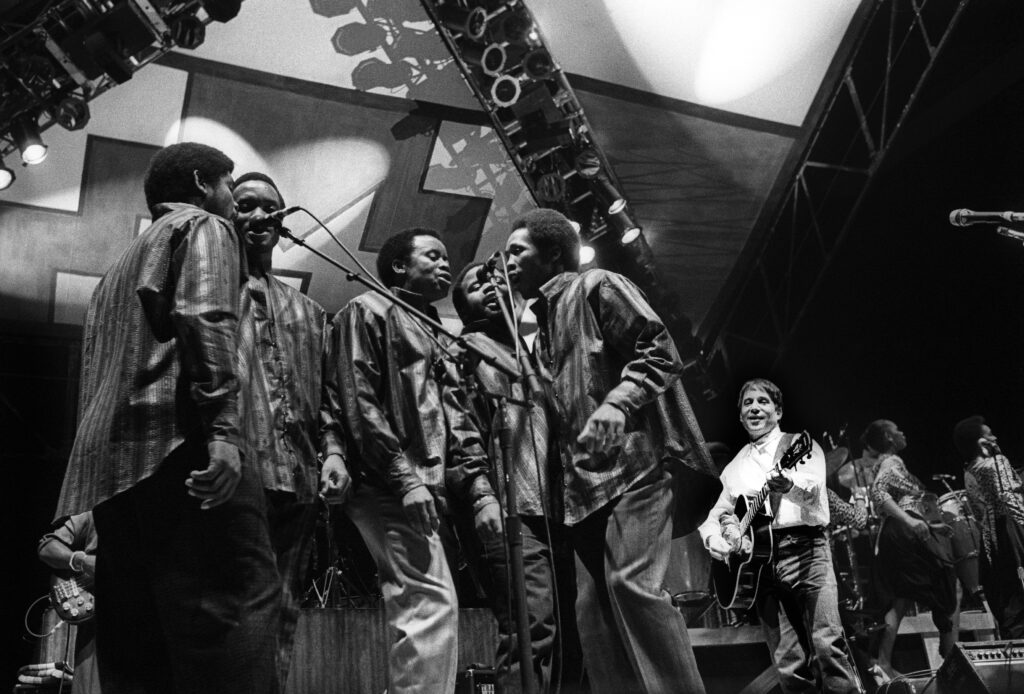
He also included many of them in his plans to tour “Graceland,” with 24 musicians who included South African legends Miriam Makeba and Hugh Masekela, all of Ladysmith Black Mambazo and a full Pan-African group: a not inexpensive proposition with no guarantee of success. To make it happen, Simon did not pay himself during the initial year of the tour.
By all appearances, Simon had done as he should, and most journalists agreed. Yet some still could not get past the “cultural tourist” idea of a White leader from the West leading an African ensemble. It was a feel thing, more than facts.
Years later at the height of the Black Lives Matter era, in a Vulture magazine conversation piece, “Is Culture Borrowing Always Theft?,” Simon was measured against other White musicians then appropriating Black music and cultural trends, like Iggy Azalea, Justin Timberlake and Macklemore. “Leagues more mindful” was how “Graceland” was judged.
The other accusation against “Graceland” was trickier. It related to Simon’s 1985 decision to record in South Africa, a country then embroiled in political turmoil, the result of almost 40 years of one-party dominance locked in place by a White-minority government that, through the pernicious apparatus of apartheid, controlled the country’s resources and subjugated its Black African population.
As Simon prepared to fly to Johannesburg, protests were flaring in South Africa, and government security forces had become more brutal — more visibly than ever in the U.S. and Europe, as the expansion of global news services and nightly cable television coverage made it impossible to look away.
The country’s Black leadership was persecuted, Nelson Mandela most prominently. Political parties engaging in any anti-apartheid activity, like Mandela’s African National Congress, were outlawed and exiled. The situation seemed a powder keg.
Exasperated governments spoke out repeatedly, threatening, then enacting, economic sanctions. Well-known musicians, many of whom helped raise awareness and funds for Ethiopian famine victims only a year earlier, were uniting on songs protesting apartheid — the Special AKA’s “Free Nelson Mandela” in Britain. In the U.S., “Sun City” by Artists United Against Apartheid, a superstar-studded collection of performers led by Steven Van Zandt, called on musicians to avoid performing at the luxury resort that skirted apartheid restrictions.
What all these anti-apartheid initiatives shared was an urge to isolate South Africa. A 1980 boycott was initiated by the ANC and sponsored by the United Nations. The document dealt primarily with the spirit of isolation, rather than specific details: “The General Assembly … makes the request to all states to prevent all cultural, academic, sporting and other exchanges with South Africa. This is also an appeal to writers, artists, musicians and other personalities to boycott South Africa.”
The resolution was loosely worded and the boycott was almost immediately tested by touring dramas born in the country’s vibrant Black theater and groups such as Ladysmith Black Mambazo and the multiethnic Juluka, which toured Europe.
Before going forward, Simon consulted with fellow musicians like Harry Belafonte, Quincy Jones and Hugh Masekela, all who were involved with the anti-apartheid struggle. Some served as go-betweens with the ANC. This helped, but only to a point. There’s little doubt that all involved intended to find a solution, but soon the “Graceland” album and tour turned into a juggernaut.
Few who were involved in the back-and-forth of that time deny that the success of “Graceland” ultimately did more good than harm by shining a light on South African culture. In a 2011 conversation videotaped for the documentary “Under African Skies,” Dali Tambo — ANC member and co-founder of the Britain-based Artists Against Apartheid — said to Simon: “We do not consider you someone who tried to stop our struggle. We consider you someone who fell into the whirlpool of that struggle. … You’re a brother and you have our respect and you’re welcome here.” On camera, Simon is visibly moved.
Had “Graceland” not been such a surprise commercial triumph, had it not generated a hugely popular tour that lasted for years, there’s little doubt that it would have simply slid past the controversy. It would have helped if Simon’s songwriting included at least one clear mention of his anti-apartheid stance. And yet, at the close of every “Graceland” performance, Simon would join the entire ensemble on the lip of the stage, and with fists raised high, they would together sing “N’kosi Sikelel’ iAfrika,” the banned anthem of the anti-apartheid movement.
Perhaps the best measure of great music is its ability to outlive the time and place in which it was made. As “Graceland” is celebrated for its songs, so it is remembered for the issues it raised, which remain a permanent part of its story. That “Graceland” still brings the party as well is a testament to a level of song-crafting and storytelling that merits Simon all of the laurels that have come his way since.
Thinking at length about the album — and how it has become part of our cultural legacy — I came to see that as much as the music still raises spirits, it also raises questions that still need to be asked about cultural creation and merit. The root of the controversies that “Graceland” faced remains. Systemic racism and cultural appropriation persist, but so do musical collaborations that rise above entrenched ethnic and political divides. Relative to 1986, and thanks in no small part to “Graceland,” we have a deeper understanding and more precise vocabulary to consider these questions.
When I was tour manager for Ladysmith Black Mambazo, I once asked Masekela how there was so much joy in the songs of Black South Africa — more exuberance than protest — starkly contrasting the grim conditions of apartheid. “The music of South Africa is about celebration and certainty,” he told me. “Even in the old days of colonial oppression, before apartheid, we never sang ‘when change will come.’ We sang songs that celebrate freedom now.”
It is a testament to its greatness that even at 40 “Graceland” still rings with that same message, urging us to listen, to feel deeply, and to celebrate our freedom to do so. Listen again and you’ll know.
The post The joyful, complicated legacy of ‘Graceland’ at 40 appeared first on Washington Post.