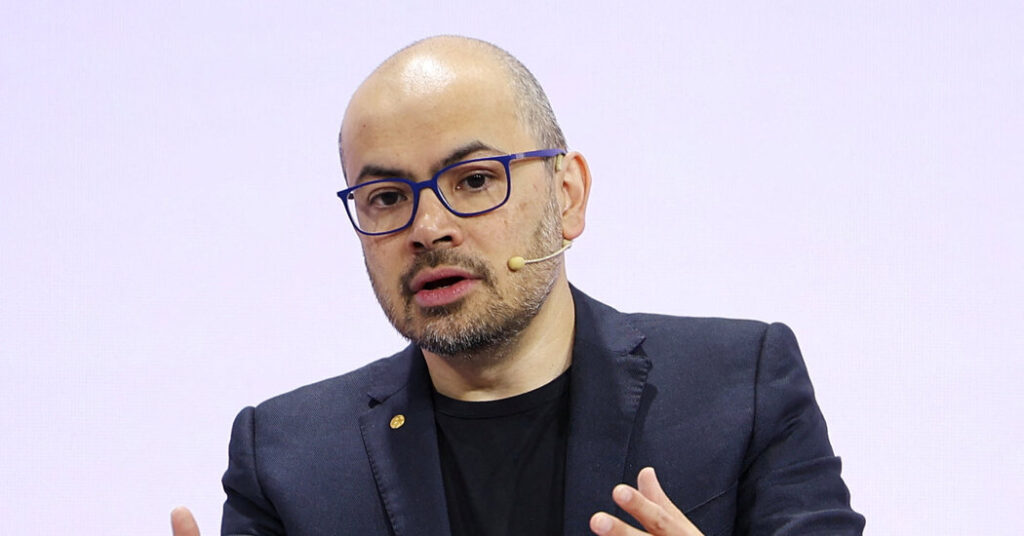
Google shook up its artificial intelligence leadership on Wednesday, moving Demis Hassabis, the Nobel-prize winning head of its Google DeepMind lab, out of his operational role to become chair of the lab and chief scientist of Google’s parent company, Alphabet.
The new job for Dr. Hassabis was announced minutes after Jeff Dean, another key A.I. researcher, said he was leaving the company to create a start-up with three other senior Google researchers.
The changes atop Google’s A.I. leadership represent a dramatic management change as concerns grow over the tech industry’s spending on A.I. They also raise questions about Google’s confidence in its work on the technology.
Even though Google, under Dr. Dean’s research leadership, created some of the key technologies underpinning today’s A.I., it was caught flat-footed when OpenAI unveiled the ChatGPT chatbot in late 2022, launching the A.I. boom.
Since then, Google has reorganized the company and even remade the Google search homepage around A.I. It merged its two A.I. labs, Silicon Valley-based Google Brain and DeepMind, in London, into one group under Dr. Hassabis’s leadership in 2023. And in recent years, Sergey Brin, Google’s co-founder, took an increasingly hands-on role in the company’s A.I. work.
But by some measurements, it has continued to trail OpenAI and its rival Anthropic. Google was expected to release a new flagship A.I. model, Gemini 3.5 Pro, in June, but that launch was delayed.
For some Silicon Valley veterans, the departure of Dr. Dean was a significant turning point for the company and a sign that Google may continue to leak talent. Google’s stock fell about 4 percent on Wednesday afternoon, after Dr. Dean’s announcement.
Jeremy Nixon, a former Google Brain researcher who now runs a start-up called the Infinity Artificial Intelligence Institute, said Dr. Dean’s decision to leave the company was “almost unimaginable.”
“This could be the first real crisis moment for a company that has been stalwart for a long time,” he said. “Is Jeff Dean’s company about to hire half of Google research — the good half of Google research? This is a really big question. Google leaks talent like no other.”
Google released several smaller A.I. models in July, including one focused on cybersecurity. That model performed well on benchmarks like coding and financial tasks, according to A.I. leaderboards, but did not outpace models from competitors.
Still, like other big technology companies, Google continues to spend aggressively on A.I. Last month, the company estimated that spending on data centers and other A.I. work would hit $195 billion to $205 billion this year, more than double the $85 billion last year and up from an earlier projection of $190 billion.
“I’ve decided that now is the right time for me to hand over my day-to-day operational responsibilities,” Mr. Hassabis wrote, so that he could “focus on the big picture and help influence what is to come to the best of my ability.”
Google said Dr. Hassabis would also focus more of his time on Isomorphic Labs, a project intended to discover new drugs using A.I. He joined the company in 2014 after it acquired DeepMind and won a Nobel Prize in 2024 for using A.I. for scientific research.
Dr. Hassabis’s oversight of the day-to-day operations of DeepMind would be taken over by Koray Kavukcuoglu, Google said.
Dr. Kavukcuoglu, a Turkish-born researcher who studied under the A.I. pioneer Yann LeCun at New York University, was among the first researchers Dr. Hassabis hired at DeepMind and was the chief technology officer of the combined lab. In 2013, before Google acquired DeepMind, Dr. Kavukcuoglu was part of a team that built a breakthrough A.I. technology called DQN that could learn to play classic video games like Space Invaders, Pong and Breakout. It was a step toward the “A.I. agents” that now learn how to use email programs, calendars and other computer software.
He later oversaw the complex software platforms that DeepMind used to build and operate its many A.I. technologies. Like Dr. Hassabis, he spent much of his career working as a scientist, not an executive of a large organization.
Last year, Dr. Kavukcuoglu moved from London to Google’s headquarters in Mountain View, Calif., and began reporting to both Dr. Hassabis and Sundar Pichai, Google’s chief executive. He was assigned to find ways to incorporate Google’s latest A.I. models across its portfolio of products.
Mr. Pichai wrote in a companywide email announcing Dr. Hassabis’s new role that he and Dr. Hassabis “have been long discussing a role that allows him to put his full attention on actively shaping the future” of A.I. “It’s work that is vitally important to Alphabet and humanity, and I can’t imagine a better person than Demis to do it,” Mr. Pichai said.
Dr. Hassabis has recently positioned himself as a policy leader on A.I., writing a proposal for the governance of A.I. companies and presenting it to leaders on Capitol Hill. In June, he attended the G7 summit and discussed the future of A.I. with world leaders. He planned to focus more on those efforts, he said in a separate companywide email.
With Dr. Hassabis stepping away from daily leadership, some DeepMind employees were concerned that the lab — which has maintained some autonomy within Google — was losing more of its independence, said three employees who spoke on the condition of anonymity.
Dr. Hassabis and Dr. Dean have been considered moral voices inside Google. Dr. Dean, in particular, voiced concerns about Google’s military contracts. DeepMind researchers are now concerned that the changes would mean their work would be increasingly commercialized and have fewer ethical boundaries, the three people said.
Dr. Dean is one of the most important employees in the history of Google. The company’s 30th employee, he played a key role in creating the global computer network powering its search business and was one of the company’s early leaders in A.I. research.
His profile inside Google appeared to wane in recent years as other executives, including Dr. Hassabis and Mr. Brin, asserted control over Google’s all-in bet on A.I. But Dr. Dean remained one of the key engineers driving the creation of the company’s most important technologies.
The three other top A.I. researchers who departed Google to work with Dr. Dean include Oriol Vinyals, who was among the leaders of Google’s efforts to build A.I. to compete with rivals like Anthropic and OpenAI.
The departures were part of a larger exodus of A.I. talent from the company over the past several months. Many of these researchers have left to found new A.I. companies. Less than two months ago, Noam Shazeer, who oversaw the design of Google’s Gemini technology alongside Dr. Dean and Dr. Vinyals, left the company to join OpenAI.
(The New York Times has sued OpenAI and Microsoft, claiming copyright infringement of news content related to A.I. systems. The companies have denied those claims.)
The post Google Shakes Up A.I. Leadership appeared first on New York Times.