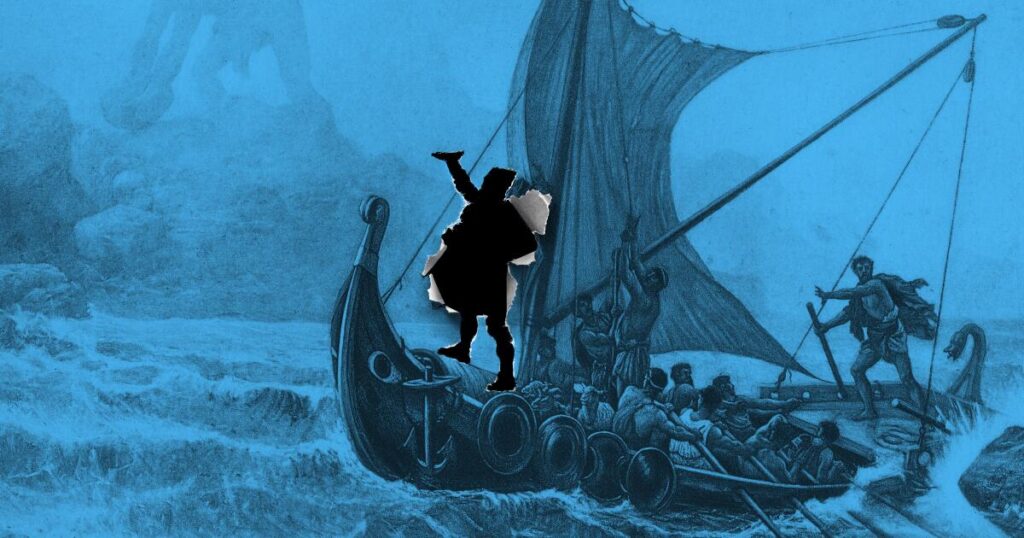
In the spirit of Zeus’ law to be generous toward guests, I’m honored to welcome classics professor Emily Wilson to the land of film criticism. As she’s recently learned, it’s an adventure that sails smack into islands of musky internet trolls and clashes with cinematic and literary titans like Christopher Nolan and Joyce Carol Oates.
Nolan credits the opening line of Wilson’s 2017 translation of Homer’s “The Odyssey” — “Tell me about a complicated man” — as partly inspiring his adaptation of the ancient epic, which, nearly a month into its release, is soldiering toward a billion-dollar box office gross. Symbiotically, Wilson’s edition is now the No. 2 bestselling book in the country. That Wilson’s incendiary essay in the London Review of Books revealed she doesn’t think much of Nolan’s blockbuster struck some as hubris, including Oates, who took to social media to decry the scholar’s “tone of dismissal” and “haughty superiority.”
If you haven’t been following the controversy, Wilson felt that Nolan had flattened the saga by mostly erasing the Greek gods and Odysseus’ wit, lust and thorny contradictions. Oates likened the tone of Wilson’s critique to the “crude language of MAGA folks.” In short: Wilson snuck a 2,700-year-old poem through the gates of mainstream taste — and after that victory, her arrogance left her marooned.
Sounds familiar if you’ve read Homer. Less so if you’ve only seen the film. Wilson is right that Nolan’s movie lacks Odysseus’ egomaniacal brilliance.
I’m here to play peacemaker. Wilson adores Odysseus so much that she has his bow tattooed on her right leg. Frankly, Nolan doesn’t seem to like the wily, libidinous and violent trickster-veteran of the poem — half Rhett Butler, half Rambo in “First Blood”— as much as Wilson or I do. Because if he did, that Odysseus would be onscreen.
But having seen his movie twice, it’s obvious that Nolan is less interested in Wilson’s first line than her fifth: “Tell the old story for our modern times.” That, he’s done. His take on Homer is, as I wrote in my original review, “a moralistic ‘Oppenheimer’ prequel.” For the record, I like it anyway.
Film critics and translators start work in the same place. Step one: What is the artist’s intent? Wilson considered the entirety of Homer’s tale and decided the right word for polytropos was “complicated.” I weighed what Nolan chose to protect, tweak and abandon in his own version and concluded that he wanted to make an action-tragedy about societal decline.
Movies must be measured against their own ambitions. A stoner comedy can’t be graded like a Shakespearean drama (and vice versa). Here’s where Wilson runs aground. She wants to allow Nolan creative freedom, knowing that the Greek playwrights rebooted figures like Odysseus and Medea just like Marvel treats Spider-Man. There’s even a spinoff of the original poem in which Odysseus has kids with Circe.
Yet, storytellers have to protect the core of their characters. Medea must be angry, Spider-Man must be helpful and Odysseus, dang it, must have swagger. Damon doesn’t.
This is why Wilson deserves empathy even if she can’t bring herself to grant Nolan the same grace. As a professor of classics at the University of Pennsylvania, she’ll be on the front line of academics condemned to unteach Nolan’s heavily altered screenplay to students who will arrive quoting it chapter and verse. For decades to come, high school kids — probably even a few high school teachers — are just going to pop in his Blu-ray and call it a day.
Nolan does hit his target, eventually. Yet his script wobbles. He’s made a movie about Odysseus’ remorse for inventing the Trojan horse without a crucial scene: the moment he invents it. We see Odysseus silently stroll the beach outside Troy, but not the pride he must have felt running back to base to pitch an idea that will finish the war and let his allies go home. The emotional arc Nolan wants to trace should start there. The beat’s absence is confounding since Odysseus also needs to appear clever (and never does).
This is what it means to measure a film against its ambitions. Only after we accept that Nolan is solely interested in human mistakes can we gauge his disregard for the Greek gods. I dig that choice — it’s bold — yet still think he flubs it by not replacing the magical powers of Charlize Theron’s Calypso and Zendaya’s Athena with, say, a personality. What a waste of two terrific actors. It’s no wonder Oates stuck up for him. Her novel “Blonde” also stripped the agency from love goddess Marilyn Monroe and its own 2022 movie adaptation launched a thousand hot takes.
There will never be a faithful modern film version of “The Odyssey.” No, not even whatever AI slop Elon Musk claims he’s green-lighted, a project I’m sure will come to fruition as fast as his any-year-now claim that he’s landing on Mars.
The issue isn’t just the poem’s length. It’s that today’s audiences have zero stomach for happy endings about horrible wrongs. We can barely rationalize the slaughter of the suitors. No one wants to watch Homer’s gory scene after that, when Telemachus cruelly orders a dozen enslaved girls to clean up the mess and then executes them too.
Only a seven-and-a-half hour Italian miniseries produced by Dino de Laurentiis in 1968 dares mention that second bloodbath and even in that, the women are hung offscreen after we’ve been assured (fictitiously) that the maids tried to kill them first. (Side note: Dino’s Penelope, played by the mighty Irene Papas, is my favorite.)
Previous movie adaptations of “The Odyssey” soft-pedal or ignore the hero’s postwar PTSD. You catch a glimpse of it in the two-part NBC special from 1997 in which Armand Assante’s Odysseus rescues a Trojan toddler. But mainly, he spends more time hot-tubbing with Vanessa Williams’ Calypso.
That’s not a knock. The ’90s “Odyssey” is as tacky as Caesars Palace but Assante’s smooth-talking horndog is closer to my ideal Odysseus than Damon’s neutered mope. He sleeps with both Calypso and Circe and still earns his tender reunion with Penelope by choosing her beloved wrinkles over those gods’ immortal perfection. (For what it’s worth, Oates is a fan of it too. Wilson has yet to comment.)
Only the two most recent versions — Nolan’s and Uberto Pasolini’s 2024 “The Return,” starring a sinewy Ralph Fiennes — center on Odysseus’ culpability for the carnage of the Trojan War. Damon’s Odysseus is numbed by the massacre of Troy’s civilians; Fiennes’ hates himself for leading the best men of Ithaca to their death, gutting his own community in the heedless destruction of another. I’m tempted to diagnose the current gloom as the result of our own post-9/11 forever wars.
The 21st century has seen enough genocide for Homer to compose a hundred sequels. Only those stubbornly ignorant to the human cost of actual combat would be psyched to bring on more of it. (Just ask the veterans in my family how they feel things are going in Iran.) At the end of “The Return,” when Fiennes stands entrail-smeared before his beloved Penelope, she recoils from the horror of the battlefield brought right into their home.
That interpretation has its flaws too. The middle stretch has a concocted outdoor chase sequence that feels like a clumsy campground slasher. Wilson applauded its “stylish sparseness.” Fair enough. I’d still love to invite her and Nolan and even Oates to a banquet of wine and roasted fowl and have a blast agreeing to disagree. No weapons allowed.
The post Yes, Emily Wilson, Odysseus has been changed for the movie. Deal with it appeared first on Los Angeles Times.