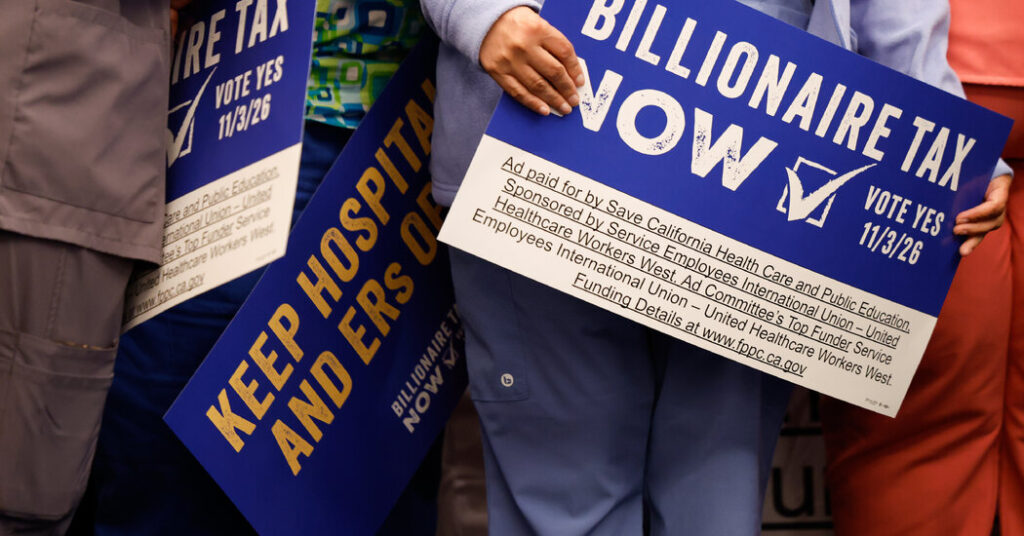
A teachers union leader rose to her feet in a hotel ballroom packed with Democratic activists, many of them wearing T-shirts that said “Tax the Billionaires.”
She addressed the obvious tensions among them, with labor unions that are often allies finding themselves at odds.
“This is a weird place for us to be,” the leader, Teri Holoman, associate executive director of the California Teachers Association, said Saturday at a California Democratic Party meeting in San Diego. Even though her union supported taxing the rich, Ms. Holoman said the billionaire tax measure on the November ballot was not the right way to do it.
Schisms over the proposal — a one-time tax on state residents with assets worth at least $1 billion — were evident throughout the weekend meeting, where the party’s executive board ultimately voted to endorse the ballot measure after three days of contentious debate. The endorsement passed by the barest of margins, and only after an initial vote by delegates failed to garner sufficient support.
The debate comes as the country confronts a rapidly growing gap between the wealthiest individuals and the masses struggling with everyday expenses. Though Democrats broadly support raising taxes on wealthy people, they differ intensely on how to do so. It’s a divide that could shape the 2028 presidential contest.
California’s fight over the wealth tax measure, known as Proposition 40, is being watched nationally because the state often serves as a testing ground for progressive policymaking. If approved, it would be the first tax in the nation assessed on a person’s total net worth, including wealth held in stocks, trusts and possessions like art and jewelry.
The weekend endorsement puts the California Democratic Party at odds with the state’s top elected Democrats. Gov. Gavin Newsom and Xavier Becerra, the Democratic candidate to replace him, both oppose the billionaire tax, saying it will reduce long-term funding for schools and other services by driving entrepreneurs away from California.
“They are, frankly, just out of step with the great majority of the people they claim to represent,” said Dave Regan, president of the Service Employees International Union-United Healthcare Workers West, which sponsored the ballot measure.
The conflict in California echoes larger divides in the Democratic Party that have pit progressives against moderates and populists against the political establishment in primary races across the nation this year. Supporters of the billionaire tax are framing it as a critical opportunity to salvage Medicaid funding in California and steer the direction of the Democratic Party nationally.
“This is the defining fight of our party: Are you on the side of the corporate donor-wing billionaire class, or are you on the side of economic populism and the working class?” said Representative Ro Khanna, one of few Democratic elected officials in California publicly in favor of the billionaire tax so far. “California’s fight is really the biggest symbol for that divide.”
But the politics may not be that clear cut. The billionaire tax was sponsored by a single labor union, whose members stand to benefit from it. The tax would generate tens of billions of dollars that would go toward health care programs that were slashed last year by President Trump. Without the funding, the union argues, millions of people will lose insurance and hospitals will close.
Other labor unions and health care organizations, including progressive groups like the California Teachers Association and Planned Parenthood Affiliates of California, object to the tax because it does not provide long-term funding for a range of services, not because they are ideologically opposed to taxing billionaires. They support a different tax on the November ballot: Proposition 3, which would make permanent a temporary income tax hike on high earners.
Willie Pelote, a political consultant working for the No on 40 campaign, called the measure inherently divisive, pitting the interests of health care workers against those of educators and others whose salaries depend on state spending. He said that labor groups should have collaborated to put a measure on the ballot that would have helped all sectors. And he warned delegates that supporting the billionaire tax measure would ultimately deepen rifts in the Democratic Party.
“Prop. 40 is making losers and winners, and that’s not the appropriate way that we should act as labor brothers and sisters,” Mr. Pelote said at the meeting in San Diego.
Opposition from progressive groups will signal to voters that California’s debate over the billionaire tax is different from other conflicts that divide Democrats nationwide, said Celinda Lake, a Democratic pollster based in Washington, D.C. In many Democratic primaries, the schism between candidates amounts to a disagreement over values, Ms. Lake said. Not so with California’s billionaire tax.
“This is a pragmatic debate, like whether or not this is a good idea or a flawed proposal,” she said.
For Republicans, the measure provides another line of attack against Democrats, a way to cast California as hostile to business and eager to expand government spending.
Democratic politicians around the country are experimenting with ways to tax the rich. In New York, Gov. Kathy Hochul and Mayor Zohran Mamdani have embraced a tax on second homes worth $5 million or more. In Washington State, lawmakers passed a “millionaires’ tax,” creating the state’s first income tax, which would apply to earnings over $1 million. Opponents are seeking to overturn it on the November ballot.
But California’s proposal may prove to be the most contentious of them all. The state is home to more billionaires than any other, including some of the richest people in the world, and a handful of them have already poured more than $118 million into a committee that is backing two ballot measures that could negate a billionaire tax.
Democratic presidential candidates will likely examine the results of California’s battle over the billionaire tax as they formulate their economic proposals for 2028, said Jim Kessler, a co-founder of Third Way, a center-left think tank in Washington, D.C.
“I don’t think there is a division within the Democratic Party about whether very wealthy people — multimillionaires and billionaires — need to pay more in taxes,” he said. “The question is how you do it.”
Mr. Kessler believes a wealth tax like the one proposed in California is an impractical, constitutionally questionable approach. His organization favors other ways of raising taxes that do not involve the challenging task of calculating the net worth of people’s assets. Instead, he said, Democrats should consider hiking income taxes for high earners and taxes on capital gains and estates, or closing loopholes that allow people to avoid taxes on certain assets. Mr. Newsom took a similar approach with his proposal to tax the rich through changes to federal tax law.
The billionaire tax, Mr. Kessler said, amounts to “a slogan over a solution.” But he said it had caught the attention of progressive populists nationwide who see the vote in California as a way to build momentum for their movement.
“Activists on the far left across America want this referendum in California to be the next pole in the tent that they put up,” Mr. Kessler said. “The more centrist wing of the Democratic Party has focused on this almost not at all.”
Theodore Schleifer contributed reporting from Washington.
The post California Democrats Support Billionaire Tax, but Infighting Lingers appeared first on New York Times.