When King Mohammed VI of Morocco addressed his people on Wednesday to commemorate his 27th year on the throne, he spoke hopefully of his North African nation’s future.
Morocco, he said, was safe and stable, with a growing economy making great strides in tourism, investment and manufacturing.
“This is a pivotal moment in our nation’s development,” the 62-year-old monarch said. “A time when confidence and optimism should prevail over despair and frustration.”
Over the next two days, however, tens of thousands of his citizens tried to escape the country. Driven by a bleak sense of their prospects in Morocco, they braved confrontations with the police and dangerous swims in the sea to reach the Spanish exclave of Ceuta, hoping for better lives.
“I tried to work and have a job and make a living, but there is nothing for me here,” said Mohammed Kinani, a 21-year-old construction worker, who had been forced back to Morocco. “If I don’t leave this country, there is nothing that will save me.”
Mr. Kinani was part of a sudden exodus that began on Thursday when 50,000 to 60,000 migrants began forcing their way into Ceuta, a tiny Spanish territory on the North African coast. By Saturday, many of the migrants had left, lacking food and water, and the Spanish security forces expelled others, but not before the crisis had given far-right politicians across Europe new ammunition to blast their opponents’ views on immigration.
The Spanish authorities said on Sunday that they had recorded 72 deaths during the crisis. The Moroccan government reported 11 deaths. Both sides said most of the deaths were from drowning.
Before the startling scenes of chaos at the border, the Moroccan government had much to celebrate: investments in logistics and industry, preparations to co-host the men’s World Cup in 2030, and strong relations with President Trump, who has lavished the country of 38 million and its monarch with praise.
But the Ceuta migration crisis exposed a deep dismay among its young people, who, when faced with scant job opportunities, recurrent droughts and frequent arrests of government critics, chose to vote with their feet and get out.
“Do you think if I had a job I would have gone?” snapped Ahlam al-Adnan, 22, when asked where she had worked before she set off for Ceuta. She sat in the sun near the border on Sunday, looking exhausted.
She had swum to the enclave with her four siblings, including her 8-year-old brother, she said. In Ceuta, they hid in a forest but got hungry, so she went to look for food, got detained and was sent back to Morocco.
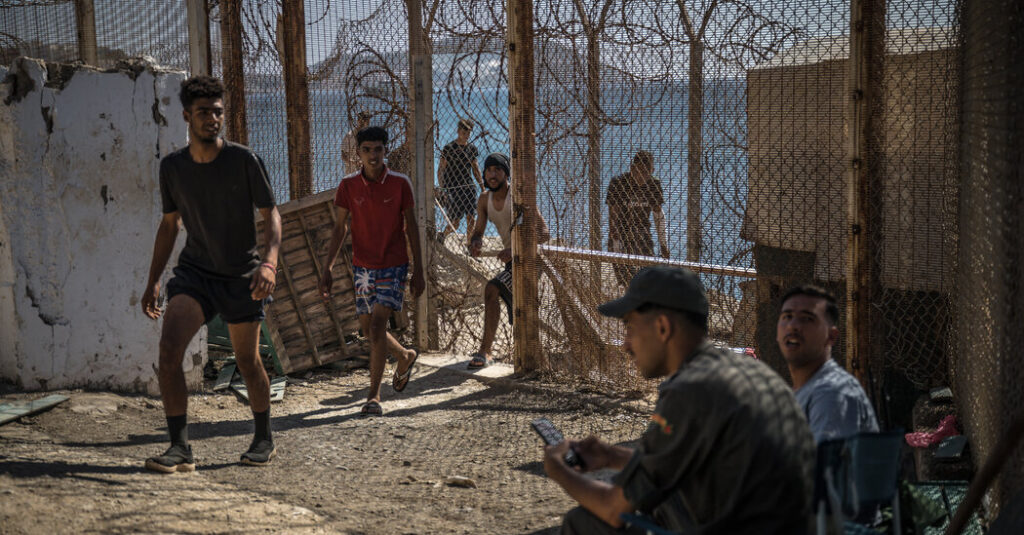
Over the weekend, thousands of the returned migrants, most of them young Moroccan men, wandered the streets of the Moroccan town of Fnideq, resting on sidewalks and sleeping in open lots. Most wore shorts, T-shirts and sandals, and carried few possessions, if any.
Teams of policemen in black uniforms swept through town, pushing the migrants out of public areas and bundling those who resisted into vans. Outside of town, dozens of buses stood near a gas station, filling up with captured migrants who would be ferried back to their home regions.
Anxious relatives of migrants who had set off for Ceuta and never returned sat along the road hoping for news.
When groups of newly returned migrants walked by, the relatives would show them photos of their missing loved ones, in case anyone had seen them.
Abdelkhalek Moumouh and his wife, Kawtar Alalej, asked about their eldest son Saad, 18.
He had recently finished high school but had not been accepted to university programs in engineering, aviation and architecture, his father said. He wanted to study in Europe, but the family could not afford it.
Trump Administration: Live Updates
Updated
- Oil Prices Plummet as Investors Digest Pause in Fighting in Iran War
- Trump calls off strikes on Iran, claiming the “perimeters of a deal” are in place.
- Pirro draws Trump’s wrath by contradicting him on damage to the Reflecting Pool.
When the family saw the news on social media that migrants were entering Ceuta, the parents drove their son to the border, they said, hoping this would be his chance. They hadn’t heard from him since.
“Other people went to Europe and benefited from it,” said Mr. Moumouh, 50. “We already wasted our lives in Morocco. We don’t want him to.”
The migrants’ determination to leave made it clear that Morocco, often considered a North African success story, has failed to deliver hope for many of its youth.
The country is politically stable, attractive to foreign investors and tourists, and a valued partner to the United States.
That relationship has deepened since Mr. Trump’s first term, when Morocco joined a small group of Arab states that established diplomatic relations with Israel. In tandem, the Trump administration endorsed Morocco’s claim of sovereignty over Western Sahara, a disputed territory.
Last month, King Mohammed informed Mr. Trump that he was naming a 656-mile expressway through the territory the “Donald J. Trump Highway.”
In recent years, the Moroccan government has showcased large investments aimed at strengthening the economy, including in a port on the Mediterranean and a high-speed train. It is spending lavishly on stadiums for the 2030 World Cup, which it will be co-host of with Spain and Portugal.
But the government’s policies focus on large companies and big infrastructure while creating too few lasting jobs, said Najib Akesbi, an economist at the Institute of Agronomy in the capital, Rabat.
“The entire logic of the economic model is the showcase,” he said. “People visit Morocco and they find it beautiful.”
Many of the investments, he said, turn out to be “white elephants” that create construction work that disappears once the projects are complete, not lasting employment.
“They are not concerned by the needs of the population, and the youth in particular,” he said.
Last year, the World Bank said that over the last decade, Morocco’s working-age population had grown by 11.4 percent, while employment had increased by only 1.5 percent.
Job creation remained “a fundamental challenge,” the bank said.
Overall unemployment in Morocco is around 11 percent, according to government statistics, but among people aged 15 to 24, it is nearly three times higher.
Ceuta, which is easily visible from the hills and coast of Fnideq, is a perpetual draw for migrants. Per capita income in Morocco is $4,600, according to the World Bank. In Spain, of which Ceuta is a part, it is $38,600.
The Moroccan government has shown little patience for citizens who make their discontent known.
Last fall, youth-led demonstrations broke out in more than half a dozen Moroccan cities. Organized through social media, the protests expressed frustration over the soaring cost of living, youth unemployment and the government’s economic priorities, including World Cup preparations.
The authorities responded with arrests and by prosecuting activists.
An earlier wave of protests focused on economic hardship in rural areas also ended with mass arrests and prison sentences for protest leaders.
On a back street in Fnideq, Mohammed Said, 36, said he had come to the coast with those headed for Ceuta. He had quit school after seventh grade and worked in construction but had not found stable employment.
By the time he reached the border, he said, chaos reigned, with cars on fire and migrants clashing with the security forces. So he had hung back.
He had tried to swim to the territory twice last year, he said, but the Moroccan authorities stopped him. This time, he had come prepared, with a can of tuna, some crackers, a phone charger, comb, two extra T-shirts and a plastic sleeve for his cellphone, all in a plastic bag.
“I’ll try again,” he said. “It’s in God’s hands.”
The post ‘Do You Think if I Had a Job I Would Have Gone?’ appeared first on New York Times.