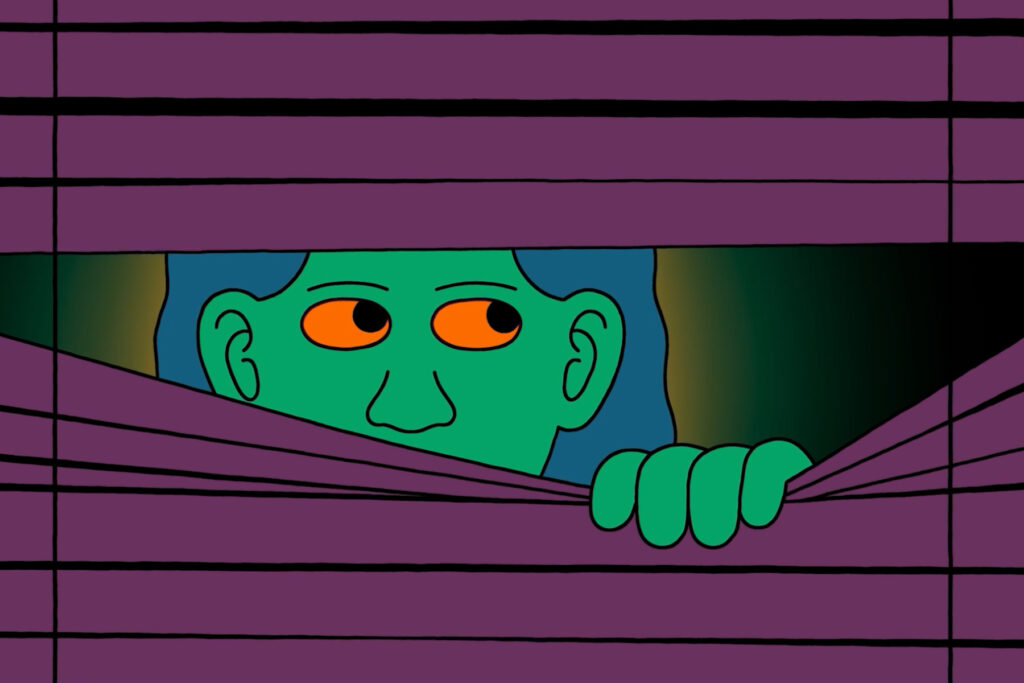
For three days in June, I was a danger to all mammals. I hid out in a dingy motel room, like a 1930s desperado on the lam from the law. Outside my window was an actual dump.
I slept across the foot of the bed, far from the wall, in case someone slept on the other side, vulnerable to my menace. I specifically had to hide from pregnant women and children under 10.
I was the most hazardous to other people I’ve ever been in my life. If I harmed someone, they wouldn’t know it for years, and they’d never know it was me.
Tell someone you’re literally radioactive, and they will assume you’ve tweeted something awful. You have to tell them clearly you are emitting gamma rays.
It was all part of a strategy my doctors developed to kill some of my parts — the thyroid gland and its tumors — and leave the rest of me fine. They had given me plenty of information about this process, but there was a lot I still hadn’t considered about being radioactive.
A friend, listening to me talk over dinner, had a question. “Not to be gross,” she said, “but what are you going to do with your fecal waste?”
In the subsequent pause, I realized I had not read all the booklets I’d been given.
My friend, who’s a veterinarian, was going through a similar thyroid thing with her cat, who had been losing weight and screaming all night, like she was on cocaine. Lyla would also need to be radioactive and alone for days. Only my friend had to keep the cat’s waste for weeks. If she tried to throw it away immediately, she’d been warned, a radiation detector could go off at the garbage dump, and the authorities might show up with questions.
“No,” said the doctor when I suggested the cocaine cat and I isolate together. We’d be as much a danger to one another as to everyone else. And I could use the toilet, as long as I flushed twice.
On the day of my appointment, I was escorted to a special room in a hospital, where everything — floors, doorknobs, walls — was covered in paper. A man wearing gloves shook a pill of iodine-131, a radioactive isotope, out of a beaten-up green metal case, and I swallowed it. He left the room, and I sat alone for 20 minutes, cooking. Once tests confirmed I was appropriately radiant, I was sent off to avoid humankind.
Isolating at home wouldn’t have worked — there was no room at my house to fit a bed away from my four cats and one dog. So it was motelville, population me. I chose one for $65 a night. It’s not like I was going to order a massage.
Three days later, I broke my isolation to go to a laundromat. I’d been warned my sweat could be dangerous, and my motel sheets shouldn’t be washed with other sheets. I also reserved the room an extra night, after I left, to give the isotopes more time to decay before the housekeepers had to touch them.
I still had that running-from-the-cops feeling, though I had a note from my doctor to explain my situation should it become necessary, such as being pulled over by a police officer. Apparently, some officers carry sensors that will alert them to radioactivity (good!).
The sunlight and the people, their casualness, felt strange. It was a bustling laundromat, and keeping 6 feet away from everyone, like my doctors had advised, was tricky. Five minutes or less near someone was probably fine, but I was paranoid. A lady told me I could use a smaller, cheaper machine, and I thanked her by darting away. All of these people acting normal had a secret history too — everyone in laundromats does. My secret was that I was doing my best not to kill everyone there in the future.
For stupid reasons, I ended up with $12.85 extra on a laundry card I can never use again. A woman by the door was reading a college textbook, and I offered her the card. She seemed suspicious. “I’m from out of town,” I lied. Take the card, please, before I alter your DNA.
“Okay,” she said, and went back to her book. Yay! It was a perfect, boring encapsulation of life among the living. Doing something dumb, trying to make it better, lying to strangers, caring inordinately what others do, trying to hide the crazy.
There was nothing like it back in the motel room.
Later, I realized my hands might have sweat on the card, making it just a little dangerous. I’ll never know. Another thing about interacting with people: It haunts you later. You Google if you did the right thing. Google says “exceedingly low danger.” You keep Googling.
Everything’s fine now. There’s a temporary, peculiar side effect: I can’t taste salt at all. My co-workers were impressed when I summoned them to watch me pour two packets of salt on my tongue. “Did you do that just for show?” my desk neighbor asked. Of course I did.
In her book “Illness as Metaphor,” Susan Sontag wrote: “Everyone who is born holds dual citizenship, in the kingdom of the well and in the kingdom of the sick.” After my three-day loneliness epidemic, and after two unrelated cancer diagnoses in two years, I’m apparently cured. Time to rejoin the living.
You could say I’m glowing with joy, but please don’t. Just say I’m happy to be here.
The post My three days at a motel as a human biohazard appeared first on Washington Post.