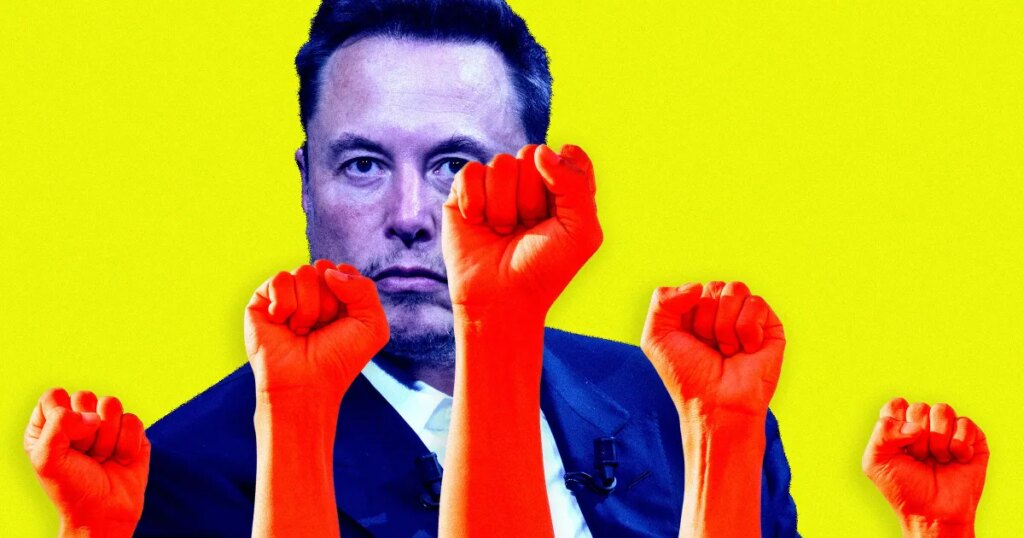
As unpopular as SpaceX and Tesla CEO Elon Musk has become in the popular eye, some say the vitriol doesn’t go nearly far enough.
In an episode of his podcast Ones and Tooze, Columbia University economic historian Adam Tooze picked apart the increasingly expensive AI arms race and its consequences for humanity. Among Tooze’s observations: the AI boom is completely upending the long-standing social contract under capitalism, a shift embodied most dramatically by Musk.
During the podcast, co-host Cameron Abadi asked what a “best case scenario” for AI might look like — where a human-level superintelligence emerges that can automate the world’s jobs. In response, Tooze pointed to a report from the Bank of International Settlements: under that scenario, labor’s share of income could collapse from an already paltry 54 percent to just 20 percent, meaning workers would be forced to fight over the remaining crumbs that drop from billionaires’ tables.
“The share in the total pie collapses, and that’s obviously a huge transformation in political power,” Tooze explained. And though that’s a future projection, the economic historian notes we’re already seeing symptoms of this extreme reversal of fortunes today, chiefly in the extreme wealth accumulation of Musk.
“I don’t understand frankly why the event of Musk’s enrichment isn’t more of a scandal, isn’t more a historic moment,” Tooze said. “Like this — to have a trillionaire in our midst ruptures the social bargain in such a — just such a dramatic way, like how can we even be any longer talking about being in the same society as this group of individuals who’ve unleashed this technology on the world.”
“It goes beyond Luddism,” Tooze continued, referring to the 19th-century labor movement that saw workers smash textile looms to fight back against economic exploitation. “It’s not about resisting the technology per se, it’s about asking ‘which social contract this belongs to?’”
Though it remains to be seen how severe an impact AI actually has on the labor market, one scenario keeps surfacing: superintelligent AI fuels a drastic rise in economic inequality, with tech billionaires on one end, and the working class on the other.
Comparing the current “AI arms race” to the actual nuclear arms race, Tooze asks the listener to imagine a “private Manhattan Project, developing a thermonuclear weapon,” calling superintelligent AI “kind of like a labor-market neutron bomb.”
And where the Manhattan Project was funded, organized, and staffed by the US government, the current AI boom takes almost the exact opposite approach, following the whims of the ultra-rich.
“Clearly, government money has gone into Silicon Valley in various ways,” Tooze caveats. “But nevertheless, the contrast between the Manhattan Project… and the realities of the current moment, spearheaded by a figure like Elon Musk, who literally has eviscerated the state apparatus of that first [nuclear] race… it strikes me that it’s really a regression away from the mid-century arms race model to something that’s much more like the ‘Merchants of Death’ vision.” (The Merchants of Death was a moniker for 1930s-era war profiteers.)
“We’re back in that space” Tooze continues, “of private, unfettered, oligarchic — but global — arms race… to my mind, the [AI arms race] analogy is interesting not because of the similarities, but because of the differences it reveals.”
More on Musk: Suddenly, as His Empire Crumbles, Elon Musk Admits He Made a Huge Mistake With DOGE
The post Columbia Economist Baffled as to Why the Masses Aren’t Rising Up Against Elon Musk appeared first on Futurism.