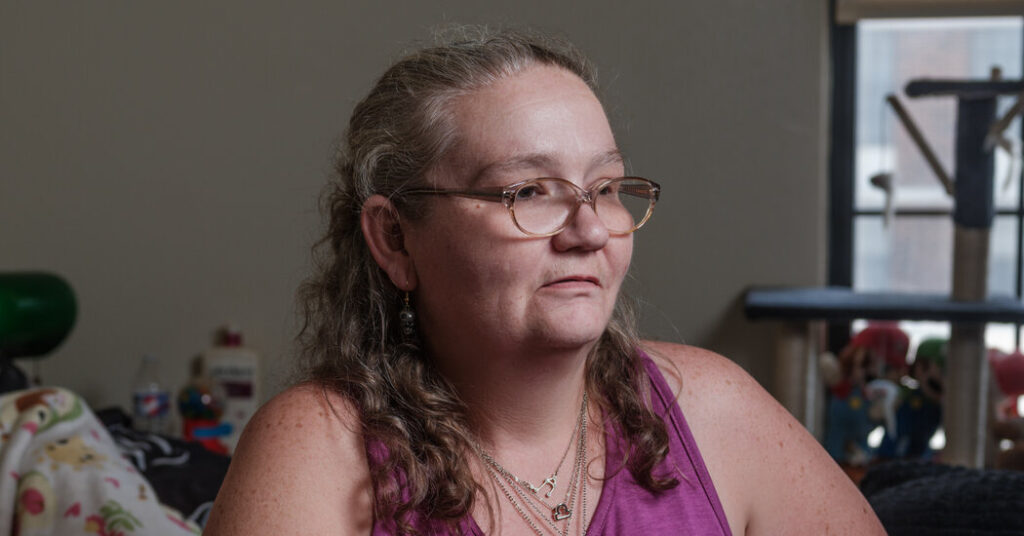
After a 1,000-mile road trip across a swath of America, I can’t get one person out of my mind: Trinity Goodman, a cheerful, chatty woman in Oklahoma City who had a bandage on her arm.
The reason for the bandage? Goodman, 44, survives by selling blood plasma twice a week. She had $3.78 in her checking account, one cent in her savings account to keep it open, and six pennies in her piggy bank.
“That’s my full assets,” she said, smiling in mockery of her own poverty.
“Barely making it,” she added. “It’s really hard and it’s miserable.”
She dwells in an America that many of us might have trouble imagining. For five years she staved off homelessness only by staying in the home of a man who was not a romantic partner but who took advantage of her vulnerability, she said, by regularly demanding sex. A heroic local nonprofit, Hope Community Services, helped her get low-income housing for $50 a month, she said; otherwise she would still have to choose between unwanted sex and homelessness.
Food stamps, $298 a month, sustain her, but they can’t be used for toilet paper or feminine hygiene products. So she searches for them at church-run pantries — lifelines in much of America.
Haircuts are likewise unaffordable. “I’ve never been to a barber or any of those places,” she said. “Never. I don’t have that luxury.”
Many sectors of America — and many Americans — are thriving. Yet my sense is that many of us are blind to how many people have been left far behind. So far behind that they scarcely inhabit the same country as the rest of us. And this pain across America is now magnified by President Trump’s cuts in food stamps, Medicaid, mental health funding for children, pregnancy prevention initiatives and other social programs, as well as by rising gas and food prices. Republicans are also imposing tougher work requirements for benefits; this is reasonable in theory, but in practice such requirements have proved costly to administer and end up mostly just driving people deeper into poverty.
On this trip, I talked to so many people who are losing food stamps and other benefits and increasingly desperate — and resentful, understandably, of elites who seem indifferent to their struggles. A recent Washington Post-Ipsos poll found that two-thirds of Americans consider groceries unaffordable.
Goodman is among those feeling the squeeze, and there appears to be some risk that she will lose her food stamps — and in that case she doesn’t know how she would get by.
I’m on my annual win-a-trip journey, which I started 20 years ago to take a university student on a reporting trip to cover neglected issues. Usually we travel abroad, often in Africa, but this time we explored poverty, addiction and human trafficking in Oklahoma, Arkansas and Kentucky.
My student winner this year is Brunella Tipismana, who grew up in a working-class neighborhood in Lima, Peru, and just graduated from Yale University. One thing we saw repeatedly on this road trip is that poverty in America is not just about a lack of money, but is often multigenerational and self-replicating.
Goodman, for example, says she grew up steeped in trauma, in a toxic family that often abused drugs. She told us that she was raped and sexually abused beginning at the age of 6 or 7. She was 9 when her mother killed herself; afterward, Goodman was raised by other family members, she said. All the trauma left a mark: She says she was clinically diagnosed with complex post-traumatic stress disorder that has left her unable to work. She has applied for disability benefits, and says she was denied, but is now appealing.
I asked Goodman what message she would have for Trump as the cuts and work requirements he ordered ripple across the land.
“You do not know what you’re doing to people who are struggling to live,” she said. “You got money in the bank. You don’t know how it feels to struggle. Live in my shoes for one day. You wouldn’t be able to handle it.”
In Pine Bluff, Ark., a largely Black city that is struggling economically, racked by crime and losing population, I visited the home of Latoya Foster, 31, a single mother with six children who has lost food stamps and as a result is behind in rent.
Foster works as a shift manager at Taco Bell, earning $13.40 an hour. She relied on $1,172 in food stamps per month — but they were abruptly cut off in May, apparently because of suspicions that two of her children were collecting improper benefits in other states. She denies that and says there was some kind of mistake in the system.
Nationwide, some 1.5 million children have lost food stamps under Trump’s crackdown over the last year, according to the Center on Budget and Policy Priorities. It notes, and superb reporting by my Times colleague Jason DeParle underscores, that pressure on states to cut costs and reduce error rates may lead to wrongful denials of benefits. In addition, some three million Americans have lost Obamacare health insurance since the beginning of this year, after Republicans cut subsidies to help pay for insurance.
Without food stamps, Foster now is behind in her rent — $650 a month for a three-bedroom home in a crime-ridden neighborhood — and accumulating a $25-a-day late fee on top of the rent owed.
“I hit rock bottom daily,” she told me. “The more I work, the harder stuff gets.”
And then she broke down and wept.
The push to cut benefits for struggling Americans is partly rooted in a desire to trim federal spending, but that’s hard to square with the expense of the Iran war, as well as subsidies for private planes and tax cuts for the wealthiest. It’s also based on a perception that the “undeserving poor” are exploiting the system, but I think we exaggerate the degree to which it is the poor rather than the rich who get away with manipulations. As of 2019, according to ProPublica, the place in America with the highest percentage of tax audits was not a haven of billionaires but rather Humphreys County, Miss., with a majority Black population and a median household income then of roughly $26,000.
In any case, the age group most likely to live in poverty — by far — is children, particularly children 2 years old and under, and they can’t be accused of fraud, laziness or personal irresponsibility. Yes, many end up making bad choices, but we fail them before they fail us.
Trump initially proposed eliminating Head Start, the federal program with bipartisan support that serves those vulnerable children in poverty. He later backed off that idea, but congressional investigators found that his administration illegally withheld $12 billion from the program for several months, causing great hardship.
But while it’s easy to focus on Trump and Republicans cutting Medicaid, food stamps and other benefits, it’s not just the Trump administration that seems to have a myopia about Americans falling behind.
Democrats talk a good game about housing being a human right, but the three states with the highest rates of unsheltered homelessness right now are blue ones: California, Oregon and Hawaii. Liberals rightly protest Trump’s plans to abolish the Department of Education, but it is a handful of red states — especially Alabama, Louisiana and Mississippi — that have shown astonishing progress and now may represent the best hope for American education.
A Black fourth-grader in Mississippi is now two and a half times as likely to test proficient in reading as a Black fourth-grader in California. Democrats have every right to call out Trump, but they should also look in the mirror at their own failures to help those left behind.
When the problems are structural, we tend to ignore them. Palo Alto, Calif., is full of well-meaning liberals — four-fifths of voters supported Kamala Harris over Donald Trump in 2024 — and it makes its outstanding public schools available to children of all colors and classes … as long as their families can afford an average home price of $3.6 million.
It’s understandable that many working-class Americans feel betrayed. As I see it, politicians of all parties have been far too complacent about Americans being left behind, even as 1.3 million Americans have died of overdoses since 2000. That’s roughly the number of American service members who have died from all the wars in American history.
One reason for the complacency is that the problems, at least in their complexity, are often invisible. Americans may see a homeless person shooting drugs, but they won’t see the arc of hopelessness that began with, say, foster care — which at its worst is a government system of child abuse.
Courtney Williams, 31, endured that broken foster care system. I met her in Oklahoma City, where she is caring for a new baby and hoping her $298 a month in food stamps won’t be taken away.
We taxpayers paid for Williams to be incarcerated — three times — but we never provided her the protection and opportunities she needed, especially when she was young and most needed help. And when we don’t invest in the front end, we end up paying at the back end.
Some of Williams’s earliest memories are of men sexually assaulting her, perhaps when she was 3 or 4. Her mother was a prostitute with addictions, she said, and at age 6 she saw her younger sister killed and was then put in foster care.
From there she bounced around foster homes in seven states, carrying her life belongings with her in a trash bag. When she was 11, one foster home put padlocks on the refrigerator, freezer and food cabinets, keeping her and other foster children hungry, she said.
Williams first tried meth at age 12 and at 14 became pregnant by a man in his late 20s who, she later found out, was a convicted sex offender. She put the baby up for adoption and dropped out of school in 10th grade.
Not every foster family was abusive or hosting her for the money, she said; she recalls that one was wonderful and wanted to adopt her. But Williams, by now deeply suspicious of human kindness and full of self-doubt, asked for a different placement.
When Williams was 17, her foster mother stopped getting checks for her — she’s not sure why, but perhaps some snafu in the system — and kicked her out. After that, Williams spent a decade largely homeless, wrestling with drugs, washing up in Dunkin’ Donuts restrooms and periodically getting locked up. Finally a new boyfriend, now husband, who didn’t use drugs helped her rebuild her life, and she says she hasn’t used drugs since last September, when she discovered that she was pregnant.
Conservatives often emphasize the importance of “personal responsibility,” and they have a point. Self-destructive behaviors are real. Scholars have said that of millennials who follow the “success sequence” (finish high school, get a full-time job and have children only after marriage), 97 percent avoid poverty by their late 20s.
Yet if we want to talk about lack of personal responsibility, we also have to have a conversation about our collective lack of responsibility, about the way we treat some kids as throwaways — or the way we’re now taking food stamps from 1.5 million children.
In Pine Bluff, I spoke to several elderly Black residents who said that in some ways life was actually better in the Jim Crow era. Black people can vote now, of course, and some have thrived.
But these seniors lamented that the quality of life for the Black population had not progressed as they had imagined. Costs have soared, crime is a threat, obesity is common and ailments like diabetes and hypertension are widespread, taking a toll on well-being. Life expectancy in the county is shorter than in Iran or Bangladesh. Schools are still de facto segregated and lagging; the Pine Bluff school district gets an F from the state.
“Civil rights were probably better back then,” grumbled Barbara Ollison, 76. I don’t know that she was really arguing that there had been no progress at all, but she’s right that Black children in places like Pine Bluff still struggle to find opportunity in 2026.
“You had enough back then to make it,” she told me. “And right now it’s terrible.”
One of the few institutions that did not utterly fail places like Pine Bluff was the U.S. military. It offered a path upward and outward, along with skills training, discipline and respect. But some people here see Pete Hegseth, the secretary of defense, ousting Black senior officers and no longer perceive the armed forces as a path of opportunity for people of color.
“The military is out,” said Glayton Johnson, a retired Army veteran who pointed to Hegseth’s impact on the military’s reputation. “No, we’re not going there.”
One of the people I most wanted to see on this trip was Emanuel Laster, whom I met a decade ago in Pine Bluff when he was a sweet, smart 13-year-old boy — at risk of joining a gang. You sensed that he could go either way: Maybe he would thrive and go to college, or maybe he would succumb to the gravity of his crime-ridden neighborhood. Emanuel’s bedroom was a portrait of dysfunctional America: It had three televisions, but electricity was supposed to be cut off the day I arrived for nonpayment (his mom had stationed a pit bull to deter the man from the power company from getting near enough to accomplish this).
What had become of Laster? It turned out that he never finished high school, had tangles with the law and is now in jail, awaiting trial this month on federal gun charges for possessing a handgun that had been converted into an automatic weapon. Visits in the jail weren’t permitted, but I spoke to him by phone. I asked him what had gone wrong, and he said, “I hung out with the wrong crowd.” His mother, when I visited her, said the same thing.
Laster told me that he had two boys, ages 4 and 6, with a former girlfriend, so I located them and their mother, Autumn Holman. She and her sons had been evicted and were homeless, couch surfing temporarily in a crowded apartment with a cousin and trying desperately to find a place to live.
Holman works in the kitchen of a nursing home, but her car isn’t working, so commuting is a daily crisis. She’s trying to get food stamps and thought they would begin in July, but they haven’t materialized.
She said that she loved Laster, her high school sweetheart, but that they had quarreled because he was an irresponsible parent. “He got mad because I had to ask him for money for his kids,” she said, adding that she simply wanted him to pay for little things like the boys’ haircuts.
“He knows for a fact that I’m going to be on his tail like I’m his mama,” she added. “Who else is going to do it? ‘You got kids,’ I tell him, ‘and I didn’t have them by myself.’”
Laster’s sons are beautiful children full of potential, but they are now growing up without a dad, just as Laster himself did. Visiting that crowded home, I kept thinking back to Emanuel a decade ago as an equally sweet child, about the obstacle course of life that Black boys face in Pine Bluff, and I wondered if his children were on a trajectory to replicate his path.
The Times is committed to publishing a diversity of letters to the editor. We’d like to hear what you think about this or any of our articles. Here are some tips. And here’s our email: [email protected].
Follow the New York Times Opinion section on Facebook, Instagram, TikTok, Bluesky, WhatsApp and Threads.
The post Meet the Americans Who Can’t Afford Hair Cuts or Toilet Paper appeared first on New York Times.