Benni and I were married for almost 61 years, until our late 80s. We were not a perfect match. He was an early bird; I’m a night owl. He watched sports and news; I binge British crime dramas. He liked home; I like out.
On the other hand, he took an abiding interest in my work, drove me wherever I had to go and always left me the last few cherries in the bowl. We raised a great kid. We traveled. We had a good life.
And then we got old, and the fun was over. Benni got all kinds of sick: prostate, kidney, heart, eyes, thyroid, arthritis, sepsis. I spent hours in emergency rooms and I.C.U. units. I spent days on hold with insurance companies and banks and home health care agencies.
I had always believed I would be too selfish and squeamish to be a caretaker, but somehow I managed to clean his surgical wounds, change his catheters and help him shower. That was tough, but even tougher was watching Benni’s mind dissolve into fogginess.
He would decide to make himself a morning snack by boiling three pounds of potatoes and then forget to turn off the stove until the smoke alarm went off. He couldn’t remember how to work the TV remote and spent hours just staring into space. In my darkest moments, I reread a Buddhist quote a friend had shared: “Suffering begins when the mind expects permanence from what is designed to change. Accept that nothing will remain the same.”
I had to accept that the marriage I cherished no longer existed, and the husband I cherished had disappeared.
Caring for Benni became a full-time occupation, and I put my own life on hold. I postponed haircuts and canceled dental appointments, and I did something no freelance actor/writer ever does: I turned down jobs. I lost any interest in socializing (what would I talk about?). I did eke out small moments of pleasure: a short sunset walk around our Los Angeles neighborhood, an afternoon nap, a soothing diet of animal fat and chocolate. But still, when I woke up in the morning, I dreaded the grim day ahead, and I feared the bleak life ahead.
Benni, on the other hand, believed his condition was just a temporary glitch, and he assured everyone that he was getting better every day. Being in denial can sometimes be a blessing. Then one day Benni fell and suddenly — without fear or pain — he was gone. (If you could choose your exit, pick cardiac arrest.)
I called 911 and contacted one neighbor. Soon there were a dozen more who stayed and helped me through the endless hours of dealing with the ambulance, the police, the collection of the body and the locating of various documents. I can’t imagine how I would have handled all that on my own.
Our group hailed from Germany, Mexico, India and Texas. They brought wine and snacks. We played Benni’s favorite Louis Armstrong song — “What a Wonderful World” — and laughed at stories about my husband’s often eccentric behavior. That simple, spontaneous vigil was the memorial my no-muss, no-fuss husband would have wanted.
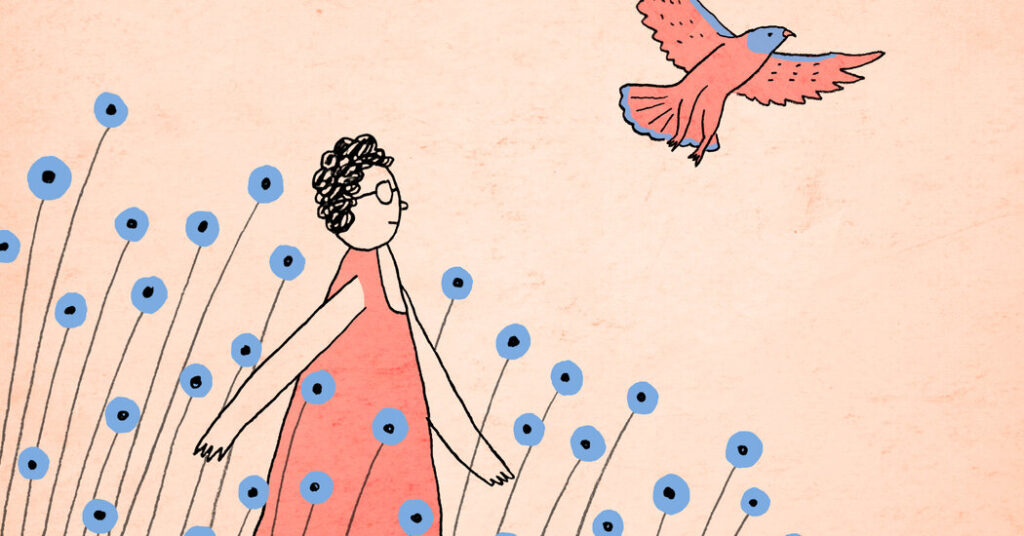
The next day I treated myself to a long walk, and after a gentle shower, the sky over our house was lit up by the most spectacular rainbow I had ever seen. A few minutes later, some friends called to say that a hawk had landed on their windowsill and stared at them for 15 minutes before flying off. They said the hawk was Benni, saying hello and goodbye.
Now I do not believe in ghosts or spirits or any of that stuff. When one of my airy-fairy friends tells me to “Keep an open mind,” I say, “Don’t keep your mind so open that your brains fall out.” But cynical as I am, I still found great comfort in the poetry of rainbows and bird visits the day after my husband’s death.
Our son Jonathan flew out from the other coast, and we decided to have people over from 5 to 7 p.m. every night during his visit. These unconventional shiva/cocktail parties were a wonderful way for me to re-enter the world of the living. I got rid of the sweats I had been wearing for months and rediscovered the pleasures of bright red lipstick and statement necklaces. My son took over all the household chores, which was a godsend because I hate household chores, and I’d had full responsibility for them during Benni’s decline.
After Jonathan left, I had to learn to live alone. I was no longer a “we” but an “I.” I created four rules for my new life as a singleton.
First, get all the help you can with the practical stuff. Social Security denied my widow’s benefits because they lost their copy of my marriage certificate. It took me and a social worker many phone calls and an office visit to clean up that mess.
Second, stay busy. Every day, I assigned myself a household task: a shelf, a drawer, a closet. It was liberating to organize the chaos Benni had left behind. Plus, I came across some sweet forgotten objects, like a charming drawing he had doodled of the two of us.
Third, pamper yourself. I indulged in a massage, a facial and a mani/pedi for the first time in ages and they all felt blissful. Maybe I just needed to be touched.
Fourth, engage with a live human at least once a day. I actively rebooted my social life, and when I didn’t have a date, I would stroll to the local thrift shop for some retail therapy, and I usually ran into someone who would stop and schmooze.
Those four rules have helped me adapt to my new solo life, which has contained some surprising moments. When the young mother behind me at the market had a cart overflowing with gallons of milk, boxes of cereal and bags of chips, my wagon was a sad contrast with its meager selection of a small container of milk, some frozen egg rolls and one banana. It shocked me to realize that I wouldn’t want to change places with her.
Sure, she has a full life, but she was going home to a chaotic household with a needy family, while I looked forward to returning to a sanctuary of rest, respite and recovery. For the first time in forever, the only person I must take care of is me, and I don’t find myself very demanding.
When people offer their weepy condolences, they seem taken aback when I assure them, with dry eyes, that I’m doing quite well. I am not the grieving widow they expected, and I myself wonder what is wrong with me. Why am I not feeling the overwhelming sadness you’re supposed to feel at the death of a beloved husband?
I think the answer is that I lost Benni while he was still alive and that’s when I mourned him — in secret and for a long time. What I’m experiencing now, more than sorrow, is a welcome sense of relief. I loved being married to Benni, and now I love being alone. How can both things be true? “Accept that nothing remains the same.”
Of course, there are still melancholy moments. I got a Wordle in one, and Benni wasn’t there for a high-five. I catch myself setting the table for two and fluffing up the pillow on his side of the bed. When I hear a funny joke, I can’t wait to share it with my husband. I have stopped reading about foreign travel because I don’t want to be reminded of the trips Benni and I dreamed of taking.
At the same time, I am grateful for my newfound freedom. I eat when I want, watch what I want, and sleep the whole night through without waking from disturbing dreams to an even more disturbing reality.
I’m planning to change my hair color and am thinking of getting a dog. I have rediscovered the simple joys of everyday life and, to my great astonishment, I have frequent flashes of something I thought I would never feel again: I believe it’s called happiness. Please don’t judge me.
Annie Korzen, an actor and writer in Los Angeles, is the author of “The Book of Annie: Humor, Heart and Chutzpah from an Accidental Influencer.”
Modern Love can be reached at [email protected].
To find previous Modern Love essays, Tiny Love Stories and podcast episodes, visit our archive.
Want more Modern Love? Watch the TV series, sign up for the newsletter and listen to the podcast on iTunes or Spotify. We also have two books, “Modern Love: True Stories of Love, Loss, and Redemption” and “Tiny Love Stories: True Tales of Love in 100 Words or Less.”
The post The Marriage I Cherished No Longer Existed appeared first on New York Times.