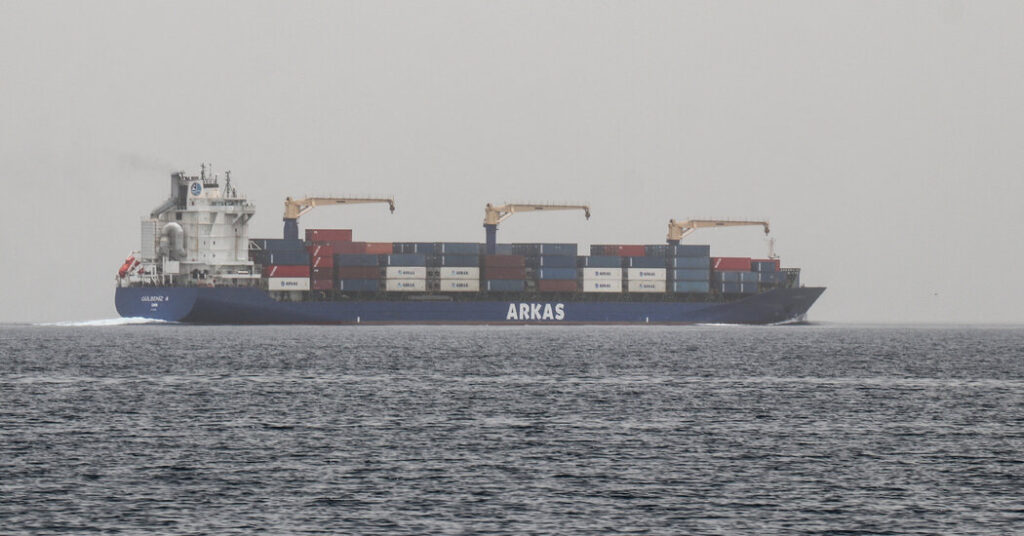
Saudi Arabia is forming a military coalition to protect shipping as attacks by a Yemeni militia in the Red Sea imperil a crucial route for Saudi oil exports and further threaten the global economy, according to Saudi Arabia’s defense ministry.
The kingdom has invited around 50 countries to join the new maritime coalition focused on the Red Sea, which would be Saudi-led, and is pushing for them to commit as soon as possible, according to two diplomats who were briefed on the effort. They spoke on the condition of anonymity to discuss sensitive diplomacy.
After a meeting on Thursday, 14 countries affirmed their support for the coalition, including Turkey, Egypt, Pakistan, Nigeria and several other Arab and African countries, the Saudi defense ministry said.
It is unclear how the new coalition would differ from a current European Union operation to protect Red Sea shipping, known as Aspides. Saudi Arabia has also invited European countries to join the new coalition, as well as the United States, one of the diplomats said.
The defense ministry statement said that other countries had “also expressed support for the initiative and are currently finalizing their necessary internal national approvals.”
The urgency of the Saudi initiative appears to be a sign that the kingdom’s leadership views existing efforts to fend off attacks by the Yemeni militia — an Iran-backed group known as the Houthis — as insufficient. On July 20, the Houthis declared a blockade on Saudi vessels transiting the Red Sea, which has became a vital route for oil exports during the U.S.-Israeli war with Iran. The Houthis have claimed attacks on several ships since then and have not backed down even after Saudi Arabia bombed Houthi-controlled territory in Yemen.
Since the blockade was declared, the number of Saudi and other ships passing through the Bab al-Mandeb Strait, at the southern tip of the Red Sea, has decreased by about one-fifth, according to Windward, a maritime data agency.
It remains unclear how the coalition would operate, and what ships or aircraft participating countries would contribute. The defense ministry described the effort vaguely as a “Multinational Maritime Defense Coalition,” and said it was “part of ongoing efforts to enhance maritime security, protect international maritime corridors, and counter threats targeting maritime navigation and global trade.”
The Red Sea, which leads to the Suez Canal, has long been an important waterway for international trade. It has become even more essential to global energy markets after the United States and Israel attacked Iran in February, leading Iran to effectively block the Strait of Hormuz — a narrow waterway on the other side of the Arabian Peninsula that had been the main route for Gulf oil shipments. Since then, Saudi Arabia, the world’s largest oil exporter, has rerouted much of its oil through an overland pipeline to the Red Sea.
During the war in Gaza, the Houthis gained international notoriety by launching attacks on Israel as well as on ships in the Red Sea, describing the operation as a moral crusade on behalf of Palestinians living under Israeli bombardment.
Because the Houthis control territory near the Bab al-Mandeb, the militia is well positioned to launch missiles and drones at vessels passing through the waterway. Starting in 2023, a U.S.-led maritime operation called Operation Prosperity Guardian sought to deter those attacks.
Saudi Arabia, seeking to avoid another conflict with the Houthis at the time, did not publicly join that operation.
When the United States and Israel went to war with Iran this year, the Houthis initially seemed willing to stay on the sidelines. But this month, renewed tensions between the Houthis and Saudi Arabia — which previously led a bombing campaign against the Houthis that turned into a decade-long quagmire — escalated rapidly, and the Houthis announced their blockade on Saudi vessels.
With the Strait of Hormuz off limits, any obstruction in the Red Sea leaves Saudi Arabia with limited options for exporting oil, the lifeblood of its government budget.
Though Saudi Arabia has long had antagonistic relations with Iran, Saudi officials had been pursuing warmer ties for several years as the most pragmatic way to manage the threat Iran posed.
The war has dashed those efforts, threatening the kingdom’s security and straining its relations with the United States, with U.S. and Saudi officials divided over the best approach to regional security. In retaliation for American attacks, Iran has launched thousands of missiles and drones at Persian Gulf states that host U.S. military installations, including Saudi Arabia.
Saudi officials have expressed a desire to stay out of the broader conflict. But on Wednesday, Saudi Arabia carried out joint airstrikes with the United States in Iraq, accusing Iran-backed militias there of attacking Saudi oil facilities. No Iraqi militias have claimed responsibility for those attacks.
Even before the Houthi blockade, Saudi Arabia was facing economic headwinds because of the war. The country’s gross domestic product contracted by 4.8 percent during the second quarter compared with the same period last year, according to preliminary estimates released this week by the Saudi statistics authority, which pointed to a sharp decline in oil-related activities.
Saudi officials have now turned to another detour, sending some ships in the Red Sea instead north to the Suez Canal or a nearby pipeline, according to Windward. But that route is also vulnerable to attacks and has other drawbacks, such as adding about a month to voyages from Saudi Arabia to Asia, home to the kingdom’s largest energy customers.
Ismaeel Naar contributed reporting from Dubai, United Arab Emirates, and Jenny Gross from London.
The post Saudi Arabia Pushing for New Military Coalition to Deter Red Sea Attacks appeared first on New York Times.