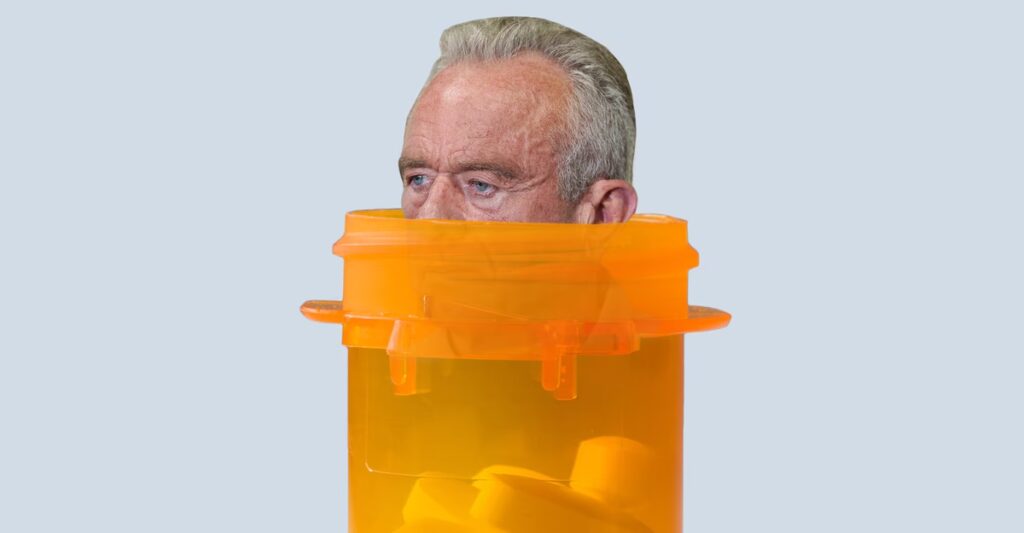
Robert F. Kennedy Jr. is vocal about his view that Americans overuse psychiatric medications, particularly antidepressants. As a general rule, the Health and Human Services secretary is skeptical of pharmaceuticals, but he’s gone further in his critiques of SSRIs, suggesting without credible evidence that their use might be linked to violent behavior, including school shootings. This past spring, he announced plans to discourage doctors from prescribing antidepressants and encourage them to de-prescribe the drugs—that is, to help patients who have previously been prescribed SSRIs stop taking them.
According to a recent survey, about 17 percent of American adults take an antidepressant. Some of them are my patients, many of whom were upset or infuriated by Kennedy’s move to rein in the prescribing of drugs whose benefits they have experienced firsthand. One of my patients, who has tried to stop taking Zoloft several times only for his depression to recur, told me that he couldn’t understand why the nation’s health secretary might want to discourage people from taking the SSRIs they’ve been prescribed.
Kennedy’s claim that antidepressants are overprescribed contains a grain of truth. Some patients receive antidepressants without really needing them or stay on them for longer than necessary. Earlier this year, an independent task force of psychiatrists suggested that more attention be paid to how and when patients and their doctors test whether tapering off these medications would be reasonable. In fact, inappropriate prescribing creates the impression among both patients and doctors that antidepressants are less effective than they are.
When Kennedy talks about de-prescribing antidepressants, exactly what he’s proposing remains unclear. He doesn’t specify which groups of depressed patients he believes can stop their medication. In fact, contrary to his often-heated rhetoric about SSRIs, he said in May when announcing the de-prescription measures that “if you are taking psychiatric medication, we are not telling you to stop”—and then encouraged such patients to “make the right decision” in consultation with their doctor. The benefits of antidepressants vary greatly. There is abundant evidence that antidepressants are effective for people who have moderate or more severe forms of depression. If you feel persistently sad, believe that life isn’t worth living, and lose your energy, appetite, concentration, or ability to experience pleasure, you likely have clinical depression, and your symptoms would be good targets for antidepressant treatment. But the same is not true of people experiencing what psychiatrists call everyday distress. Feeling, say, unhappy in a soul-sucking job or grief-stricken over the loss of a loved one are painful but entirely appropriate emotional responses. They call for changing your situation or contacting a friend for support, not for an antidepressant.
[Read: Talk to your doctor about your distrust of public health]
Taking an SSRI in such a scenario would be like prescribing an antibiotic for a common cold: a waste of resources that’s likely to only give the patient side effects and leave them questioning the efficacy of the drug. Some providers nevertheless prescribe antidepressants for everyday distress. I’ve seen patients going through grief or job loss who were prescribed SSRIs by my colleagues, perhaps because they thought the patients were right on the edge of depression. And in the clinic where I teach and supervise residents, I’ve met many people who were unnecessarily prescribed a cocktail of antidepressants by other clinicians in the community. Many of my colleagues have come across such patients too.
Even people who have chronic mild depression can respond well to antidepressants, some studies have found. But a 2010 meta-analysis showed that people with the most severe depression experienced the greatest improvement from antidepressant treatment, whereas the benefit for those with milder depression was smaller, in some cases near zero. One possible explanation for this finding is that placebo responses tend to be higher in patients with milder depression (perhaps because they start to feel better when researchers ask how they’re doing throughout the study), so drug-placebo differences in that group are slight. Another explanation is that people with more severe depression likely have more biological abnormalities in the brain, such as elevated levels of the stress hormone cortisol and exaggerated responses in the fear circuit, which can be good targets for antidepressants.
No national data prove that antidepressant overuse is rampant, though. The closest approximation we have is a landmark 2014 study that examined the health records of more than 1 million patients during one year of treatment and found that about 40 percent of antidepressant prescriptions were written without a documented psychiatric diagnosis. This, however, doesn’t prove that the prescriptions were medically unnecessary: Antidepressants are legitimately prescribed for other reasons, including pain, quitting smoking, and insomnia. And the fact that nearly a fifth of Americans are taking an antidepressant is in line with the actual burden of psychiatric illness in the general population: In the most recent national data available, which were published in 2005, 7 percent of survey respondents reported having major depressive disorder, 4 percent reported PTSD, and others reported additional diagnoses for which SSRIs can be appropriate.
[Read: 20-somethings are in trouble]
Of course, some patients don’t like being on antidepressants, even if they experience an improvement in their mood. A small proportion of SSRI users experience side effects such as decreased libido, weight gain, and tiredness. Although these effects can understandably be distressing, they are also commonly transient and manageable. If Kennedy’s efforts lead to widespread de-prescribing of antidepressants, it would be a potentially harmful overreaction to a limited problem.
Meanwhile, Kennedy’s focus on antidepressant overprescribing ignores—and may even deepen—a more urgent crisis in psychiatry. The 2023 National Survey on Drug Use and Health found that roughly one in three adults who experienced a major depressive episode received no treatment for their illness that year. Evidence suggests that several common barriers drive this undertreatment of depression: People don’t know where to go for help, think they can manage without help, or cannot afford help. In my experience, some depressed patients avoid treatment because they feel that a depression diagnosis is stigmatizing and connotes that they are weak rather than medically ill. The more doubts Kennedy and other officials instill about antidepressants, the more likely some people who really need them may be to turn them down. “The United States is facing a growing challenge of overmedicalization in behavioral health care,” Emily Hilliard, an HHS spokesperson, told The Atlantic in an email. “Under Secretary Kennedy’s leadership, HHS is committed to ensuring that patients and clinicians have transparent information about the benefits, risks, side effects, and potential withdrawal effects of psychiatric medications so they can make informed, evidence-based treatment decisions.”
Depression is a serious illness, and discouraging people who need antidepressants from seeking them—or enacting policies that impede access to them—would only spur on its greatest harms. Roughly half of people who experience an episode of major depression will go on to have a chronic course of the illness. That means many patients cannot stop taking antidepressants without a significant risk of relapse or worse: Depression carries a lifetime suicide risk of about 2 to 9 percent, with more severe forms of the disease corresponding to higher risk. In this sense, depressed patients are dependent on their SSRIs in the same way that people with high blood pressure are dependent on their antihypertensive drugs. To mitigate the risk of fatal complications of the illness, you might have to stay on the treatment for life. That kind of dependency is something that competent clinicians and health-policy experts should encourage.
[Jeffrey Ruoff: Between not wanting to live and not wanting to die]
Kennedy, by contrast, has likened antidepressant dependence to heroin addiction. “Listen, I know people, including members of my family, who’ve had a much worse time getting off of SSRIs than people have getting off heroin,” he told a Senate committee at his confirmation hearing last year. But the fact is that, unlike an opiate such as heroin, antidepressants do not make people high and do not result in habituation, which requires users to take ever-larger doses to maintain their clinical effect. And although research on tapering is somewhat limited, one of the largest available studies shows that any withdrawal symptoms tend to be mild and dissipate within weeks.
Kennedy’s desire to reduce Americans’ reliance on antidepressants fits in with his larger antipathy toward pharmaceuticals, especially vaccines. He generally seems to believe that eating and exercising well is all that is necessary for health. In the case of depression, he favors non-drug alternatives, such as psychotherapy, exercise, and “real food.” But I’ve seen many patients in exemplary physical health—for example, triathletes and serious swimmers who adhere to strict diets—become suicidally depressed. Taking an antidepressant after you have tried exercise, a healthy diet, and psychotherapy isn’t a sign of weakness or a character flaw. It’s a recognition that disease has an underlying biological basis—and that sometimes, you need medication to get better.
The post The Real Antidepressant Crisis appeared first on The Atlantic.