Iraq is home to dozens of armed militias, a legacy of the 2003 U.S.-led invasion of the country and the war against the extremist group Islamic State. Now, some of those militias have once again been drawn into the broader conflict engulfing the Middle East.
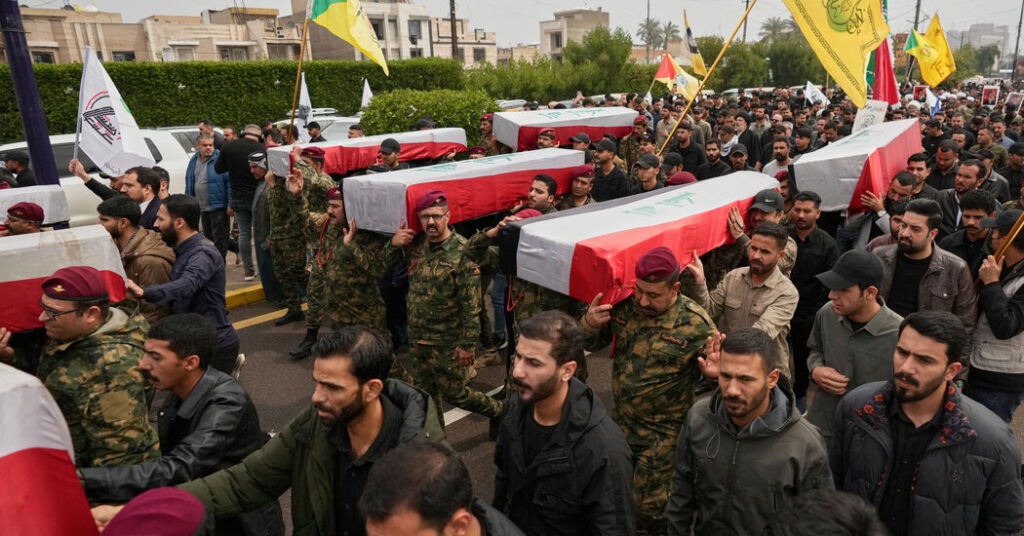
At least 20 fighters of the Popular Mobilization Forces, or P.M.F., an umbrella group of Iraqi militias with ties to Iran, were killed in a wave of U.S. and Saudi airstrikes across Iraq targeting the group’s headquarters, the P.M.F. said in a statement on Wednesday.
Iraq maintains close ties to both Iran and the United States and has often found itself caught between the warring sides, with Iraqi territory at times turned into a proxy battlefield. Iraq has also struggled with exerting tighter control over the militias.
Here’s what you need to know about the Iraqi militias.
What is the P.M.F.?
Iraq’s many militias first formed after the U.S.-led invasion and occupation of Iraq in 2003, which led to widespread anti-American sentiment in the country. Neighboring Iran, which, like Iraq, has a majority Shiite Muslim population, responded by helping to train and arm Iraqi Shiite militias to attack occupying American forces in Iraq.
In 2014, as Iraq was battling the rapid spread of the Sunni extremist group Islamic State, many Shiite militias banded together under the grouping known as the Popular Mobilization Forces to fight the group, which had seized large parts of Iraq. Some of the militias within the P.M.F. receive military and financial backing from Iran.
Some of those militias at the time also cooperated with the U.S.-led coalition fighting the Islamic State.
Among the P.M.F. forces that succeeded with American and Iranian support in ousting the Islamic State from much of the country was a militia called the Badr Organization. It was also accused at the time of atrocities against members of Iraq’s Sunni Muslim minority. The militia was one of the groups targeted in the Wednesday airstrikes.
In recent years, the P.M.F., which gained political influence as some of its leaders moved into ministerial positions, has agreed to come under the authority of Iraq’s national security forces. But it has never been fully integrated, and some of the militias under its umbrella continue to operate with a large degree of independence and maintain close ties to Iran.
How did the P.M.F. get drawn into this latest conflict?
The joint U.S.-Saudi airstrikes targeting the P.M.F. were carried out early Wednesday morning. The United States said it attacked Iranian proxy armed groups in Iraq in response to recent drone strikes launched by those militias.
The U.S. Central Command said in a statement on social media that under the direction of Iran’s Islamic Revolutionary Guards Corps the Iraqi militias had launched more than 30 drone strikes this week on U.S. forces in the Middle East and on Saudi energy infrastructure.
None of the Iraqi militias claimed responsibility for these recent attacks.
The Saudi foreign ministry said in a statement on Wednesday, published by state media, that the country was not seeking escalation but would not hesitate to respond to any aggression.
The Badr Organization, one of the most powerful groups in Iraq and known for its close ties to Iran, strongly condemned “the heinous and unjustified attack targeting the sovereignty of Iraq and its armed forces” and called on the Iraqi government to take a firm stance against the strikes.
On Feb. 28, when the United States and Israel launched the war on Iran, the headquarters of another Iraqi militia, Kataib Hezbollah, was hit with airstrikes. The strikes killed three militia members and wounded others.
Neither U.S. Central Command nor the Israeli military claimed responsibility but the P.M.F. blamed the “Zionist-American forces.”
Kataib Hezbollah, along with other Iran-allied armed groups in Iraq, immediately threatened to retaliate against the United States and Israel. The militias said they were defending Iraq’s sovereignty and supporting Iran.
In early March, the U.S. Embassy in Baghdad was targeted in a rocket attack. No group took responsibility. Since then, Kataib Hezbollah and other militias have launched regular drone and rocket attacks on U.S. targets in Iraq.
The group has also claimed responsibility for high-profile kidnappings, including the abduction this year of Shelly Kittleson, a U.S. journalist in Baghdad. She was freed after one week.
Kataib Hezbollah has long been closely tied to Iran’s Quds Force, the overseas arm of Iran’s powerful Revolutionary Guards. In 2009, the U.S. designated it as a foreign terrorist organization.
Both Kataib Hezbollah and the Badr Organization are among the militias that operate partially outside state control.
What is the Iraqi government position?
The Iraqi presidency condemned the U.S. and Saudi strikes on the P.M.F. headquarters and said it “considers this an unacceptable attack and a blatant violation of Iraq’s sovereignty and targeting its official security institutions in contravention of international law and the Charter of the United Nations.”
The statement on Wednesday also said the government rejected the use of Iraqi land “as a launching pad or arena for attacks on neighboring countries or for settling regional and international scores.”
Soon after he came to power in April, Iraq’s prime minister, Ali al-Zaidi, ordered the country’s militias to come under direct state control in an attempt to rein in the armed groups. It was not the first time Iraq has tried to bring the militias under tighter government control, but previous attempts have failed.
Some of the most powerful Iran-linked militias rejected the latest government attempt.
Falih Hassan contributed reporting.
The post Here’s What to Know About Iraq’s Militias appeared first on New York Times.