Some still believe that you can’t manage a car company unless you’re a fully paid-up “car guy.” Tell that to Benedetto Vigna, Ferrari’s CEO. He’s a physicist by education, hired to run the company in 2021 after a career in semiconductors, although he did significant business with automotive during that time.
Vigna also helped develop a three-dimensional motion sensor first used in airbags, later adapted for the Nintendo Wii and the iPhone’s screen rotation function. An inventor, then. “I prefer innovator,” he once told me. “A lot of the time inventors are just thinking, but innovators conceive new things and make them happen.”
This is all useful background to the Luce, Ferrari’s first fully electric car, engineered in Maranello, Italy, but designed in California by LoveFrom, the agency set up by renowned iPhone designer Jony Ive. It’s not Apple’s abandoned car, reskinned and rebooted for the world’s most famous automotive name, but more the product of a union between like-minded innovators—Italian spirit and attitude, Silicon Valley lateral thinking.
But unless you’ve been hiding under a rock on Mars with Elon Musk these past few months, you’ll also know that the result didn’t land the way its creators would have anticipated. Ferrari’s immense global fan base is seemingly not on board with the idea of an electric car on a point of principle. And hiring Ive and his team to reimagine the aesthetic has proven as welcome as Kryptonite is to Superman.
Part of the frequently obnoxious discourse around the Luce centered around the idea that a Ferrari’s design should deliver an instant dopamine rush. These aren’t cars that require a PhD in design to understand; they’re meant to hit hard and fast, seeding desire the moment you see them. The Luce spectacularly breaks from tradition, and without the famous Prancing Horse badge, there’s little here that yokes it to perhaps the most revered automotive back catalog of all. But that was all part of the brief: Do something different.
The driving experience amplifies this feeling. The Luce is a Ferrari, just not the sort we’re used to. “In the past 100 years, technology has changed for sure,” Raffaele de Simone, Ferrari’s chief test driver, tells me. “But what hasn’t changed is our bodies. We have two hands, two eyes and ears, and two feet. The interface is the same—steering, brakes and throttle—but the Luce has a different sort of driving emotion and a different way of announcing driving thrills.”
Driving Different
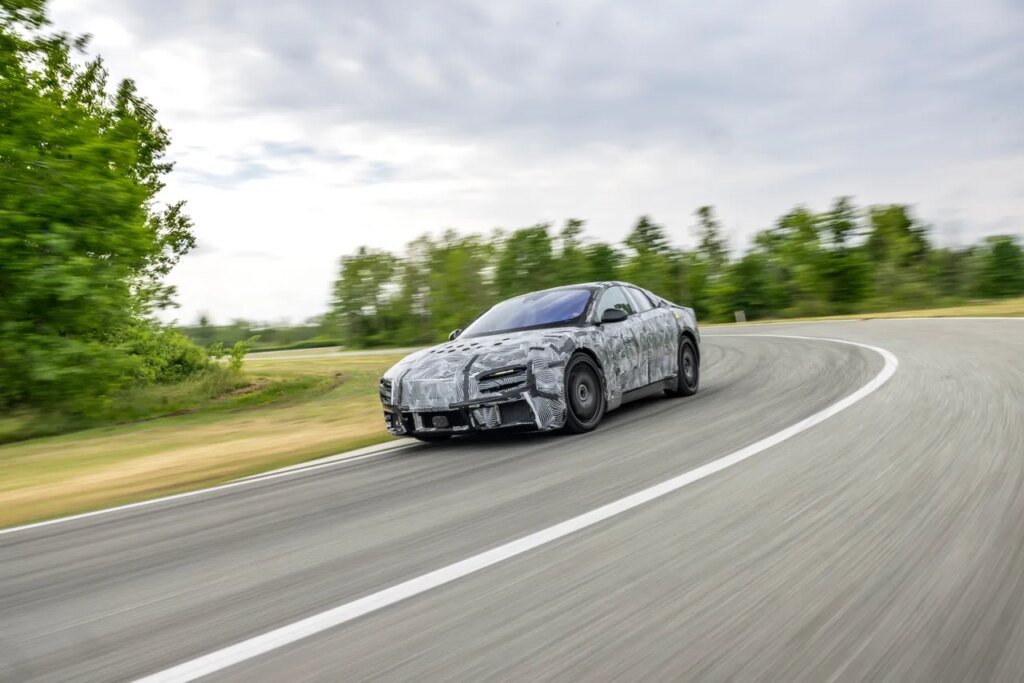
I was at a test track in northern Italy in May to find out how successfully that’s been achieved. I was in a preproduction car, still disguised at the time of driving because it pre-dates the car’s reveal in Rome. First impressions? The Luce’s cab-forward proportions mean you sit closer to the front axle than usual, and higher because there’s a large battery pack beneath the cabin. It’s clearly not low-slung or sporty.
You can’t help but take in that interior, clearly Apple-inspired but positing a whole new approach to territory that has seen an entire generation of new cars lose sight of first principles. The three-spoke wheel’s design is inspired by a classic Ferrari’s, and it feels fantastic. The air vents pivot with a deeply engineered precision. Even the seat runners are elegant. The space in the rear is almost limo-like.
One of Ive’s superpowers is being able to detect the level of care invested in a product’s design, and whether you like the Luce’s aesthetic or not, that’s indisputable. But he rejects the concept of a touchscreen inside a car, choosing instead to elevate haptic feel and the clarity of the dials to a level previously unseen in the automotive context. Ive is all about input and output. The Luce is a special place to be.
There’s a slickness to the first driving impressions, too. Ferraris have become less highly strung over the years, with greater emphasis now placed on daily usability. As befits its four-door, five-seat layout, the Luce is arguably the most accessible Ferrari in the company’s near-80-year history. Its major controls—the throttle and brake pedal—are beautifully calibrated, so it moves away effortlessly with an impressively and perhaps unexpectedly light touch. On some classic Ferraris, you have to let the gearbox oil warm thoroughly before going anywhere. This is not an issue on the Luce, despite its complex electronic drive units.
The structure is all new. The chassis consists of hollow castings, extrusions and aluminum sheets, to reduce weight and optimize load paths. The 800-volt battery architecture is integrated into the chassis, positioned as low in the Luce’s floorpan as the engineers could achieve. So it has a center of gravity that’s 95 mm lower than the Purosangue, Ferrari’s quasi-SUV, and a yaw moment of inertia 15 percent less than that car. That means it’s more agile and changes direction more keenly.
That’s physics in play. Ferrari’s commitment to technology is greater than ever, and the Luce deploys everything it knows to manage those external forces. It enjoys unprecedented control of each wheel in all three axes (lateral, longitudinal, and vertical), with particular emphasis on lateral body dynamics. A new “vehicle control unit” oversees power delivery and energy recovery, and updates target metrics 200 times per second. As with all high-end electric vehicles, the Luce’s master controller has a lot to do.
Prancing Power
The electric Ferrari has a 122-kWh battery and four e-motors, two on each axle, and optimum weight distribution. The front motors deliver 282 brake horsepower (bhp), the rears 831 bhp, so the total output is north of 1,000 bhp. And there’s mammoth torque: 5,900 pound-feet (around 8,000 Newton-meters) at the rear wheels, a crazy amount of force.
The front motors can spin at up to 30,000 revolutions per minute and can go from nothing to maximum in less than a second. The chassis and body consist of 75 percent recycled aluminum. There’s also a separate rear subframe for the first time on a Ferrari; it’s connected to the rest of the chassis by elastomeric bushes—polymers with a high viscosity—which helps reduce noise and vibration.
A new “e-manettino” dial on the lower left of the steering wheel joins the existing one on the right, a staple of all Ferraris since its arrival in 2004’s F430 model. The new addition has three settings that govern power and traction, as well as the shape of the torque curve. In Range mode, power is limited to 429 bhp, and the car is predominantly rear-drive. Select Tour, and the driver has 608 bhp to enjoy, with all-wheel drive capability. In the Performance setting, that rises to 958 bhp, and the top speed is raised to a maximum of 190 mph.
Engineering this sort of bandwidth into an EV is nothing new. However, the application here is more emotionally charged: Ferrari has an obligation to organize the possibilities as entertainingly as possible. How else will it be able to silence that fan base seemingly intent on shunning the concept of an electric Ferrari?
“What excites me is that we have more tools available than ever before to give the driver exactly what they’re asking from the car,” de Simone tells me. “Let’s say you’re entering a corner and suddenly the radius tightens. Instantly the driver is asking the car for a little more rotation. In that moment, rear-wheel steering, active suspension, and torque vectoring from the four motors are all working together to help achieve that response. What’s interesting is that you don’t necessarily feel the individual systems at work. What you feel is confidence.”
Because it can vector torque on both axles, the Luce’s dynamic behavior plays out in hi-def widescreen. The front end is positive without being overly sensitive; it remains neutral throughout the middle phase of the corner and has incredible traction on the exit. Ferrari long ago mastered the chassis hardware, but it’s a software leader now, too; its Side Slip Control system reaches v10 in the Luce, and its traction control has evolved to suit the car’s quad-motor configuration. Select Performance mode and switch the other manettino to “CT off” (traction control off), and the Luce gets distinctly more playful. It’s doubtful that many owners will ever drift their $600,000 electric Ferrari, but it can certainly do it.
Like all engineers, Ferrari’s people love graphs and charts and will happily share what they deem is proof that the 4,982-pound Luce feels significantly less than that. Subjectively, it has the alertness and willingness to change direction of a much lighter car, but given that it’s five meters long and two meters wide, you still need space to explore these limits.
Electric Shifts, Kraftwerk Sounds
Further interactivity (and graphs) arrive in the form of the Luce’s Torque Shift Engagement. This is Ferrari’s answer to one of the issues with EVs: the rather one-dimensional way that they deliver their energy. Pull the right paddle on the steering column and you get five power and torque levels; the left one delivers five grades of regenerative engine braking, with incremental illumination within the instrument display so you can keep track of the deployment.
The Luce plays with the torque curve so that you feel like you’re fully in command during cornering entry and exit rather than simply riding a huge wave of torque. In essence, it’s designed to conjure the sensation you feel driving a car with a conventional transmission and engine braking. The amount of energy corresponds with the available grip and the nature of the corner itself. It’s a step up from the synthesized gearbox in the Hyundai Ioniq 5 N and the e-shift option available in the latest Porsche Taycan, as good as they are.
The Luce’s dynamic bandwidth extends to its ride quality, even on 23- and 24-inch wheels, and on the gnarliest surfaces. It’s fitted with the third generation of Ferrari’s 48-volt active suspension and controls its mass very adroitly without ever becoming floaty.
Finally, there’s the way it sounds. Largely silent, barring some mild wind and tire noise, the Luce finds its voice in Performance mode. There’s something of the harmonic rasp of a six-cylinder to it, and it’s not quite as rumbly as a V-8, never mind a V-12. But it’s real and musical—more Kraftwerk-adjacent than Pavarotti, perhaps—and has been achieved by using an accelerometer and by equalizing naturally occurring frequencies on the rear inverter.
“You can think about it like a musical instrument. It has its own timbre,” says Antonio Palermo, who led this part of the Luce’s development team. “We need to take away the annoying noise, because there’s no point amplifying gear whine, for example. But there are lots of other beautiful frequencies we can work with and let out. We talk about orchestras when it comes to ICE. Well, there’s a different type of orchestra inside this machine, too.”
The Luce clearly repositions and reimagines the very idea of what a Ferrari could be. For most people, that’s a romantic notion likely steeped in dreams of Italy at its most seductive, or a wailing combustion engine closing in on an 8,500-rpm redline. Hence the fallout. The Luce is on a different path, and it demands an alternative response. But in terms of how it drives, there’s no question it’s authentically Ferrari. We can’t wait to drive it again.
The post Love It or Hate It, the Ferrari Luce Is a Thrilling Drive appeared first on Wired.