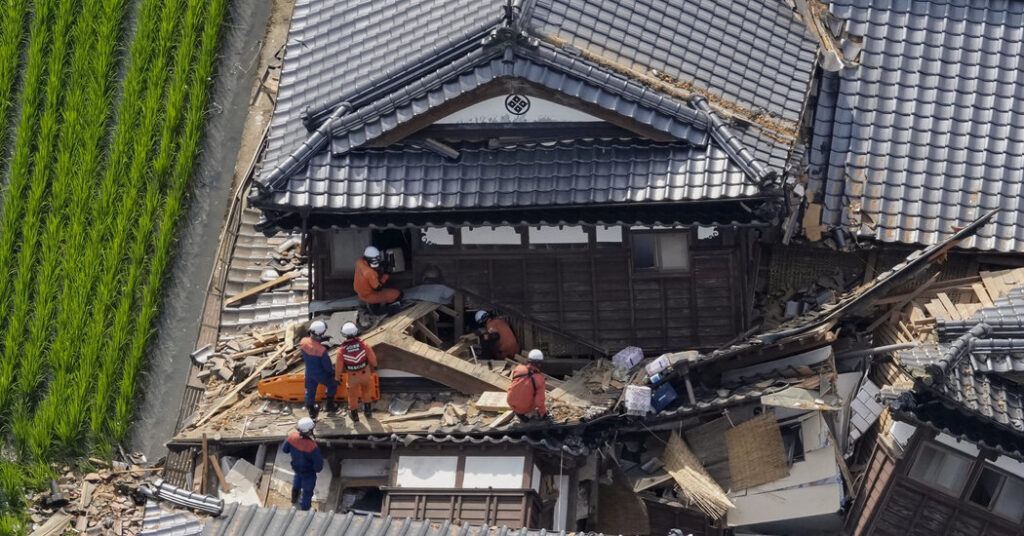
Japan rescuers rushed on Wednesday to save people trapped in collapsed buildings after a powerful 6.8-magnitude earthquake struck the southwestern prefecture of Kumamoto on Tuesday, killing at least 13 people.
As more than 200 aftershocks continued to jolt Kyushu, Japan’s southernmost main island, rescue teams worked to find people trapped inside partially collapsed structures. Those included a shopping mall and a paper factory in Kumamoto.
Fire response teams and the police joined 4,600 military personnel in the rescue efforts. As of Wednesday afternoon, 10 people had been pulled from the heavily damaged mall. Of that group, three were confirmed dead, one person was in a state of cardiopulmonary arrest and five others sustained non-life-threatening injuries, according to officials from Kumamoto’s disaster countermeasure department.
Cardiopulmonary arrest is a term often used in Japan before a death can be confirmed by a coroner. The location of three of the mall’s employees could not be confirmed, according to Aeon, which operates the mall.
At the paper plant, 11 people were trapped after its chimney collapsed from the heavy shaking, Kumamoto officials said. As of Wednesday afternoon, five had died, two had suffered injuries and four were still missing.
“Arduous rescue operations are still underway,” Governor Takashi Kimura of Kumamoto said at a meeting about the disaster on Wednesday. “As the situation remains unpredictable, we intend to take all possible measures.”
As of Wednesday, the total number of quake-related fatalities had reached 13, Prime Minister Sanae Takaichi told reporters. In brief remarks, Ms. Takaichi offered condolences to bereaved families and said she was grateful to rescue teams that had been “working tirelessly through the night.” “There are still people waiting for help, and we are in a race against time,” she said.
Tuesday’s earthquake stirred painful memories of a series of earthquakes in Kumamoto a decade ago that killed more than 270 people and injured thousands of others.
After the 2016 earthquake, it took Yatsushiro-gu Shrine in Kumamoto around five years to rebuild. Ten years after that quake, people in Kumamoto “were just thinking that the recovery process was entering its final phase, when this happened,” said Masataka Takehara, 49, a senior priest at the shrine. “Honestly I just felt like, ‘wait, why?’”
On Tuesday afternoon, Mr. Takehara described hearing a deep, rumbling sound coming from beneath the ground, and then bookshelves in the shrine’s back office started to topple over. Just as he stepped out of the building, the shrine’s main worship hall began to sway, then collapsed.
Mr. Takehara said local residents still showed up to pray at the shrine on Wednesday. The first person to arrive “was visibly moved — teary-eyed and left speechless,” he said. “I share those same feelings myself.”
The quake’s initial death toll was expected to rise. As of Wednesday afternoon, six people were in a state of cardiopulmonary arrest, and six were seriously injured, according to Kumamoto officials. Over 530 people had received, or were receiving, treatment at major hospitals in Kumamoto, according to the public broadcaster NHK.
In addition to mobilizing rescue operations, local officials in Kumamoto were assessing widespread damage to buildings, expressways, bridges and historic sites across the prefecture.
Seiji Sakumasu, 30, operates a gym a short walk from the partially collapsed paper factory in Yatsushiro, a coastal city in Kumamoto. When the earthquake struck, machinery toppled and slid across the room, and mirrors cracked across his facility.
“That was the level of shaking,” Mr. Sakumasu said. “Because I experienced the previous earthquake, I knew immediately to get my things together.” Still, he said he remained worried about his gym members, several of whom worked at the neighboring paper plant.
After the quake on Tuesday, fires erupted in Kumamoto City, the regional capital, which has a population of more than 700,000. At Kumamoto Castle, a centuries-old landmark in the center of the city, a stone wall partially collapsed.
At the mall, about 3,000 customers were evacuated immediately after the initial earthquake on Tuesday, according to Aeon. Less than an hour later, an explosion rocked the structure.
People in the surrounding area described feeling a shock wave so forceful that they thought another earthquake had hit, followed by thick white smoke that blanketed the neighborhood surrounding the mall. The cause of the blast has not been confirmed, but an assessment indicated that it was likely a gas explosion, according to Aeon.
As of Wednesday evening, power outages affected more than 31,000 households in Kumamoto, according to Kyushu Electric Power. About 84,000 households in five prefectures had no water supply, according to Japan’s land and infrastructure ministry.
Kumamoto Airport resumed operations on Wednesday, while many trains in the area, including bullet trains, suspended services across Kyushu. Parts of the island’s main expressway remained closed.
The post Japan ‘Races Against Time’ to Reach People Trapped After Large Quake appeared first on New York Times.