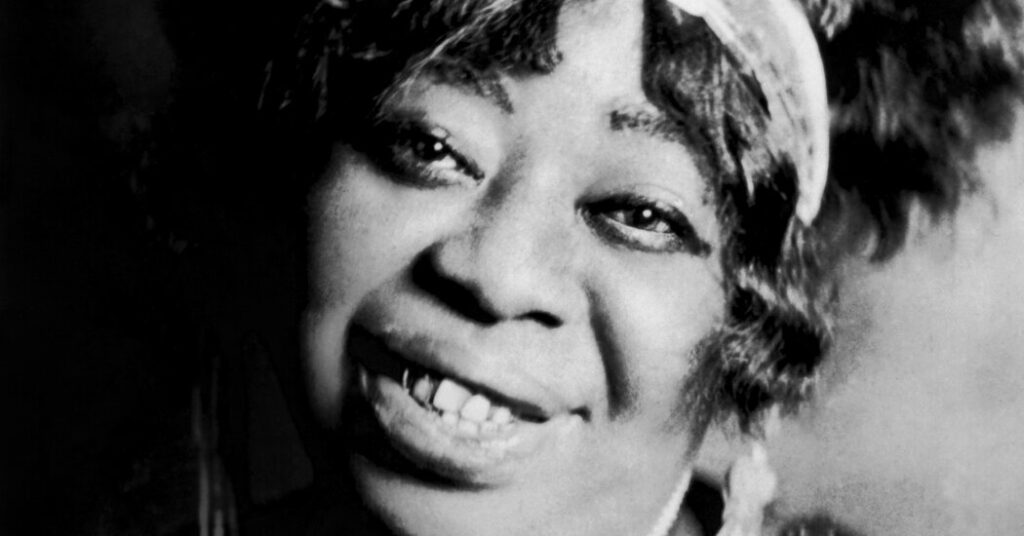
Before Thomas A. Dorsey became the father of gospel music, he spent the mid to late 1920s at the piano accompanying Ma Rainey, the mother of the blues. After touring with her, he would later reportedly say there was “nowhere else to go but to the Lord.”
At the dawn of the recording industry, Rainey, known as the mother of the blues, plied a new style derived from vaudeville that spoke to a Black audience just a generation removed from slavery. “She was the star of her day,” said Gaye Todd-Adegbalola, a blues singer who has covered and written about Rainey. Despite her hit songs including “See See Rider” and “New Bo-Weavil Blues,” which became blues standards, and vibrant touring career, Rainey’s impact was inconsistently documented after her death in 1939.
A new boxed set, released last week, offers the most complete look at Rainey’s recording career to date. The collection, from Black Swan Records and the George H. Buck Jazz Foundation, compiles Rainey’s complete recordings from 1923 to 1928, includes rare test pressings, alternate takes and 118 original recordings painstakingly assembled after almost a decade of searching through private collections and jazz discographies.
That these recordings exist at all is a minor miracle. Paramount Records, the label responsible for much of Rainey’s recorded output, was a subsidiary of the Wisconsin Chair Company. It produced records largely to sell phonographs, with little regard for audio quality, pressing them onto cheap shellac. Doug Benson, the Grammy-nominated engineer behind the collection, said this source material was the most challenging he “has ever worked with.”
Rainey’s voice was powerful enough that when she hit her loudest notes, the grooves distorted. “The first time people played these songs on a Victrola with a heavy steel needle,” Benson said, “it’d skip right past them.” Those notes are audible on the new release.
The restoration uncovered new details hidden within the records. “We discovered a violin that is not in any of the other discographies,” said Benson. The strings, played by Leroy Pickett, can be heard on “Little Low Mama Blues” and “Grievin’ Heart Blues.”
Jazz luminaries including Coleman Hawkins, Fletcher Henderson and Louis Armstrong can be heard elsewhere on the compilation, responding to Rainey’s crashing and moaning delivery.
Rainey was deeply involved in writing songs that spoke directly to the Black experience. She is credited as composer, co-composer or lyricist on roughly a third of the recordings collected in the set, based on surviving copyright records, which means the true number is likely to have been higher. In the words of Todd-Adegbalola, Rainey was “the Black griot of the blues”
Born Gertrude Pridgett in Columbus, Ga., in 1886, Rainey developed her rich, ragged contralto within the traditions of field hollers, folk songs and the communal storytelling techniques of Black Southern life.
Her rise on the entertainment circuit coincided with the explosion of Black music in the 1920s, and the Harlem Renaissance, a period in which Black culture and scholarship were finding new audiences. Rainey did not strive to make her music legible to newcomers. “She wasn’t trying to be white and she wasn’t trying to appeal to white values,” said Todd-Adegbalola. “With Ma, Black people had found a mother, and that’s as close to God as you can get.”
Rainey belonged to a new generation of Black Americans who sought greater freedom even as Jim Crow policies still terrorized the South. In her songs, she explored the complexities of romance: one moment pleading with a lover not to leave, the next asserting her own independence. Her 1928 recording “Prove It On Me Blues,” accompanied by a jug band, remains one of the boldest examples of the latter:
“Went out last night with a crowd of my friends / They must’ve been women, ’cause I don’t like no men.”
The song has become central to modern interpretations of Rainey’s legacy, with scholars identifying it as one of the earliest expressions of queer identity in popular music. But the new compilation questions recent assessments that the song confirmed her bisexuality.
“There isn’t much to suggest she was,” said David Sager, a historian who worked with a team of researchers to write the liner notes. “Although there are anecdotes about her having orgies with women backstage, we can’t know whether they were or were not true.”
The collection also showcases Rainey ranging beyond the blues. Before she ever entered Paramount’s recording studio, she had already spent years performing in tent shows and on minstrel and vaudeville stages, dabbling in popular styles of entertainment. Across the recordings, one can hear elements of ragtime, comedic sketches and the 32-bar pop song “Honey, Where You Been So Long?”
Branding Rainey as a blues act was the work of J. Mayo “Ink” Williams, the promoter hired by Paramount in 1924 to oversee its race department at a time when 12-bar blues was among the most commercially successful forms of Black recorded music. “Every glimpse we get of her stepping away from that straitjacket is precious,” said Sager.
Rainey retired from music in 1935, returning to her family home in Columbus, Ga., a place that beckoned her far more than the stage. She died four years later, and was little remembered outside the Black news media until August Wilson’s 1982 play “Ma Rainey’s Black Bottom” became a Broadway hit. A 2020 Netflix adaptation starring Viola Davis earned the actress an Oscar nomination.
Among Rainey’s most ardent followers after her death were avid record collectors in the 1940s who began gathering reissues of early jazz, blues and country recordings. Their efforts helped preserve a body of work, as her records were passed down through families who “considered Rainey an authority,” said Sager.
With the scratchy recordings and paltry historical records, points of Rainey’s biography have been subject to mythologizing. We do know that she dressed for the stage in sequined gowns spangled with golden coins or pearls and ostrich-feather boas, and wore heavy greasepaint and powder. Taken together with productions like the Wilson play, Benson said, the version of Rainey portrayed to millions differs greatly from the woman heard on these recordings.
“They made the character much more aloof and unfriendly,” said Benson. “But just from listening to this woman, you can feel this is someone you’d really like.”
The post Ma Rainey, Mother of More Than Just Blues, Comes Alive on New Release appeared first on New York Times.