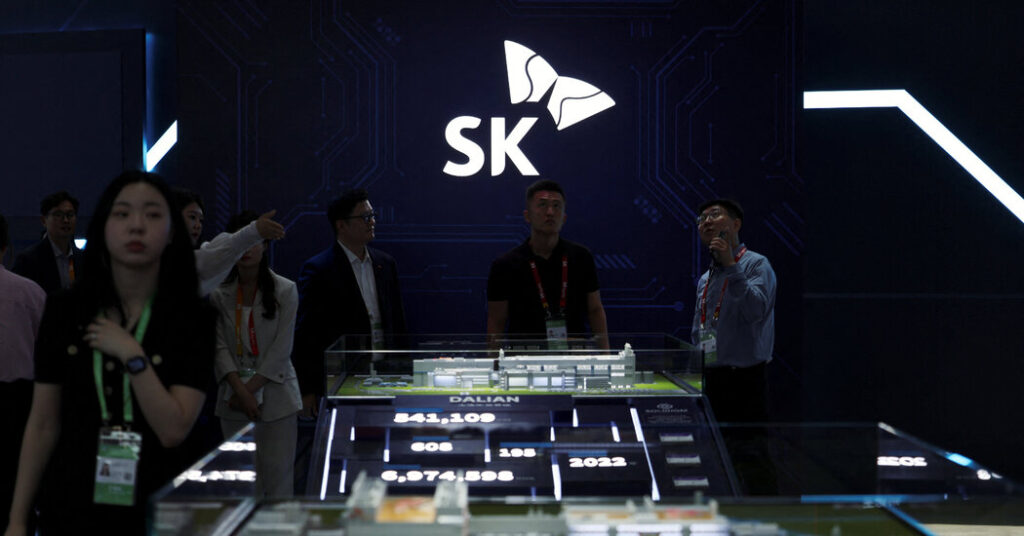
For decades, the business of making memory chips had been the digital equivalent of mining raw materials. Production required enormous investments in expensive factories, while prices swung through boom-or-bust cycles. The hope was that, over time, the good years would outnumber the bad.
The glamour and lofty profits in the semiconductor industry lay in the data-processing brains of computers, not the memory chips that stored and transported data.
But artificial intelligence, with its nearly limitless appetite for training data, has transformed the stature and profitability of the memory business beyond recognition. No company reflects that dramatic shift more than SK Hynix, the leading producer of high-speed memory, a crucial A.I. technology.
And no company has been more exposed to the wild stock-market gyrations that have roiled A.I. companies in recent weeks. Hynix has been a focal point for investor concerns over the seemingly runaway costs of Silicon Valley tech giants building A.I. data centers and worries over tougher competition from China. If A.I. investment slows, Hynix appears especially vulnerable.
Hynix shares have been battered in the A.I. sell-off this week, and are down about 50 percent from their recent high. Yet the stock has more than doubled so far this year. This month, Hynix raised $26.5 billion in a U.S. share sale, the largest ever by a foreign company.
Hynix reportequarterly results on Wednesday that underscored how much the A.I. boom is lifting the South Korean chipmaker. Its revenue more than tripled from the previous year to roughly $54.5 billion, while operating profit jumped 557 percent.
But the financial performance was slightly below even higher forecasts from analysts. The company’s shares fell nearly 10 percent in trading on the Seoul stock market. Shares of Samsung Electronics, South Korea’s other memory chip giant, also fell 5 percent, while the benchmark KOSPI fell 6 percent.
In a conference call on Wednesday, Hynix executives said they saw no signs of a slowdown. Orders from its big tech customers, they said, remained robust and the company’s biggest challenge was keeping up with demand. Asked about more efficient, open A.I. models from China that require less computing firepower, they replied that the impact should be to broaden A.I. adoption and usage rather than reduce demand for A.I. chips.
So far, Silicon Valley’s tech giants, including Google, Amazon, Meta and Microsoft, say they plan to increase their spending on data centers and software development for A.I. this year, not pull back.
Despite the recent stock-market slide, the Hynix business remains exceptionally strong. It has a cash nest egg of more than $60 billion, and operating profit margins reached a record 76 percent in the second quarter. The shortfall compared to expectations, company executives said, reflected its investment in staying ahead in A.I. chipmaking, which should yield higher sales and profits in the near future.
For Hynix, however, the road to its current prosperity has been long.
Over the years, Hynix, founded in 1983, flirted with insolvency and changed ownership a few times. In 2012, it became part of the SK group, one of South Korea’s biggest family-controlled conglomerates. Even during good years, Hynix was overshadowed by its much larger South Korean rival, Samsung.
As the smaller challenger, Hynix sought innovations to close the gap. It spent years developing designs that stacked chips vertically to shuttle information faster between memory chips and processors. The early efforts were promising but expensive.
By the time A.I. technology, with its unlimited demand for data, began to take off, the technology had matured. The company forged a close relationship with Nvidia, whose processors power most A.I. systems and is Hynix’s foremost customer.
Nvidia’s new Rubin processor, for example, bundles two large A.I. chips with eight stacks of high-speed memory, each containing 12 chips, with Hynix as its key supplier.
The A.I. boom has rippled across the broader memory market, lifting prices and profits for chips used in smartphones and notebook computers. But the most sought-after and most lucrative products are the high-speed chips that go into the A.I. memory stacks.
Hynix is the clear leader. In the first quarter of this year, it accounted for 58 percent of the so-called high-bandwidth chip market, according to Counterpoint Research. Samsung and Micron, America’s big memory chip maker, each had 21 percent of the market.
But in the year-earlier quarter, Hynix held 69 percent of the market. Samsung is gaining ground, analysts say, and Micron was recently certified as a supplier of high-speed chips to Nvidia.
Today, big tech companies worry that a memory shortage will be a bottleneck to A.I. development. They are trying to lock in supply with long-term contracts, despite high prices. In some tech circles, there is talk of a memory chip “supercycle” of rising demand and high prices that could stretch out over several years.
Jim Handy, a seasoned semiconductor analyst, is skeptical. “In today’s market, the biggest challenge is keeping up with demand,” said Mr. Handy, whose research firm, Objective Analysis, tracks the memory market. “But when the AI bubble bursts, they will have huge issues the other way.”
Xinyun Wu contributed reporting.
The post South Korea’s Memory Chip Giant Defies A.I. Market Jitters appeared first on New York Times.