In historic Marietta, Ohio, riverboats churn past shores once surveyed by George Washington. Trolleys bump along brick roads that pass between Victorian homes and 2,000-year-old Adena and Hopewell burial mounds. Its cemeteries hold more Revolutionary War officers than anywhere else in the nation.
And there is something else buried deep beneath Marietta: Hundreds of millions of gallons of radioactive fracking wastewater.
For years, it has arrived in a caravan of tanker trucks that come night and day to deposit the toxic brine in injection wells that pump it thousands of feet underground, where it is supposed to stay forever.
But the brine is spurting to the surface, and locals fear it could soon contaminate the drinking water source for 32,000 people. “It would destroy the city,” said Susan Vessels, president of the Marietta City Council. “Once the damage is done, it cannot be undone.”
Residents and local officials were for years “completely unaware” of their place at the heart of an interstate marketplace for toxic waste, Ms. Vessels said. They’ve come to realize, she said, that their corner of Ohio has become a major destination for fracking brine.
Ohio has permitted more than 240 injection wells for the disposal of oil and gas waste. By comparison, there are 19 such injection wells in Pennsylvania, and a few dozen in West Virginia, both of which border Ohio.
Pennsylvania, which produces more natural gas than any state besides Texas, last year exported to Ohio roughly three-quarters of all the fracking brine that it needed to permanently dispose of, according to state records.
Ohio pumps about 1.4 billion gallons of wastewater underground annually, according to state data. Estimates vary, but roughly one-third to one-half likely comes from out of state.
The fracking boom has transformed the United States into the world’s largest producer of natural gas. But fracking also produces huge volumes of salty wastewater laden with heavy metals, radioactive materials and cancer-causing benzene, as well as hazardous chemical additives from the fracking process.
Ohio became a destination for wastewater because decades ago, long before fracking, it received permission from the federal government to regulate its own injection wells, which were then just a small part of the oil and gas industry. As a result, today it’s easier to drill injection wells in Ohio than in states like Pennsylvania where there’s federal oversight.
Rural Washington County, home to Marietta, has 19 permitted injection wells. Over the past two years, 59 percent of the 562 million gallons of waste injected under the county came from out of state, according to state records reviewed by The New York Times.
The industry says injection wells are tightly regulated, and that thousands of feet of rock and shale safely contain the wastewater. Injection wells, “when properly sited, constructed, operated, and regulated, do not pose a significant threat to drinking water,” said Rob Brundrett, president of the Ohio Oil and Gas Association.
But brine has bubbled up from injection wells in Oklahoma, raising concerns about drinking water contamination, and it has gushed from the ground in Texas. Now, it’s coming to the surface in Ohio.
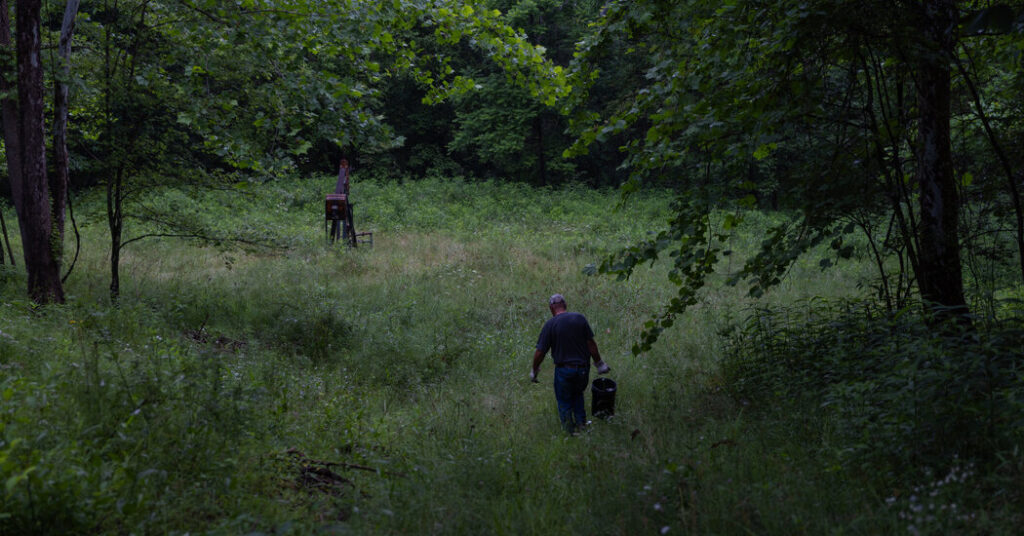
Last month in a wooded hollow outside Marietta, Bob Wilson wrestled with a wrench beneath a traditional oil and gas well (not a fracked well). A jet of fluid erupted: briny fracking wastewater.
“There should not be any water here at all,” Mr. Wilson said. He squinted at a pressure gauge that read 335 pounds per square inch — higher than he’d ever seen it, he said. “It keeps climbing.”
Mr. Wilson said he’d lost two more of his oil and gas wells in recent weeks to intrusions from fracking wastewater. Now the wells “don’t make me a nickel,” he said. He is suing several injection well companies, arguing that injected brine contaminated oil and gas reservoirs and violated his property rights. A lower court dismissed the allegations, which have been appealed to the Ohio Supreme Court. The injection well companies argue, among other things, that the plaintiffs couldn’t prove where the wastewater originated.
The flooded wells are evidence that brine is “migrating” underground through crooks and crannies in the rock, said David Jeffery, a professor of geology at Marietta College who previously worked as a petroleum geologist at BP.
Complicating matters, as many as 66,000 undocumented, old-fashioned oil and gas wells pockmark Ohio, according to state estimates. And some almost certainly pass through aquifers, experts say.
They could be conduits for brine that has been pumped underground, Dr. Jeffery said, and “we have no idea where they are.”
In 2024 the Ohio Oil and Gas Commission, a body of industry experts that oversees regulatory appeals, “explicitly confirmed” that brine was migrating underground, according to Cory Haydocy, an attorney who served as the commission’s executive director until 2023.
“The state and industry have possessed definitive proof for years that these injection wells were threatening the surrounding geology,” Mr. Haydocy said.
Ms. Vessels, the Marietta City Council president, said she didn’t know a thing about injection wells until about a year ago. Four wells just outside Marietta, population 13,000, are permitted to inject a combined 840,000 gallons of brine daily within two miles of the city’s drinking water aquifer.
Sitting on her porch recently, surrounded by stacks of inspection reports and well permits, Ms. Vessels, a Republican and former U.S. Army intelligence officer, said she wanted an immediate halt on injection and for state leaders to prohibit injection wells near public drinking water.
“We need a community that we can hand down to our children and our grandchildren,” she said. “And if we keep walking down this path, we might not have that.”
The four injection wells within two miles of Marietta’s drinking water source accepted wastewater from fracking sites in Pennsylvania that reported median levels of radium-226, a cancer-causing radioactive material, ranging from 428 to 1,800 times the U.S. Environmental Protection Agency’s drinking water standard, according to Pennsylvania waste records assembled by FracTracker, an organization that monitors oil and gas activity.
“If we get anything nuclear in our water, that’s it,” Ms. Vessels said. “We’re done.”
Last year, after the state approved a fifth and then a sixth injection well at Marietta’s doorstep, officials declared an emergency. (A seventh proposed injection well is pending.)
Not only was brine “regularly migrating to the surface,” officials said, but seismic activity in Washington County had increased almost 20 times over since 2023, a “clear indication” that underground rock formations holding billions of gallons of waste were “moving and likely fracturing.”
Marietta officials asked state leaders to halt injection within six miles of the city’s aquifer and to stop permitting new wells. By March, eight more water authorities in the county had followed suit in calling for a moratorium.
Drinking-water tests in Marietta and surrounding areas show no signs of brine, officials said. But if radioactive material were to enter the system, “we don’t think we can remove it,” said Bob Allen, who serves on the board of the Little Hocking Water Association south of Marietta, which supplies drinking water to nearly 10,000 people in rural Washington County.
Earlier this year, a lawsuit brought by Buckeye Environmental Network, an environmental advocacy organization, and Earthjustice, an environmental law group, challenged the proposed wells outside Marietta, all of which belong to DeepRock Disposal Solutions. Lawyers argue that the state didn’t follow the proper rules for issuing the permits. A lawyer for DeepRock said the permits should be upheld.
And in July, state regulators said that four injection wells in Washington County had shut down, including one owned by DeepRock outside Marietta, after regulators determined that fluid and high pressures found at oil and gas wells like Mr. Wilson’s “could only be caused by nearby injection wells.”
At a Republican Party executive meeting last August, Ohio State Senator Brian Chavez, who stepped down as DeepRock’s chief executive after taking elected office in 2023, downplayed the threat posed by injection wells, describing the brine as “ancient seawater,” according to an ethics complaint filed against him with the state’s legislative ethics committee. Mr. Chavez, who chairs the senate energy committee, also compared the radioactivity levels of the waste to that of a banana, according to the complaint, which was filed by residents of Washington County over his relationship with DeepRock.
A spokesman for Ohio Senate Republicans called the ethics complaint meritless.
In a statement, Laura Goins, an attorney for DeepRock, said, “We respect the concerns that have been raised by members of the community and believe those concerns deserve to be addressed through a science-based regulatory process.” She said “DeepRock remains committed to protecting public health, drinking water resources, and the environment.”
The post In Ohio, Toxic Wastewater Is Bubbling Up Out of the Ground appeared first on New York Times.