Medievalists must be jealous.
Classicists are having a moment on social media, happily discussing whether Odysseus was “polytropos,” “polymetis” or “polymechanos.” And that’s very cool. Thank you, Mr. Nolan.
Christopher Nolan’s “The Odyssey” is a throwback to the days when Hollywood big shots fearlessly took on literary classics, undaunted by the challenges of bringing vast, thorny tales to the screen.
Conjuring the Civil War in “Gone With The Wind”? Recreating the desert battlefields of World War I in “Lawrence of Arabia”? Depicting the Russian Revolution in “Doctor Zhivago”?
Why not?
Nolan’s portal to ancient Greece has lured audiences back to theaters and spiked book sales of Homer’s “The Odyssey,” over 12,000 lines of dactylic hexameter verse composed in the seventh or eighth century B.C.E. Nolan has turned one of the foundational works of Western literature into an entertaining adventure saga.
Nolan told Stephen Colbert that he used every trick in the book to achieve his stunning visual effects. (The Mediterranean was ready for its close-up!) Yet the director failed to capture the essence of the man of tricks and twists, Odysseus, who delighted in storytelling and feigned identities.
Much of the moral ambiguity has been drained to make Matt Damon’s protagonist more likable. Except for a few mournful appearances by Zendaya’s Athena, who seems more like Odysseus’s conscience than his shape-shifting partner in deception, Nolan doesn’t depict any of the major meddling gods from the story. Besides being rich, fascinating characters, the gods are the framework for everything that happened in the ancient world. If you take the gods out of the picture, you just have people struggling within themselves. You lose the depth and force of the epic.
Nolan’s nearly three-hour master work, the classicist Mary Beard noted, does not have Homer’s “elusive sexiness.” In keeping with Gen Z’s waning interest in sex, the poem’s famous sex scenes have been excised, sapping erotic power from the female characters. As a headline in New York magazine wondered, “Is No One Horny in ‘The Odyssey’?”
Nolan brought the dark spirit of his last hit, “Oppenheimer,” with him to Greece, imbuing Odysseus with shame about his brilliant engineering invention that won the war: the horse that tricked the Trojans. His Odysseus is filled with remorse and haunted by the idea that his actions may lead to the end of civilization as they know it.
Homer’s guy, not so much. After Odysseus and his men sacked Troy, they went across the way and sacked another city.
Emily Wilson, whose popular modern translation of “The Odyssey” inspired Nolan, said the director turned Odysseus into an all-American hero weighed down by anxieties foreign to the ancient Greeks.
“He’s traumatized Jason Bourne,” she said of Damon’s portrayal on Derek Thompson’s podcast. “He’s an action hero who feels bad about being an action hero. He’s not that complicated. Unfortunately, he’s not ‘The Talented Mr. Ripley’ in this film. The Odysseus of the Greek poem is complicated.”
Nolan did not want his Odysseus betraying Penelope and enjoying his sojourns with other women. The director completely cut out the young princess Nausicaa, whom Homer’s Odysseus has a flirtation with, and neuters the text’s sexual encounters with Circe and Calypso.
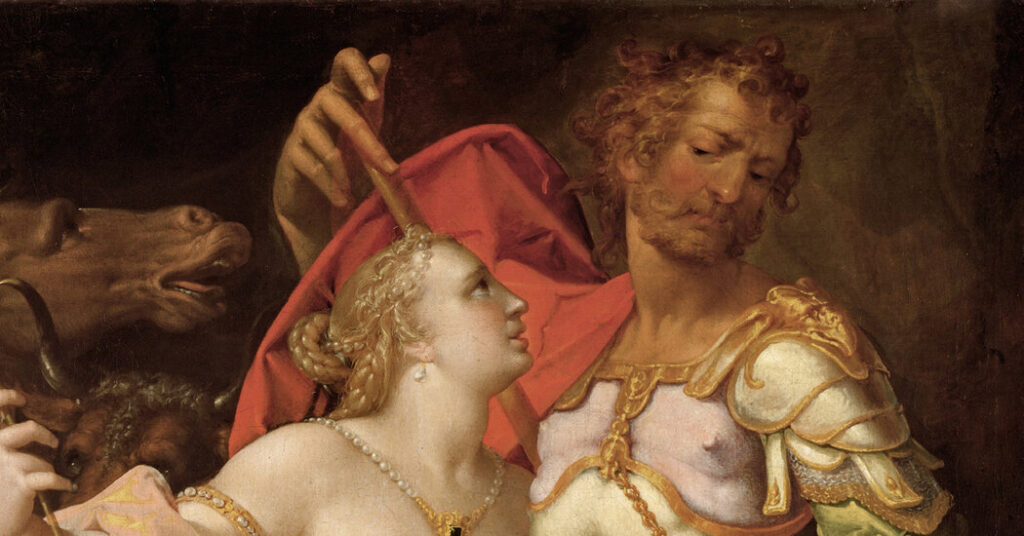
In Homer, Odysseus sails to Aeaea, the island home of the enchanting sorceress Circe, “the nymph with the lovely braids.” (I named my kitten after that Circe.) When Circe drugs Odysseus’s crew and taps the men with her wand, turning them into swine, it’s witchy foreplay.
The messenger god, Hermes, also a trickster, comes down from Olympus to give Odysseus an antidote for when Circe tries to use her magic on him. Hermes also advises Odysseus: “Don’t refuse the goddess’s bed,” because that’s really what Circe wants in return for turning the swine back to men. Under no spell, Odysseus says, “I mounted Circe’s gorgeous bed.” He was so smitten with “the lustrous goddess,” who doted on him with “sides of meat and drafts of heady wine,” he didn’t leave for a year — despite pleas from his homesick men.
Nolan’s Circe, played by Samantha Morton, is like a vindictive feminist hippie making ceramic pots in Vermont, except she’s sculpting pigs. Her romance with Odysseus is scrubbed.
In Homer, Odysseus lands on the island of another luminous goddess, Calypso, and stays seven years. He’s imprisoned, but at the beginning at least, he enjoyed himself, even as Penelope was fending off her boorish suitors back home.
Nolan whitewashes Odysseus’s infidelity here by turning Calypso — played by Charlize Theron — into a fashionable beach therapist who gives him mood-altering lotus flowers to help with his PTSD. In Homer, Odysseus has no need to forget. He cries once over the human cost of the war when he hears a song about Troy’s fall, but mostly he’s proud of his war exploits. And the “scalawag,” as Calypso calls him, doesn’t partake in the lotus; his men become addicted lotus-eaters on a different island.
In the movie, Calypso graciously lets Odysseus go when he comes out of his lotus fog and insists on returning home. In the book, Athena has to ask Zeus to intervene to make Calypso give up her sex slave, and she complains that there’s a double standard, because the male gods have affairs with mortals but interfere when the female gods are similarly romping.
Penelope, a mortal, is expected to be faithful, no matter that Odysseus’s sexual liaisons have added eight years to his 10-year voyage home.
When Homer’s Odysseus finally gets home, there’s a charged scene where he is outraged to see that the marital bed he built, crafted out of an olive tree that grew inside the palace, has been moved. It’s a test by Penelope. Nolan dispensed with that, too.
The director also sanitized Odysseus’s character by skipping the scene near the end when the hero orders his son to round up the 12 female servants who slept with suitors and hack them to death with a sword. Telemachus persuades his father that the women should be hanged instead.
Nolan’s IMAX Odysseus gives up the crown for his son and goes into exile with Penelope to redeem his actions during the war. Homer’s hero? No way!
Homer did not portray a world turning against violence. He limned a profoundly martial universe — interspersed with lots of magic and sex and cavorting, conniving immortals. If you smooth it out and modernize it too much, you lose what made it so important to begin with. And you’re just left with a guy finding his way home.
The Times is committed to publishing a diversity of letters to the editor. We’d like to hear what you think about this or any of our articles. Here are some tips. And here’s our email: [email protected].
Follow the New York Times Opinion section on Facebook, Instagram, TikTok, Bluesky, WhatsApp and Threads.
The post Nolan’s Zero-Eros ‘Odyssey’ appeared first on New York Times.