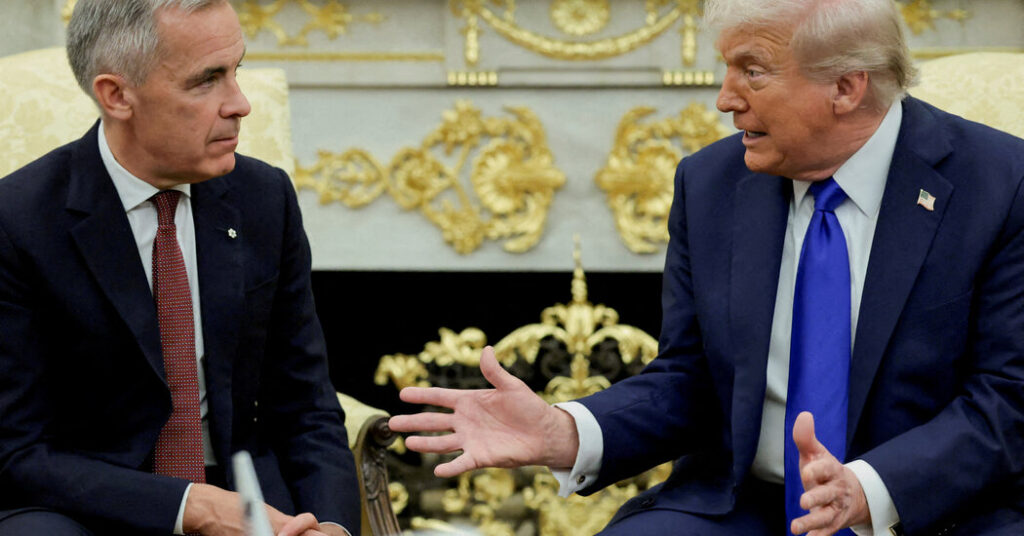
This week President Trump signed an order imposing 50 percent tariffs on a wide array of Canadian exports in retaliation for Canada’s retaliation on his earlier tariffs, and some Canadian premiers were soon urging even more revenge.
[Read: Trump to Impose 50% Tariff on Many Canadian Goods]
[Read: Trump Is Squeezing Canada. Don’t Expect Carney to Roll Over.]
Doug Ford, Ontario’s premier, called on Ottawa to block or limit exports of potash, important minerals and energy, including oil and electricity. All of those items, which are among Canada’s largest exports, are excluded from the new tariffs taking effect on Aug. 19.
“They need to feel the pain,” Mr. Ford said.
The tariffs dominated talk at the premiers’ annual summer meeting this week in Charlottetown. Susan Holt, the premier of New Brunswick, home to a large oil refinery that provides the Boston area with much of its gasoline, also raised the possibility of striking back with energy restrictions.
“We put gas in their cars, we put jet fuel in their fighter jets, and we heat and cool their homes,” Mr. Holt said. “So we know that we have those kinds of tools at our disposal.”
And business leaders and other politicians across the country are pushing for more tariffs on imports from the United States, like the 25 percent one Canada put on cars after Mr. Trump imposed one on Canadian-made cars.
After meeting with the premiers, Prime Minister Mark Carney wouldn’t exclude retaliation from the government’s list of possible responses.
(I’ve written a guide to the latest round of tariffs: What to Know About Trump’s Tariffs on Canada, and What’s Next.)
[Read: New Tariffs as Old Ones Expire: The Latest on Trump’s Trade War]
While more retaliation may be popular among many Canadians, it’s not an idea widely endorsed by economists.
“I understand the frustration,” said Daniel Trefler, an economic analyst with the Rotman School of Business at the University of Toronto. “But the first important thing about retaliation is that for every dollar of harm to the U.S. — by harm I mean lower wages, lower G.D.P. — we take about $4 of harm when we retaliate.”
The harm to Canada, he said, comes mainly in the form of higher prices. Small manufacturers, for example, generally cannot shift even most of their steel purchases to Canadian mills because the steel makers are oriented toward large buyers like automakers. The result is that the tariff-inflated prices manufacturers pay for steel imported from the United States are compounded several times before products finally reach consumers.
But Professor Telfer said that retaliation by Canada is also undermined by several political realities.
“Our economy is much more exposed to the U.S. than the U.S. economy is exposed to us,” he said. “So it’s much easier for them to hurt us than for us to hurt them.”
He agrees that restricting the supply of energy and potash or greatly boosting their prices to American buyers could be an effective weapon, but he quickly added: “Politically, it’s a nonstarter.”
At the premiers’ meeting, both Danielle Smith, the premier of oil-rich Alberta, and Scott Moe, her counterpart in Saskatchewan, which is laden with potash, flatly rejected the idea.
“You’re asking them to bear the brunt of this policy, I just don’t see it working,” he told me.
Worse, he said, the use of those resources or electricity from Quebec as a pressure tactic would likely feed separatist sentiments in both regions.
So what should Mr. Carney do? Professor Telfer recommends patience.
The regulation of international trade constitutionally falls to Congress, not the president, in the United States. Mr. Trump has taken trade powers Congress has granted to presidents far beyond how they were intended to be used.
If, as may be likely, the Democrats take back control of the House of Representatives in the midterm elections in November, Professor Telfer anticipates that Congress will move quickly to rein in Mr. Trump on trade.
“So let’s play the waiting game,” he said. “So just stay calm, everybody, and think what’s in Canada’s best interest, and take anger out of the equation.”
Ian Austen reports on Canada for The Times. A Windsor, Ontario, native now based in Ottawa, he has reported on the country for two decades. He can be reached at [email protected].
What it’s like to cover Ontario’s wildfires
Wildfires have razed millions of forest acres in northwestern Ontario this month, uprooted remote communities and polluted the air as far away as Washington.
Late last week, the photographer Cole Burston and I flew two hours north of Toronto, where we are based, to Thunder Bay, Ontario, the city nearest the fires, to report on the evacuations and firefighting effort.
We drove hundreds of miles around the region that is especially popular with wilderness outfitters from the United States for pristine lakes, backcountry canoeing and endless boreal forest. Canada’s natural beauty is breathtaking in the north — not just the sights, but the smells. Four days after we arrived, the acrid wildfire smoke had cleared significantly and a fragrant, tea-like aroma wafted from the pine trees around the fire hall in a rural community called Nolalu.
The scent lured me out of the open garage door and I waved over Val Warner, the first response coordinator on the fire team comprised entirely of volunteers, to ask, “What is that smell?”
“Fresh air,” Ms. Warner responded, not missing a beat and clearly amused, as was I, with her jab at city folk. (In true Canadian fashion, she immediately apologized, though she had nothing to be sorry about.)
Her lighthearted joke played into a running theme of our reporting in the north: the rural-urban divide. Those fissures deepened during the wildfire evacuations as residents blamed politicians in Toronto for ignoring the needs of northerners, and for endangering them by providing spotty communication about the fires. Some evacuees described feeling left to fend for themselves, and a group of First Nations leaders are now calling for a public inquiry into the government’s response.
[Read: ‘Help Never Came.’ Canadian Wildfire Evacuees Want to Know Why.]
Evacuees recounted the harrowing details of their escape. In Namaygoosisagagun First Nation, about 155 miles north of Thunder Bay but inaccessible by car, residents leaped into small fishing boats and fled across the lake as a fire came, seemingly out of nowhere, to their doorstep.
[Read: Evacuees of Ontario’s Wildfires Wait and Worry]
Many of the people I spoke to demanded accountability, which is an important function of journalism and why institutions like The New York Times send reporters to disaster scenes. But a challenge of covering wildfires in Canada is the lack of access to the front lines. Ontario’s Ministry of Natural Resources, the provincial department responsible for forest management, denied our request to photograph the wildfire response. The ministry also would not allow us to visit the fire crews staging at camps located a major distance from the blazes.
Ontario’s position is not an outlier. Photographers have largely been barred from documenting the work of firefighters across the country, including by the governments of British Columbia and Alberta. The Globe and Mail, Canada’s national newspaper, put it aptly in a 2024 column by its editorial board: “Where there’s smoke, there’s a smoke screen.”
The policy to broadly deny these requests from journalists, barring safety risks, is different from some jurisdictions in the United States like California where the law protects such access for journalists.
Around Thunder Bay, road blockades warned of fines and tickets by the police. Some residents we spoke to defied the orders, but didn’t want to run the risk of having reporters in their vehicles.
After closely studying maps and driving for hours along bumpy dirt paths, Cole and I managed to document some of the aftermath in areas where road access was not restricted, and where the fire had long been gone.
Eventually, our luck ran out. A conservation officer approached Cole when he was parked to file his pictures. Though the main highway wasn’t blocked, the officer still warned him to leave.
More on the wildfires and smoke
President Trump threatened to impose tariffs on Canada because the smoke spewed across many cities in the United States. On a visit to Thunder Bay, Premier Ford responded that Americans should be supporting Canada during a wildfire crisis, not punishing the country.
The smoke set poor air quality records for many towns and cities in Canada and the United States, an analysis shows. And for firefighters, enduring high temperatures make it even more difficult to control and extinguish blazes.
My colleague Norimitsu Onishi explained why many of Canada’s wildfires are impossible to put out.
Dave Wallace-Wells, an Opinion writer at The Times, argues that society must adapt to smoky seasons as “nothing can prevent the new wildfires.”
Vjosa Isai is a Toronto-based reporter for The Times covering Canada.
Trans Canada
-
Norimitsu, our Montreal correspondent, and the photographer Renaud Philippe, traveled to Nunavut and reported on Jacinto Marques, who left Angola for Canada’s Arctic. Now he’s running a bus service in Iqaluit, and a road to nowhere has a new stop.
-
Ian Austen reported on the Gordie Howe International Bridge, which finally opened on Friday after a delay ordered by President Trump and new tariffs against Canada. But Americans were disinvited from the ceremony.
-
Jacob Tsimerman, a professor of mathematics at the University of Toronto, won one of four Fields Medals, an award for top mathematicians under 40, for his work on the André-Oort conjecture.
-
For over a decade, something strange has been happening in a lake straddling the border of Quebec and Vermont. Lake Memphremagog is home to brown bullhead catfish, and anglers began noticing that some were covered in velvety black growths.
-
A large investment firm and a Canadian uranium mining and enrichment company made a big bet three years ago on nuclear power. Now, that wager is proving prescient.
-
World Cup winners and losers off the field: Host cities, hotels, tourism boards and more had lofty expectations for the 39-day tournament. Some struck gold but others fizzled. See how Toronto and Vancouver fared.
-
From Opinion: Iran, China, Canada? A defense of Trump’s grand strategy.
How are we doing? We’re eager to have your thoughts about this newsletter and events in Canada in general. Please send them to [email protected].
Like this email? Forward it to your friends, and let them know they can sign up here.
The post As Trump Escalates Trade War, Some Canadian Premiers Want to Hit Back appeared first on New York Times.