The world’s most popular podcaster, Joe Rogan, reached out privately in April to the world’s most powerful man, Donald Trump, to discuss the healing power of ibogaine, a psychedelic made from the root bark of a Central African shrub that researchers are studying as a treatment for addiction and trauma. Trump responded by text, “‘Sounds great. Do you want FDA approval? Let’s do it,’” Rogan announced weeks later, when he stood behind the president in the Oval Office for the signing of an executive order on psychedelic therapies. “It was literally that quick.”
But it wasn’t that simple. After hearing from Rogan, the president told his team at the Department of Health and Human Services to change the policy, and the team sent a draft executive order to the White House Domestic Policy Council. That’s when things got messy. In the days that followed, Rogan’s allies engaged in battle with a mid-level White House health adviser, Dr. Heidi Overton. As a deputy assistant to the president who focuses on health policy, Overton ran a process to revise the draft in coordination with other stakeholders, including the Departments of Justice and Veterans Affairs.
Members of the “Make America Healthy Again” movement were furious, convinced that Overton, not for the first time, had undermined Trump’s own desires. The friction, which has not been previously reported, became so intense that Rogan and W. Bryan Hubbard, the CEO of Americans for Ibogaine, a nonprofit that champions the drug’s therapeutic benefits, threatened to pull out of the signing ceremony if they did not have a say in Overton’s final edits, according to three people familiar with the events.
Overton’s efforts on the Domestic Policy Council shrank the roughly 1,400-word HHS draft to about 900 words by the time Trump signed his name. Entire sections were removed, including those calling for a psychedelic-therapy czar and treatment-funding reforms, according to a draft we reviewed. A $250 million research fund became a $50 million partnership with states. In the end, the document accelerated review for some drugs and pushed the government to reschedule psychedelic substances that perform well in large clinical trials, enough to persuade Rogan and Hubbard to show for the signing.
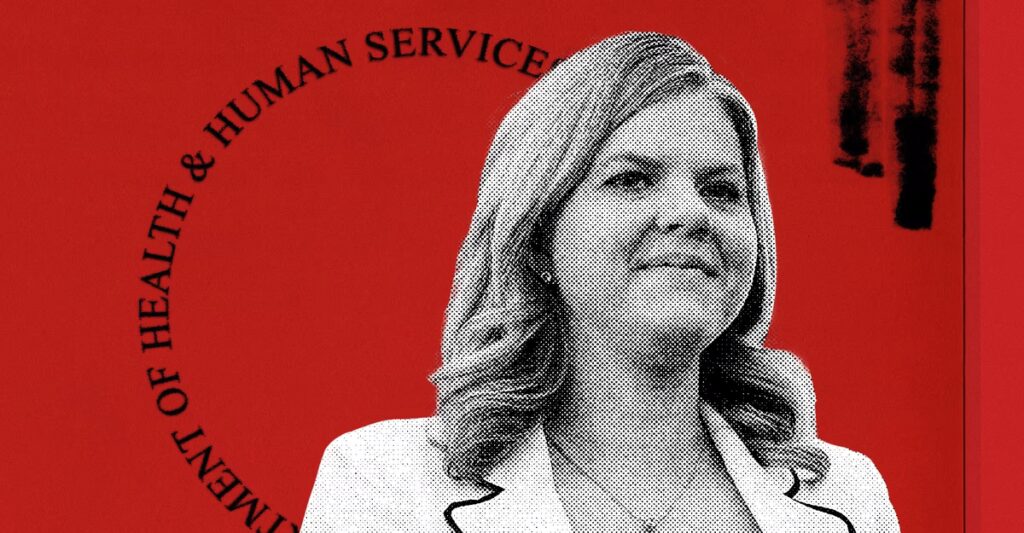
Overton is one of the most powerful public-health officials in Trump’s orbit who has little public profile. Her job, as a senior health-policy official on the White House Domestic Policy Council, is to convert the president’s priorities into the scope and language of documents that will advance the White House’s agenda. But Overton’s detractors describe her as one of the biggest obstacles to MAHA actually realizing its priorities—“the controlled opposition,” one person who has worked with her told us. They accuse her of slow-walking marijuana rescheduling, trying to limit MAHA changes to federal nutrition guidelines, and delaying or weakening several other initiatives. “As an unelected bureaucrat, Heidi Overton sought to use her pen to override the intended exercise of presidential power,” one person outside of government who was familiar with the psychedelic-executive-order process told us. “It was a derogation of representative democracy.”
Leaders of the West Wing and HHS, by contrast, say the 37-year-old physician represents democracy at work. They have rushed to her defense, describing her as a star scientific wonk with a medical degree and a doctorate in clinical investigation who knows how to balance competing interests to achieve Trump’s goals. “The president adores her,” White House Press Secretary Karoline Leavitt told us. Since the start of Trump’s second term, the White House has trusted Overton to coordinate nearly all of its major health policies, including MAHA priorities such as revisions to childhood-vaccine recommendations and the redesign of the food pyramid.
“In President Trump’s administration, the Domestic Policy Council is the White House office that is and should be depended on to make sure things are correct, legally durable, done with policy consistency, and, in this case, medically sound,” White House Chief of Staff Susie Wiles told us. “Any suggestion that Heidi Overton or the Domestic Policy Council is slowing things down is being made by an uninformed person. Things move at a light speed in this administration.” The White House has been sufficiently impressed by Overton’s work that she has been named as one of three finalists to become the next Food and Drug Administration commissioner, a promotion that would give her direct power over the pharmaceutical industry, medical devices, tobacco products, and most of the nation’s food.
The fight over Overton’s role in the first 18 months of Trump’s second term is certain to become more public if she faces Senate confirmation later this year. It has already revealed a growing rift between the White House and a group of MAHA policy makers over the pace and limits of reforming federal health policy.
[Read: Why is Robert F. Kennedy Jr. so convinced he’s right?]
Sky-high expectations for radical change at the start of the administration yielded some dramatic shifts on vaccine recommendations, nutrition guidelines, pharmaceutical regulation, and agricultural policy. But the team that Health and Human Services Secretary Robert F. Kennedy Jr. built has faced pushback on pesticide regulation and other areas where they sought to disrupt decades of federal policy making. Overton, as the traffic cop of health policy at the White House, has found herself at the center of those fights. This story is based on interviews with 17 people with direct knowledge of Overton’s work. Nearly all of them requested anonymity because they are not authorized to speak publicly or feared retribution from the White House if they publicly criticized her. Overton declined to comment for this story.
Kennedy, the founder and public face of the Make America Healthy Again movement, who has from the start of the administration found himself limited by the interagency process that Overton runs, is nevertheless one of her most vocal defenders. At the signing ceremony for the psychedelics executive order, he thanked Overton while acknowledging the behind-closed- doors fights that had taken place. “It was often frustrating but always right,” he said of her advice. “She brings exceptional dedication, meticulous attention to detail, and strategic leadership to every policy she touches, turning our vision into meaningful results for the American people,” Kennedy told us in a statement.
But supporters of Kennedy’s MAHA ambitions say that he has been frustrated at times with the limits that Overton and the White House have put on him. “Time after time her views were to dig in and resist the president’s agenda until his friends called him directly and overrode her,” another person familiar with her work told us, pointing to issues such as psychedelic treatments for veterans and marijuana rescheduling.
At the HHS headquarters building last year, a joke began circulating about all of the policies that Kennedy advisers believed Overton was holding up, according to three sources: Policy proposals that go to the White House fall into what they call the “Overton window” of inaction—a play on the social-science term named after an unrelated researcher that describes the range of acceptable change in a political system.
Overton began working for Trump in 2019 while completing a surgical residency at Johns Hopkins University, where she became an ally of the last FDA commissioner, Marty Makary. She joined the White House at a time of crisis, serving on the front lines of the nation’s COVID response. Allies say that the experience left her skeptical of the established public-health infrastructure, pushing her to finish her doctorate in clinical investigation at Hopkins and perhaps making her receptive to the reforms called for by the MAHA movement. After Trump’s defeat in 2020, she joined Brooke Rollins, her former boss at the White House Domestic Policy Council, at America First Policy Institute, a think tank that doubled as a Cabinet-in-waiting for a second Trump term.
Rollins became agriculture secretary when Trump returned to the White House. Overton helped Kennedy put together his team for HHS, people involved told us. She supported Trump’s embrace of the MAHA agenda, people who interacted with her at the time told us. Top Trump advisers trusted her to support the cause while running the scientific traps, keeping an eye on the political risks, and managing the contentious inter-department fights that Kennedy’s proposals would inevitably create.
One of Kennedy’s first major MAHA drives was to replace what he called the “unreadable” scientific groundwork by the Biden administration to revise federal nutrition guidelines. He launched a new push for “gold standard science,” prompting a monthslong rush to develop new evidence reviews to back up the guidelines that Kennedy wanted to issue. Those effectively flipped the 1990s USDA “food pyramid” to prioritize the consumption of proteins, healthy fats, and fibrous vegetables—what Kennedy considers real food—over refined grains and ultra-processed foods. Rollins, at USDA, and Kennedy, at HHS, made a show of working closely together. But behind the scenes, their departments engaged in sometimes acrimonious battle, and Overton was in the center, mediating the back-and-forth.
HHS officials became convinced that Overton was siding with USDA. Wary of a legal deadline to produce the new recommendations, she chafed at Kennedy’s idea of throwing out all of the Biden administration’s work. She wanted to keep the parts that the Trump administration had no qualms about, such as research done on saturated fats. And some HHS officials viewed her as sympathetic to USDA concerns about a lack of consultation with the new scientific advisory panel that HHS had appointed, two people said.
“At one point, her recommendation was Can we just use the old science?” one person involved in the process told us. “Long story short, she did everything she could to prevent the real-food thing from being a success.” HHS officials became so concerned that Overton was favoring USDA and undermining their efforts that they created a binder, documenting every communication among her and USDA officials in a bid to better counter her arguments, according to two people familiar with the effort.
Overton’s allies say that to suggest that she did not want a major remake of nutrition guidelines is just wrong. They point to the end result as evidence. Overton also subsequently led the policy process that resulted in USDA committing $700 million to a regenerative-farming program, championed by Kennedy, that seeks to avoid heavy dependence on chemical fertilizer and pesticides. She also helped write the first MAHA executive order last February, which reframed the government’s health priorities around countering chronic diseases, reversing declining life expectancy, and reducing supposed overreliance on medication.
But other changes came more slowly, to the frustration of MAHA advocates. Recently, Overton has been involved in drafting new policies for the use of peptides, short chains of amino acids that are available on the gray market but that, in many cases, have scant scientific evidence to support their safety or efficacy. An FDA advisory board is meeting this week to consider whether to recommend easing regulations on seven popular peptides, allowing them to be made by compounding pharmacies, which prepare custom medications that in many cases aren’t available from traditional pharmacies.
MAHA advocates support greater peptide availability, often portraying them as preferable to conventional pharmaceuticals. Kennedy himself has acknowledged using peptides. Overton, however, is viewed by some as wary of the lack of scientific research into some of the compounds. For her supporters, this is proof that she is doing her job. For her opponents, it is evidence that she is a bureaucratic institutionalist representing the kind of inaction that MAHA had hoped to break. “Heidi is a skeptic of anything that is not pharma, and that would include peptides,” a person familiar with the matter told us.
Overton was also in the middle of a fierce internal debate over marijuana regulation. Trump made a 2024 campaign promise to reclassify the drug from Schedule I (a criminal designation that highlights abuse potential for substances without medical value) to Schedule III (lower abuse risk and an allowance for medical prescription and study.) Law-enforcement agencies and conservatives were wary of marijuana’s harms, and the Trump administration stalled on the initiative for almost all of last year.
Marijuana entrepreneurs and one of the president’s wealthy friends, Howard Kessler, eventually triumphed with direct appeals to the president, creating a playbook that Rogan followed in his outreach on loosening the regulation of psychedelics. Those direct appeals were designed, to some degree, to bypass the interagency process, people familiar with the matter told us. Once Trump decided to move, he relied on Overton to make the change happen. “I’ve never been inundated by so many people as I have about this particular reclassification,” Trump said at a December signing of an executive order that finally directed the marijuana-classification change. Kessler developed a direct relationship with Overton during the process and has since been working with her on other health issues.
In late December, Trump pushed for another MAHA health initiative to be codified in short order, calling for a new childhood-vaccination schedule to be in place by the end of the year. Once again, Overton was in the middle of wrangling between the White House and HHS. She and department officials created an initial draft, but HHS lawyers initially rejected the proposal as lacking enough scientific backing and therefore vulnerable to legal challenge. At a meeting that month in the Eisenhower Executive Office Building, next to the White House, Overton dressed down HHS officials for not presenting a document that would pass legal review, according to a person who attended. “I think she felt blindsided,” the person said.
HHS staff worked through Christmas and New Year’s to footnote the document, recruiting Martin Kulldorff, a former Harvard biostatistician who now works in Kennedy’s office, to help. The new rules were introduced in January. A federal judge blocked them in March, ruling that the agency had not done a proper scientific review even after the later revisions.
Kennedy suggested last year that Overton take the job overseeing the Centers for Disease Control and Prevention in Atlanta, an offer that she declined, according to two people familiar with the situation. But in recent weeks, Overton has made clear that she is open to running the FDA, a larger and more powerful agency. White House officials are also considering two others: Jeff Vacirca, a cancer physician serving as the CEO and chairman of the board of New York Cancer & Blood Specialists, and the senior Pentagon health official Stephen Ferrara. A decision is expected soon.
Trump’s psychedelic order came together in weeks. Shortly after Rogan reached out to Trump, they saw each other at an Ultimate Fighting Championship event in Miami. “He came to me and said, It’s done. We’re going to take care of it. It’s a good thing for the soldiers. It’s a good thing for everybody,” Rogan later recounted on his podcast.
[Read: How to have a ‘don’t-know mind’]
Some in the White House were caught off guard and questioned the wisdom of unleashing psychedelic mental-health treatments that had not yet been studied like other approved pharmaceuticals. Officials at the Department of Veterans Affairs were concerned about patients suddenly demanding treatments that the department was not ready to provide. Overton once again stepped in. “She wanted to make sure it was being done the right way,” Chris Klomp, a senior adviser to Kennedy, told us. “What I observed with the psychedelics is that Heidi ran a process to try to align all these different pieces.”
But Klomp said that he was not surprised that the process ended with some people unhappy. “The Domestic Policy Council is in no small part a quarterback aligning all those different parties,” Klomp said. “If you don’t understand that process, you can at times feel pretty frustrated.”
MAHA activists, who view Trump’s presidency and Kennedy as a rare opportunity for major change, see Overton’s more cautious, deliberate approach as anathema. Overton’s allies say that this is a misreading of her role, which is to build consensus and deliver a lasting outcome. Now, as Trump considers moving her to a much larger position, the debate may soon find a wider audience.
The post The White House’s MAHA Gatekeeper appeared first on The Atlantic.