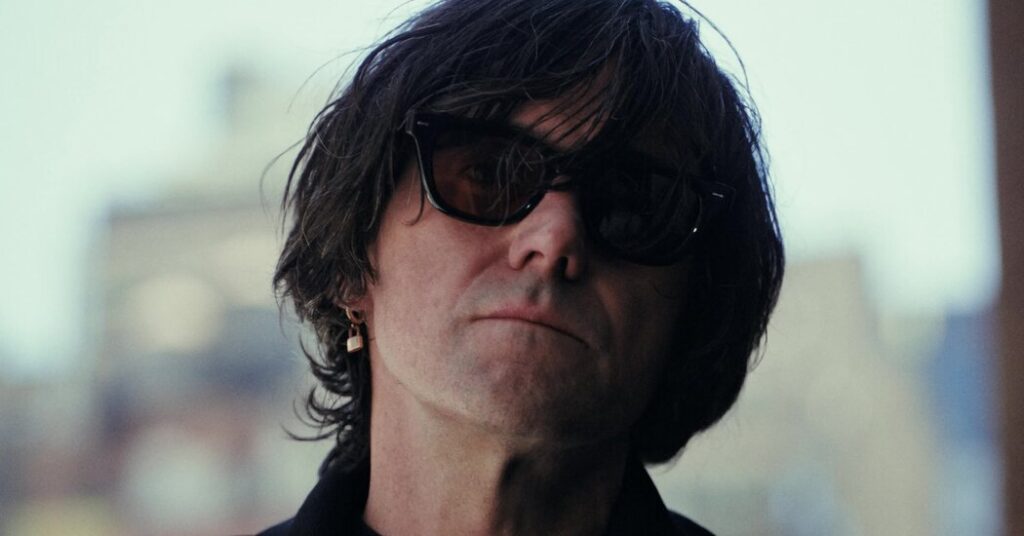
Conor Oberst may not fit the industry archetype for a former child star, a la Michael Jackson, Britney Spears or Justin Bieber. Yet since he was 12 years old, people have built businesses around Oberst’s homemade, shaky-voiced folk songs, making him the reluctant, adolescent poster boy for 2000s indie rock and then a potential cautionary tale about the burden of such pressures.
“Definitely everything that was ever written about me or our bands, forever, started with ‘wunderkind’ or some reference to how young I was, because I was very young,” Oberst, now 46, told Popcast, The New York Times culture chat show, in a recent interview.
As the frontman and creative foundation of Bright Eyes and other groups, he anchored the D.I.Y. independent music scene in Omaha that made Saddle Creek Records an international concern. His prolific musical output (and the label) influenced generations of disaffected, diaristic songwriters across genres — emo, punk, Americana — along the way.
But after more than three decades as an itinerant, hard-living — though bashful — rock star, Oberst is now reckoning with a legacy that he previously preferred not to confront, and nearly opted out of entirely. In 2024, his struggles with substance abuse and mental health challenges nearly killed him, Oberst said. Instead — forged by a career in which his every open wound, psychic or otherwise, was inspected and speculated over by obsessive fans and detractors alike — he emerged with a clarity of purpose that has allowed him to get back to work.
Reinvigorated after grappling with his health problems and public pillorying, Oberst called the weeks he spent recently writing and recording new music outside of Paris “magical.” And he successfully (save for some weather) brought Bright Eyes on the road for a small tour celebrating the 21st anniversary of his dueling 2005 albums, “I’m Wide Awake, It’s Morning” and “Digital Ash in a Digital Urn.”
In conversation with Popcast’s Jon Caramanica and Joe Coscarelli, Oberst spoke in-depth about the pressures of having been an unconventional kind of niche icon; recovering his will to live; and how the combination of aging and American turmoil have made him question whether he’s still meant to make the sort of agitpunk he once thrilled to.
These are edited excerpts from the conversation, which can be watched here or listened to below.
COSCARELLI You’ve been in the folk tradition, you’ve worked in the protest song tradition. I wonder how your attitude toward those types of songwriting have differed under President Trump versus, at the time, under George W. Bush, when you wrote “When The President Talks to God,” one of your best-known songs.
OBERST You know, it’s really hard for me to even articulate the Trump era. Maybe at some point I’ll be able to do it. It’s like, you can’t satirize what’s already a parody. It’s already a disgusting, gross cartoon.
I guess the bar has been lowered to such a degree, societally and in every aspect of our lives. Look at who the president is: He’s a con man, has done nothing but rob the country — literally, him and his family, his businesses, robbing this country in front of our eyes. I’m sure it permeates everything I write, but to write directly toward, I found it almost impossible.
CARAMANICA You’ve tried?
OBERST I mean, I’ve thought about it and I’ve had plenty of people be like, where’s the new “When the President Talks to God”? I don’t know. It’s such an avalanche of insanity.
COSCARELLI Do you think that accounts for the lack of protest music in this moment overall?
OBERST I think people are scared. I think they’ve gone out of their way to try to intimidate all of us. It’s right before your eyes, you know? So it’s almost like, I don’t gotta tell you about it. Just, like, look at it.
COSCARELLI I felt a similar sort of disdain and befuddlement from you in the early 2000s. Is there something about youth where you were more eager to tackle these un-tackleable things, whether it was the war in Iraq or Clear Channel and the monopolies around live music and radio, animal rights or the other issues you’ve spoken out about throughout your career?
OBERST There’s that. I think it’s also just life — there’s peaks and valleys and sometimes I have more internal reservoir of energy I can give. And then I’ve had periods of my life where I just feel very just empty and I can’t even really keep my own [expletive] together, so it’s hard to be able to create, even though I want to.
CARAMANICA Do you feel like those stretches of time that Joe’s referring to, you had yourself together more on a personal level?
OBERST I don’t know. [Laughs.]
COSCARELLI That was a loaded laugh.
OBERST You know, it’s always like a rodeo. I guess my point is I’m 46 years old and I’ve been doing this since I was like — more than three decades. There’s been a lot of ups and downs.
COSCARELLI You’re alluding to this but you’ve had a lot of health issues. In recent years, you were at the Mayo Clinic for cysts on your brain, you had vocal issues, you’ve referred to eating disorders, struggles with sobriety. How much of that do you put on the troubadour lifestyle that you’ve lived since you were a teenager versus something more internal, whether biological or emotional?
OBERST There’s addiction and mental illness on both sides of my family for a long time, so there’s certainly that. But yeah, just being on tour and just doing this for my entire life, basically.
COSCARELLI You’re in this moment of celebration. People are experiencing the nostalgia of revisiting these records and seeing you seem happy and healthy and bright. It wasn’t that a couple of years ago. In 2024, you canceled a bunch of tour dates after what you called a “near-death experience.” Can you talk a little bit about what it was like to hit — I don’t know if you call it a “rock bottom” for yourself, but what it was like to know that you needed to regroup and what allowed you to bounce back in this way?
OBERST Yeah, I didn’t like, see the light or anything like that. But, you know, it got — it was very real. I didn’t really feel happy or sad or anything. I actually had the meanest internal voice being like, “Haven’t you wanted this your whole life, you [expletive] son of a bitch?” when I was fading out — it’s not very, um, angels and stuff, you know? When I feel like I was really close to the edge, there was nothing good about it.
When I luckily got through that and had a choice to make — like, OK, I could keep doing what I’m doing and probably be dead really fast, or I could change up my style and try to stay around and make more things. People need me around, my family needs me around, friends. It’s one of those things — I think people find different reasons to live for. It’s been a long life.
CARAMANICA What are the things you were doing to hurry that along — we’re talking drugs and alcohol at that point?
OBERST Yeah, a lot of that. My body was just unable to deal with all this stuff.
COSCARELLI How immediately were you able to flip that switch when you made the decision, I want to be here?
OBERST We were supposed to play at Tompkins Square Park, it was the day before our record [Bright Eyes’s 2024 album “Five Dice, All Threes”] was coming out. Early that morning is when I went to the hospital. I got home and we were doing some shows around the record and then we were going to go on the real long tour in 2025. There were conversations, obviously, with everyone — do you need more time, blah, blah, blah? And I was like, I want it. I want to go. I need something to motivate and focus on. So that’s what we did. That was in September and then we played again in January.
COSCARELLI And in that stretch, that winter, you were able to get yourself right?
OBERST Yeah, I mean, you know, um. [Laughs.] There was a lot of people that didn’t think we could do it. And I’m really proud of all the shows we played that year, I think the band was smoking. You get a reputation.
CARAMANICA You feel like you have a reputation?
OBERST Whatever, I mean, everyone remembers the show you walked out on, but they don’t remember the thousand shows that you played great.
COSCARELLI We do this to so many of our legends — often female artists. I think of Lauryn Hill, Fiona Apple, Cat Power — these people who are essentially dared to screw up because people are waiting for them to lose it onstage. We love their fragility in music and then maybe we are less accepting of it in a human being. Do you feel kinship with those artists?
OBERST Absolutely. It’s a lonely place to be when you feel like everything is counting on you, but whatever your state of mind or your physical state is just not in a good place. So it’s compounded shame and letting everyone down and losing money. People have it worse than me in that regard. My star is low in the sky, you know?
COSCARELLI Basically everyone you know has been through music in some way or another. Presumably you’ve written songs about many of them — family, friends, loved ones, romantic relationships — but then because they’re also artists, they write songs about you. What has it been like to be a muse for others, whether it’s Phoebe Bridgers or Maria Taylor of Azure Ray?
OBERST: I think that’s part of the deal. If you’re hanging out with songwriters, you know, you’re kind of fair game. I mean, I definitely take little observations or little things out of my life that people who hear it will know what I’m talking about — little inside jokes, basically.
CARAMANICA There’s no presumption of privacy if your entire social circle consists of people who — and I say this not derogatorily at all — violate personal intimacies for a living. Does it change the nature of how you interact with your friends who are creative, or the things that you withhold?
OBERST I don’t worry about it too much. I mean no one wants to hear a mean song about them. Thankfully, that’s never happened. [Laughs.]
CARAMANICA You’ve also been on the receiving end of some tough things over the course of your career from people who did not know you personally, but were speaking like they did. You had a false rape accusation leveled against you. Are those moments where it’s hard for you to maintain the distance between the public avatar of yourself versus Conor, the individual? Does that force you to be like, actually, I’ve got to show up and speak for myself?
OBERST Yeah, that whole thing was just nightmarish, surreal.
COSCARELLI For those who don’t know, that was a false rape accusation that stemmed from a comment section on a website and then ballooned into something nuts and was eventually retracted by the individual.
OBERST Yeah, this person, I think, thought they were living in an imaginary place where they’re getting feedback from people on a comment section. And then our super-fandom web boards took it, and then all of a sudden it’s real to people. That absolutely took years off my life.
COSCARELLI Was that the beginning of this dark period?
OBERST It definitely sent me on a darker way down the path. Like, I’ve put myself, all this music into the world and I’ve lived this whole life, and the fact that something completely false on the internet can become a real thing, it’s like a weird monster, an invisible thing attacking you.
I’ve had to come to peace with just, no one’s gonna know you and you can’t know everybody. And the people that know you, that’s what matters.
When someone’s like, oh, I don’t like your record, it’s like, who cares? I’ve had the worst thing said about me, so there’s really nothing you could say to me. I’ve seen the horror of the mob, felt the stones hitting me, you know? I’m kind of like, impenetrable. I’m not scared of anybody.
Credits
Popcast is hosted by Jon Caramanica and Joe Coscarelli and produced by Sophie Erickson, Kate LoPresti and Felice Leon. This episode was filmed by Luke Piotrowski, Bernardo Garcia Elguezabal and Dave Mayers. It was edited by Eddie Costas with help from Rebecca Blandon. Our theme music is by Elisheba Ittoop. Nick Pitman is our audio engineer and Amanda Webster is our photo editor. Brooke Minters is our executive producer. Header video cinematography is by Diego Garcia.
Special thanks to Sarah Bonn, Dahlia Haddad, Mike Cordero, Nicole Huber, Aaron Byrd, Carl Mazurek, Zach Caldwell, Maddy Masiello, Brad Kimbrough, Andrew Wilcox, Sia Michel, Nina Lassam and Sam Dolnick.
The post How Conor Oberst Survived Teenage Rock Stardom appeared first on New York Times.