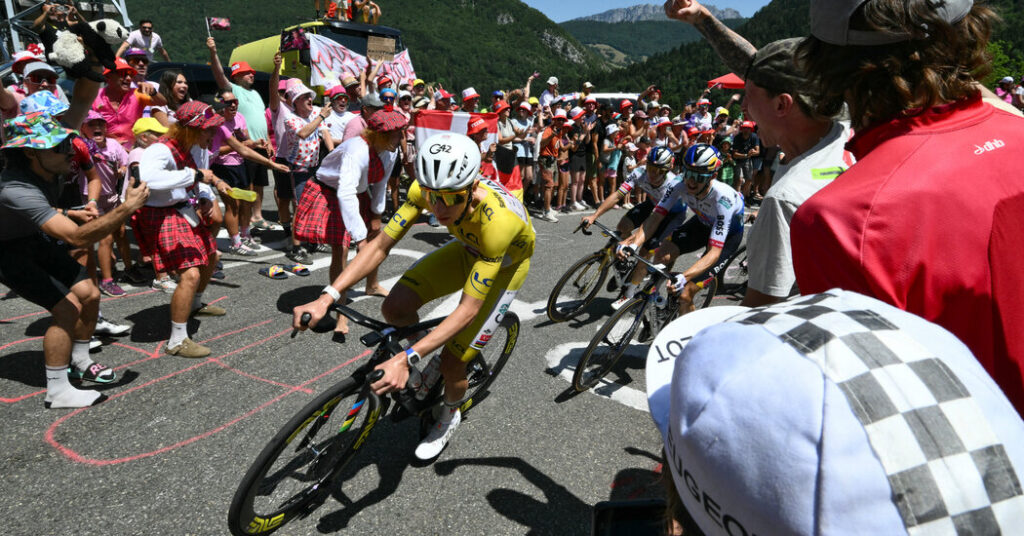
During a heat wave in mid-July, a throng of spectators lined the streets of Périgueux, a historic town in southwestern France, whooping and sweating a full two hours before the start of the eighth stage of the Tour de France. They had not come to catch a glimpse of the lead riders.
They had come to catch tiny packets of sausage.
Also, bags of chips. And samples of pasta, gummy bears, coffee and pairs of socks, as well as polka-dotted hats, oven mitts, tote bags, key chains, bandannas and cheese.
All of these and more are tossed, every day, by hype teams aboard a riotous convoy of vehicles known as La Caravane Publicitaire, the Publicity Caravan. The parade of 170 customized cars and floats precedes every stage of the Tour and stretches for about six miles. It’s a honking, jingle-playing, siren-blasting pileup of novelty rigs, most of them decked out with oversized fiberglass renderings of the product they are promoting — soda, candy, a slab of raw hamburger.
During the three weeks of the Tour, 18 million freebies will be hurled into crowds. People show up with wide fishing nets, hoping to improve their haul and throw the occasional elbow under this hail of swag.
“It’s ‘Lord of the Flies’ out here,” said Andrew Jones, who had come from Ireland on vacation with family. “I just saw two guys wrestling on the ground over a bucket hat.”
The delightfully garish production is a noisy cash machine for Amaury Sport Organization, the company that owns the Tour de France. A beloved tradition since 1930, the caravan is the madcap outer layer of a far more reserved company. A.S.O. is a privately held and family-run business based in Paris, and thoroughly resistant to change.
In recent decades, leagues and marquee events in virtually every sport have expanded in ways that have minted fortunes. The just-finished World Cup is expected to pull in $13 billion, double the sum of 2022’s tournament. It started with more teams and matches; interrupting games with “hydration breaks” that increased the number of television commercials; and enacting “dynamic pricing,” which sent ticket prices soaring.
The Amaurys — the matriarch, Marie-Odile, who is in her mid-80s, and her children, Jean-Etienne and Aurore — will have none of this.
Many have urged them to change their minds. Silicon Valley billionaires, European entrepreneurs and, most recently, Saudi Arabia’s Public Investment Fund have all approached the Amaurys with offers. Some wanted to buy all or part of the Tour for immense sums. Others, like the Saudis, wanted to make it the crown jewel of a new league, one that would tie together a bunch of races and produce a multi-month season, like football or soccer.
All of these supplicants were given the same answer. Non.
This unyielding approach has plenty of fans among France’s cultural preservationists. It also has more than a few critics, including cycling professionals who say the Amaurys are stunting the growth of the sport and, in the long term, could doom it to irrelevance.
The family doesn’t share any of the television rights revenue, reportedly worth more than $170 million a year. That starves the sport of capital that could expand the fan base and leaves cycling in a precarious spot. The huge cost of fielding teams has always been outsourced to wealthy benefactors, who routinely walk away after losing interest in what is basically an exercise in high-end branding.
The Amaurys won’t even discuss sharing the spoils, as Jonathan Vaughters, the chief executive of EF Pro Cycling, one of 23 teams on the Tour, learned a decade ago. He broached the subject to A.S.O. executives at a cocktail party.
“I didn’t even say, ‘You know, we would like a cut of what you are making right now.’ It was more like, ‘Hey, let’s figure out a way to make the pie bigger for everybody,’” he recalled. “And even then what I heard was: ‘No, we like the size of the pie, and we like our share. Listen, little boy, go in the corner and enjoy the snacks.’”
The Amaurys don’t share because they don’t have to. (They don’t have to talk to the press, either; they declined a request for an interview.) Their company has a monopolist’s hold on the sport, with a revenue engine unlike any other. About 300 cities apply each year to become a stop on the Tour — the 2,000-mile route changes annually — and chosen ones pay A.S.O. about $160,000 for the honor. Local authorities and the French government also help cover the cost of road closings and about 28,000 police officers and firefighters.
In return, the towns get what amounts to the greatest commercial in the history of tourism. Television coverage of the Tour amounts to hour after hour of riders pedaling through gorgeous landscape and postcard towns. It’s a highlight reel, broadcast in 190 countries, with one billion live viewing hours worldwide. For host cities collectively, the attention yields a windfall estimated at $900 million.
A.S.O. executives say Gallic boosterism is just part of what makes the Tour unique. Christian Prudhomme, the company’s general director, called the Tour a “national monument.” Using a translator, at the start of the 10th stage, in Aurillac, he said: “It is a time that brings people together and unites them. Children, older people, women, men, French people, foreigners, regardless of social class.”
The caravan was passing by, and he needed to raise his voice. People were clamoring for detergent samples lobbed from a float bearing a gigantic pair of blue pants.
At the Tour, profit and patrimony sit side by side.
Scrabbling for Dollars
The business model of the Tour gives new meaning to fantasy sports. Teams are funded by sponsors, at a cost ranging from $30 million to $60 million a year. The sponsors fall into three categories: very rich patrons (the British billionaire Jim Ratcliffe), corporations (the German supermarket chain Lidl) and countries looking for an image boost (the United Arab Emirates).
Sponsors pay for the eight riders each team fields; the average rider salary is about $440,000, though stars earn far more. Support staff number 30 people and up. Then there is the cost of food, which is often cooked by a chef in a mobile kitchen. In return, the sponsors get media exposure that has been estimated to be worth tens of millions of dollars.
The teams are separate companies, and they are perpetually scrabbling for money. The bulk comes from sponsors, but they are a fickle lot. Rich people develop other passions, corporations find other ways to spend marketing dollars. The race is free to watch, so there’s no ticket revenue for anyone. The teams earn modest sums selling branded gear.
What do they get from A.S.O.? About $63,000. That’s enough to cover gasoline for the bus.
“We are the actors in the movie and get nothing at the box office,” said Doug Ryder, general manager and founder of the Pinarello-Q36.5 Pro Cycling Team. “That doesn’t happen in any other sport.”
Those who are most irate about the Amaurys’ resistance to change note that since a brief uptick during Covid, the television audience for cycling has been headed in the wrong direction. In Europe, where the Tour is most popular, viewership figures this year are down 4 percent from recent years, according to Daam van Reeth, a professor of economics at KU Leuven in Belgium.
A.S.O. incurs costs, too, but a spokeswoman for the company would not discuss numbers. Its employees oversee television production, safety and security, and the elaborate logistics of setting up and tearing down both starting and finishing points. It puts up the prize money, which for first place is 500,000 euros, about $571,000. (When adjusted for inflation, that is less than the purse was 20 years ago.)
A.S.O. also pays for and assigns hotel rooms under the theory that richer teams should not gain an advantage by bunking in swishier quarters, French égalité in action.
The lodging choices caused plenty of grousing in mid-July during five consecutive days at or above 100 degrees. Many riders were bivouacked in rooms without air-conditioning. In the media zone in Aurillac, several cyclists said they had developed a strategy: Take a cold shower, then jump straight into bed and hope sleep arrives before the sweating begins.
Sleeping in a room without air-conditioning, said Matthew Riccitello, an American rider with Decathlon CMA CGM, is “more difficult than the race.”
A.S.O. has many sources of Tour income beyond the sale of television rights. Sponsors pay to have their names on metal barricades. This year, Barcelona paid an estimated $11.5 million for the rights to host the Grand Départ, the opening stage of the Tour.
“This whole enterprise, all the profits go back to A.S.O.,” said Alex Clements, who co-hosts a cycling podcast, “Stanley St. Social.” “Nothing is reinvested back in the teams.”
An Industrial Treasure
The race originated in 1903, as an outlandish gambit to sell newspapers for the Paris-based L’Auto. The idea was to lure readers with what sounded like a physically impossible stunt, an epic dash around the entire country.
After World War II, the French government seized the race from the previous owner, who had collaborated with the Nazis. Then, in 1956, Émilien Amaury, the founder of Le Parisien Libéré, another newspaper, and a partner bought the rights, in perpetuity, for 20 million French francs, according to Alex Duff, author of “Le Fric: Family, Power and Money: The Business of the Tour de France.” That is the equivalent of about $700,000 in inflation-adjusted terms, a huge number for a trophy asset that in the days before television was losing money.
In 1965, Mr. Amaury bought out his partner’s stake, and he was succeeded by his son, Philippe, who died in 2006, leaving the company in the hands of his widow, Marie-Odile. By all accounts, she is formidable and unyielding.
In the late 2000s, a Belgian sports entrepreneur, Wouter Vandenhaute, teamed with a private equity firm to propose a modernized cycling league with a full season and the Tour as its Super Bowl. The idea went nowhere. Mr. Vandenhaute offered Mr. Duff a theory about why he had failed.
“It was the French culture of conservatism that stopped any progress,” he said.
That culture has been called “economic patriotism,” an idea reinforced in 2005. That year, the government quashed a rumored takeover of Danone by PepsiCo, calling the yogurt maker an “industrial treasure.” The bid never materialized.
For his book, Mr. Duff got a rare interview with Jean-Etienne Amaury, who took control of the Tour when his mother stepped back in 2020. During the conversation, Mr. Amaury ruminated about one of the offers he and his family had deflected, this one purportedly from a group of billionaires in Silicon Valley.
“The Americans think everything is for sale,” he said.
The more Mr. Duff looked into it, the more he came to believe that money was not the family’s main motivation.
“They regard themselves primarily as guardians of the race,” he said in a phone interview. “And I think they know that many French people would be worried that they would lose their heritage if a foreigner came in and tried to do things differently.”
‘There Are Always Grumblers’
As spectator sports go, the Tour is an anomaly. It zips by in a relative flash, and there is rarely much suspense about who will win. That honor goes to the rider with the lowest cumulative time after 21 stages, and on a few occasions two athletes are plausible victors late in the race.
Not this year. Tadej Pogacar, a 27-year-old Slovenian who has already won this event four times, was dominant from Week 1. By Stage 18, he was 4 minutes 32 seconds ahead of the second-place rider. He could stop for a croque monsieur and call his mom and still take his fifth title.
Even if it’s often a foregone conclusion, plenty of fans watch the Tour for its pageantry, its gorgeous setting, its history. But without a bunch of titles up for grabs over the course of months, as there are in Formula 1, for instance, there is no opportunity for drawn-out drama and rivalry. Professional cycling has never developed the sustained following that a season-long narrative arc would produce. Even among enthusiasts.
“If you look at my readership numbers during the three weeks of the tour, it’s more than the combined readership during every other week,” said Spencer Martin, who writes a Substack called Beyond the Peloton. “It is the center of the cycling universe, beyond everything else by orders of magnitude.”
For sponsors, a major upside of associating with the Tour is the opportunity to impress clients. That’s why, financially speaking, one of the most important theaters of the race is not on the road, but right next to it. Near every finish line there’s a clublike, invitation-only area where sponsors can give clients a vantage point far from the sweltering masses.
In Ussel, on the day that temperatures reached 104, V.I.P.s gathered in the shade in a leafy park. People sipped cocktails and snacked on ruby red sorbet, lovingly smeared into different flavors by a man with a spatula, then spooned into cornets. Nearby, a woman dabbed apple-flavored honey on cheese atop slices of a baguette.
Landing this event had cost the city about $136,000. The mayor, Jean-Pierre Guitard, said later in an email that the money was well worth it, as a boost to the city’s profile and its economy.
One of the V.I.P.s that day was Myriam Michielin, a bookstore owner and a local business development leader. It had taken some persuading to get some peers to agree to bid for the Tour, she said. Over the years, people in other cities have balked, too. Why, they wonder, are we sending so much money to a rich family in Paris?
“There are always grumblers,” Ms. Michielin said. “But this is a great event, and it’s important for us to show France to the rest of the world.”
The post At the Tour de France, One Family Wins Every Year appeared first on New York Times.