The Trump administration will impose tariffs of around 10 percent on goods from more than 80 countries on Friday, its latest effort to put in place an expansive protectionist policy that has been repeatedly challenged in court.
The tariffs will range from 10 percent to 12.5 percent and take effect at 12:01 a.m. on Friday, replacing a global 10 percent duty set to lapse at the same time. Mr. Trump issued that earlier tariff in February, after the Supreme Court struck down duties he imposed last year.
The move provides fresh evidence of Mr. Trump’s intention to transform global trade, despite numerous court challenges and the protests of U.S. consumers and businesses that have been stuck with higher tax bills. Over the past 17 months, the Trump administration has cycled through trade law after trade law as it tries to build a system to shield the U.S. economy from foreign competition.
The duties will be issued under Section 301 of the Trade Act of 1974, which allows the president to impose tariffs on foreign countries that engage in unreasonable or discriminatory trade practices. The administration has cited the failure of foreign countries to pass or enforce laws banning the importation of goods made by forced labor into their own countries, saying that disadvantages U.S. businesses that do follow such laws.
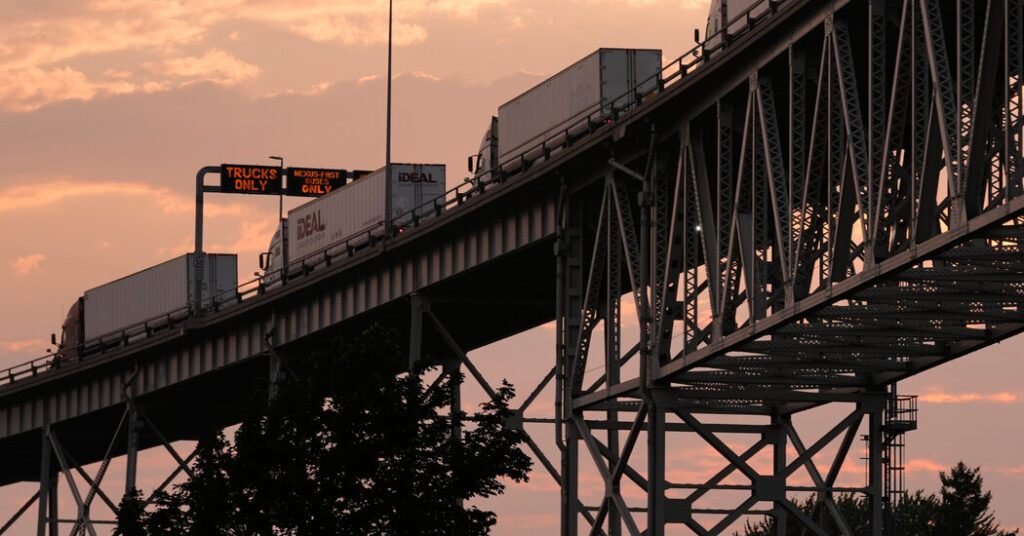
Canada, which will be subject to a 10 percent tariff under the arrangement, already prohibits importing forced labor goods. The European Union, also at 10 percent, has a ban that is scheduled to take effect in December 2027. But Trump officials say that the governments have not effectively enforced those laws.
The United States has arguably the strongest restrictions on forced labor imports of any country. It has prohibited the importation of goods made with slave labor for nearly a century, though it still allows prison labor under conditions that labor organizations consider coercive. In 2021, the United States passed a law banning imports from a region of China where it had found forced labor to be rampant.
The Trump administration also pushed Canada and Mexico to adopt a prohibition on imports made by forced labor as part of prior trade negotiations, and 10 other countries have committed to bans as part of trade deals negotiated over the past year, a senior administration official said.
But critics say the United States, too, has shortfalls on its labor protections. And some say that the administration has seized on forced labor as merely the most convenient way to reimpose tariffs struck down by the Supreme Court.
Peter Harrell, a visiting scholar at Georgetown Law School and a former Biden administration official, said that the small differential in tariffs between Canada and the European Union on one hand and China on the other “just brings home that USTR is using this forced labor investigation as a pretext to impose tariffs that Trump wants to impose for his own economic theories and preferences.”
“It’s not really about forced labor,” he added.
While Jamieson Greer, the U.S. trade representative, and other U.S. officials have publicly said they cannot prejudge the outcome of the trade investigations, administration officials have privately reassured multiple foreign governments that their tariff rates will end up being the same as in deals negotiated last year, people familiar with the discussions said.
“Trump’s next trade scheme is ordering USTR to reconstruct his illegal global tariffs under the guise of addressing forced labor,” Senator Ron Wyden, Democrat of Oregon, said in a Congressional hearing Wednesday. “If the administration wants to get serious about forced labor, the first step is to look at its own enforcement record.”
The new tariffs will exempt oil and gas and certain national resources, as well as goods already covered under the United States-Mexico-Canada Agreement, or national security-related tariffs Mr. Trump has imposed on cars, steel and other goods.
More duties are likely to be on the way in the coming weeks. The administration has proposed another batch of tariffs, also using Section 301, on 15 countries and the European Union to offset what the White House calls unfair practices in their manufacturing sectors. An administration official said Thursday that an investigation was continuing.
Mr. Trump has long maintained that U.S. tariffs on imports were unfairly low, and he came into office wanting to transform that system. But his efforts have been met with plenty of stops, starts and setbacks, reflecting the fact that a president’s legal authority over tariff policy is in some ways limited.
The Constitution gives Congress the power to regulate trade, but legislators have written numerous laws that allow the president to issue tariffs in certain circumstances. But typically, those laws are designed to help the president address unfair trade practices in certain countries or industries, not to replace the U.S. tariff system wholesale.
Mr. Harrell said that Mr. Trump’s use of Section 301 was much broader that the statute intended, and that it likely would be challenged in court. While Section 301 was supposed to be used to create leverage to push a country to address an unfair trade practice, he said, “Trump is reinterpreting the statute to try to impose perpetual tariffs on almost all imports.”
“They are showing that on tariffs, they can kind of run faster than the courts will, and they’re going to force the courts to keep playing catch up,” he added.
The Supreme Court invalidated Mr. Trump’s preferred legal tool in February, when it said his use of an international emergency law to impose tariffs was unlawful and ordered roughly $160 billion in tariff revenue to be refunded. Mr. Trump had used the emergency law to announce his “Liberation Day” tariffs on foreign countries last year, and to penalize Canada, Mexico and China for their real or alleged role in channeling fentanyl to the United States.
After the Supreme Court decision, Mr. Trump turned to Section 122 of the Trade Act of 1974 as a stopgap, a law which had never been used to impose tariffs before. Section 122 allows a president to impose a tariff to address balance of payments issues, but it has a 150-day time limit that is set to expire early Friday.
Mr. Trump’s use of Section 122 has also faced legal challenges. A group of small businesses and a coalition of states each sued the administration, claiming that the government did not satisfy the law’s strict criteria. In May, a majority of judges on a federal trade court agreed, handing down the second major tariff defeat against Mr. Trump.
The administration appealed the decision, and the courts have allowed the government to continue collecting the 10 percent tax on imports as the appeal progresses.
The provision that the administration is turning to next, Section 301, is more battle tested. Mr. Trump used it to impose tariffs on China in his first term, and his use of it has survived multiple challenges in court. But it has never before been used in such a sweeping way, to issue tariffs on dozens of countries simultaneously.
The administration also turned to another obscure trade law earlier this week, when Mr. Trump signed orders to impose a 50 percent tariff on billions of dollars of Canadian exports. The law, the Tariff Act of 1930, also known as the Smoot-Hawley Tariff Act, was written by Congress to shield American businesses during the onset of the Great Depression, though many historians believe it actually deepened the crisis. The Section 338 provision of the act that the administration used had never been used to impose tariffs.
Testifying in Congress Wednesday, Mr. Greer said that the administration remained intent on imposing tariffs, regardless of the legal approach.
“The specific authorities this administration is using have changed, but the trade strategy has not,” Mr. Greer said. “We are committed to continuing to use tariffs and to negotiate deals to support the re-industrialization of our economy, protect American workers and increase their wages and shrink our trade deficit.”
Tony Romm contributed reporting.
The post U.S. to Impose Tariffs on Over 80 Nations, Setting New Grounds for Trade Policy appeared first on New York Times.