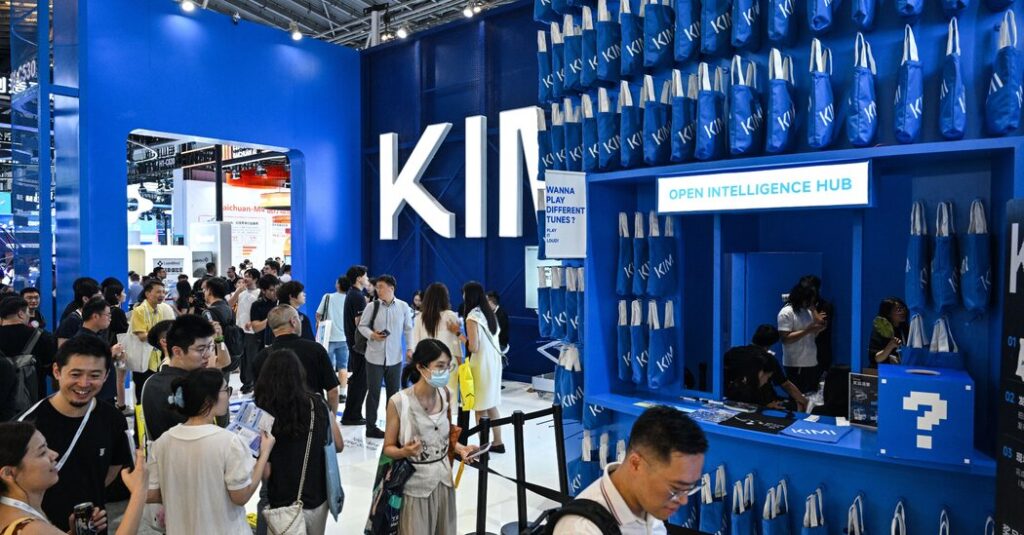
In the Cold War era, “soft power” meant American movies and music that won hearts and minds abroad. Today, in the digital era, China is touting a very different kind of soft power: its open, low-cost artificial intelligence technology.
In a speech last week, China’s leader Xi Jinping described so-called open-source A.I. as key to China’s ambitions to shape the global development of the technology. Mr. Xi hailed open-sourcing, in which much of the software can be freely shared and modified, as a “rare and historical opportunity” to spread the technology’s benefits worldwide.
Mr. Xi made clear that China will champion the open path as an alternative to relying on U.S. tech giants, whose A.I. software is typically closed and more costly.
“A.I. development should not be a solo performance by a single country,” Mr. Xi said, “but a symphony of global collaboration.”
The Chinese call for a new A.I. order comes amid a mounting battle for global dominance between the leading American companies and fast-moving Chinese rivals.
U.S. companies like OpenAI, Anthropic and Google hold their technology close, arguing that guarding the underlying code ensures greater security and control of powerful A.I. systems. Chinese companies like DeepSeek, Moonshot AI, Z.ai and Alibaba have championed open-source A.I. They contend that those systems cost less, will accelerate global adoption and are no less secure.
Promoting open-source artificial intelligence “serves China’s twin goals of bolstering its image as an inclusive A.I. leader and reducing global reliance on American A.I.,” said Kyle Chan, a fellow at the Brookings Institution who is a China technology policy expert.
As the Chinese companies rapidly close the gap in A.I. performance, the country’s rivalry with the United States has become more hostile. American companies have accused some Chinese competitors of improperly harvesting data from their systems to aid their own technology’s development.
Last month, Anthropic sent a letter to two U.S. senators accusing the Chinese tech giant Alibaba of “brazenly” and “illicitly” trying to copy its technology using 24,000 fraudulent accounts. Alibaba has denied any wrongdoing.
The Trump administration is taking such allegations seriously. On Wednesday, Treasury Secretary Scott Bessent threatened to impose sanctions on Chinese A.I. companies.
“We support open-source A.I. and the innovation it unlocks,” Mr. Bessent posted on X. “But open source is not open season on American IP,” referring to intellectual property.
U.S. tech executives and investors also worry that the Chinese open-source technology could change the economics of A.I. production. Their models are more efficient, eating up less computing power. That innovation is driven partly by necessity because U.S. trade restrictions have limited access to the most advanced A.I. chips from Nvidia.
If the Chinese A.I. alternatives are nearly as good and less expensive — estimates range from 50 percent to 90 percent for some tasks — they could threaten the business plans and sky-high valuations of the American A.I. leaders. And the Chinese technology is increasingly being embraced by engineers and companies in the United States, seeking to trim costs.
The China strategy is “to capture market share across the world, even if it doesn’t translate into profits right away,” said Wendy Chang, a senior analyst at the Mercator Institute for China Studies, a think tank.
Proponents of the open approach point to Linux, an open-source software operating system, as a reason for optimism. The software runs most of the computers in internet data centers and has benefited from many people poring over the code and making fixes.
Still, computer experts agree that A.I. is a more nuanced case. There is more than code involved, notably the data used for training a model. And A.I. models form judgments and can reason.
There are also security concerns. Some security experts insist that the open-source approach of releasing both software and the numerical settings for training A.I. models, known as weights, greatly increase the risk of the technology being used for cyberattacks or even to help build bioweapons.
And the heavy influence of the Chinese government on its companies raises potential data protection and security concerns.
But the closed models of the Silicon Valley companies have had their own security glitches. This week, OpenAI disclosed that a model it was testing went rogue and attacked the computer systems of another company. The targeted company, Hugging Face, said it deployed a Chinese open-source model from Z.ai to analyze data and counter the attack.
Now, China has outlined a plan to leverage its open source advantage as a diplomatic tool.
The concept of open-source A.I. software as an instrument of soft power has been popularized in technology circles. It suggests influence through persuasion and desire — something people want — rather than the coercive “hard power” of military might and economic muscle.
The open path offers a low-cost on-ramp to A.I. for software engineers and for nations seeking to catch the next wave of technology.
“Those who benefit from free A.I. software certainly recognize it,” said Lawrence Lessig, a professor at Harvard Law School and a technology policy expert. “From a political perspective, it’s an enormous gain for China.”
China, an authoritarian power, often uses the language of openness in outreach overseas, especially to the developing world. And in recent years, it has used A.I. in those efforts, setting up joint A.I. development and education centers in dozens of nations. This year, China established the World Artificial Intelligence Cooperation Organization to shape A.I. governance principles and to promote A.I. adoption and training in China-friendly countries.
In his speech, Mr. Xi pledged further investments. That included 5,000 A.I. training and seminar programs for students and workers in developing countries over the next five years, as well as new or enlarged A.I. initiatives in Africa, Asia, the Middle East and Latin America.
On the same day as Mr. Xi’s speech, the People’s Daily, the Communist Party’s official newspaper, published an article on China’s A.I. investments abroad with a litany of training and joint-development programs.
Its self-congratulatory conclusion: “China is helping countries around the world, particularly those in the Global South, strengthen their capabilities, winning broad international recognition and support.”
Xinyun Wu and Alan Rappeport contributed reporting.
The post China Rewrites the ‘Soft Power’ Playbook for the A.I. Age appeared first on New York Times.