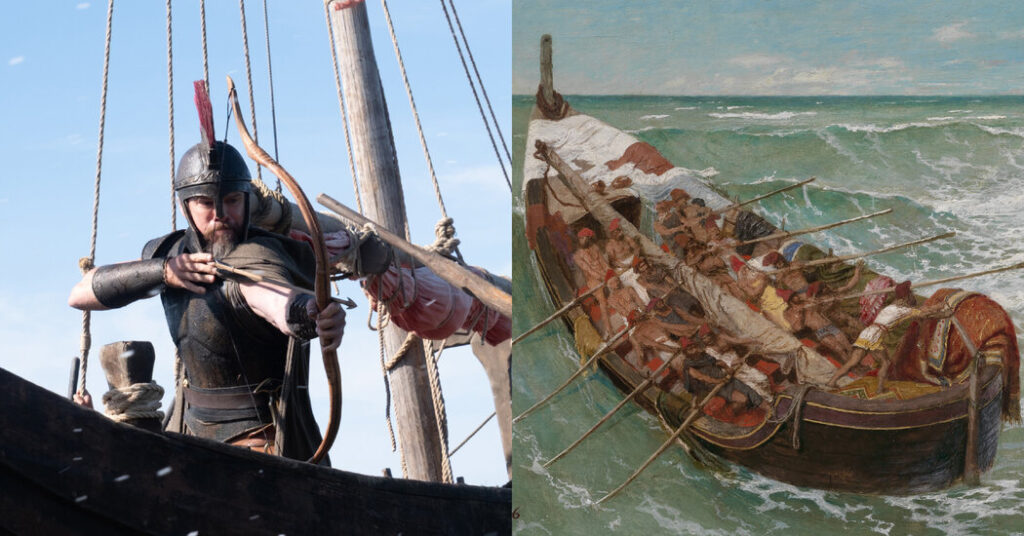
The release of Christopher Nolan’s “The Odyssey” last week has prompted fresh interest in the story of King Odysseus’ 10-year journey home to Ithaca after the Trojan War.
Part of the reason for the continued fascination with the epic poem that inspired the movie is Odysseus’ proximity to humans in it, said Joel Christensen, a professor of classics at the City University of New York. “He’s not the son of gods; he’s not the son of a goddess,” he said. “He doesn’t have special powers — he’s just really smart.”
Kenneth Lapatin, the curator of antiquities at the J. Paul Getty Museum in Los Angeles, said he found it fascinating that the story had been reflected in so many media. “You have it on vases,” he said, “You have it in silver. You have it in wall paintings. You have it on gems. You have it in sculpture.”
The societies these artifacts originated in shine through their interpretations of the story. “The story of ‘The Odyssey’ is like a palimpsest manuscript,” Christensen said. “It keeps getting written and overwritten again, but you can see underneath the other stories.”
If Nolan’s star-studded movie has piqued your interest, images inspired by the adventures are on view at several U.S. museums. Below is a closer look at some of them.
Metropolitan Museum of Art in New York City
Two Greek terra-cotta, fifth-century B.C. plaques at the Met stand out for their detailed representation of two episodes toward the end of Odysseus’ journey. They were probably affixed to a wooden chest or a wall.
One focuses on the moment an old nursemaid, Eurycleia, washes the feet of Odysseus, who has returned to Ithaca in disguise, and recognizes him from a scar.
“If her face were preserved — the fragment is missing — we would see her looking at him in this moment of recognition,” said Seán Hemingway, the curator of Greek and Roman art at the Met.
In a second plaque, Odysseus, dressed as a beggar, approaches his wife, Penelope, who has faithfully awaited him. She “appears desolate but resolute,” Hemingway said. “Soon she will recognize her husband and know that he is home again.”
Such scenes of homecoming emphasize the importance of family and shared experiences for the ancient Greeks, he added, noting that the renderings of the details are what make the pieces poignant.
Museum of Fine Arts, Boston
The Museum of Fine Arts, Boston, houses several items devoted to Odysseus’ adventures: two wine jars, or pelikai, from ancient Greece and a painting by the 19th-century Swiss painter Arnold Böcklin.
On one jar, Odysseus is portrayed meeting Elpenor, a deceased crew member, in the underworld. “Elpenor’s plaintive expression, beautifully drawn in three-quarter view, pulls at Odysseus’ heartstrings by forcing him — and the vase’s intended audience — to remember and to honor all those left behind,” said Phoebe Segal, a senior curator of Greek and Roman art.
The second jar takes on one of the poem’s best-known stories: Odysseus’ escape from Polyphemus’ cave while clinging to a ram. It is “perhaps the most vivid, thrilling episode,” Segal said, adding that it “exemplifies his wily resourcefulness.”
Pelikai were common during drinking parties, she said, and images from the epic “provided jumping-off points for poetry recitations and philosophical discussions.”
Thousands of years after the pelikai were popular, Böcklin also explored Odysseus’ escape in an 1896 artwork showing Polyphemus preparing to throw a boulder at the king’s boat.
In a curatorial note shared by the museum, the art historian Emily Beeny highlighted how the seascape is imbued with a literary narrative. “Böcklin creates a distinctive blend of fear and humor, and of fantasy and reality, in his take on this story within the painting,” she writes.
J. Paul Getty Museum in Los Angeles
Several items at the Getty Villa in Los Angeles spotlight moments from the poem. Among them are a two-handled cup and a lamp, both from ancient Rome.
The cup, featuring a chapter from Odysseus’ visit to the underworld, is made of silver. “It’s obviously of much greater value,” Lapatin said, adding that it probably belonged to a wealthy Roman.
Such cups were also common at drinking parties.
Lapatin noted that the lamp, which captures the moment Odysseus offers a cup of wine to Polyphemus to get him drunk, was instead a less “elite” object. Homer was popular culture, and his stories would have been widely known, Lapatin said.
At the Getty Center, visitors will find “Ulysses at the Palace of Circe,” a 1667 work by Wilhelm Schubert van Ehrenberg, a Flemish artist who specialized in architectural images, and Carl Borromäus Andreas Ruthart, a German painter known for his portrayals of animals. The work depicts the encounter between Odysseus and the sorceress Circe on her island after she turned his crew members into pigs.
The writer Madeline Miller, the author of the best-selling novel “Circe,” featured the artwork in an essay for her website. “These artists have taken the lush, seductive atmosphere of the original Circe story and run with it,” she writes. “Now Circe lives in a Versailles-extravagant house, surrounded by a louche entourage, and exotic animals, including an ostrich.”
Art Institute of Chicago
This panel is part of a cassone, a decorated chest that was usually part of a bride’s dowry in Renaissance Italy. The artist, Apollonio di Giovanni, was one of the most prolific makers of cassoni in 15th-century Florence, said Rebecca Long, curator of European painting and sculpture.
The panel shows Odysseus strapped to his boat’s mast to avoid the temptation of the Sirens; his encounter with Nausicaa, the daughter of King Alcinous; and his return home to Ithaca.
At the center of the painting is Penelope, weaving inside her home. That choice, Long said, was intentional: Cassoni were usually associated with domesticity and marriage. “It’s women holding out for their husband, women being faithful,” she said.
Bonus: Isabella Stewart Gardner Museum in Boston
Housed in a niche along a staircase, this statue of Odysseus has been amusing visitors of the Isabella Stewart Gardner Museum for decades. From the interior courtyard, you see his front, but if you stand next to the elevator, his uncovered behind is facing you.
The placement would not have been lost on Isabella Stewart Gardner, a pioneering collector and the museum’s founder, said Nathaniel Silver, associate director and chief curator of the museum. “She had a terrific sense of humor,” he said.
The statue was discovered on the premises of what had once been the pleasure garden of the Roman historian Sallust. Odysseus is depicted in a crouching position, Silver said, and would have been either part of a group of statues in the garden or of a pediment, an architectural element on the front of a temple.
The statue is believed to represent a moment in the Trojan War, before the events of “The Odyssey”; in the poem, the conflict is revisited through flashbacks and stories told by the characters. Odysseus’ posture suggests that he might be on a clandestine mission, Silver said, and he holds a sword.
The post In Artwork Across the Ages, Odysseus’ Myth Keeps Entrancing Audiences appeared first on New York Times.