The Senate race in Michigan has become one of the nastiest of the year. It has exposed electoral fault lines over religion, race, inflation, tariffs and, of course, President Trump. It could decide control of the chamber.
It has also emerged as the year’s most consequential contest for Democrats as they look ahead to 2028.
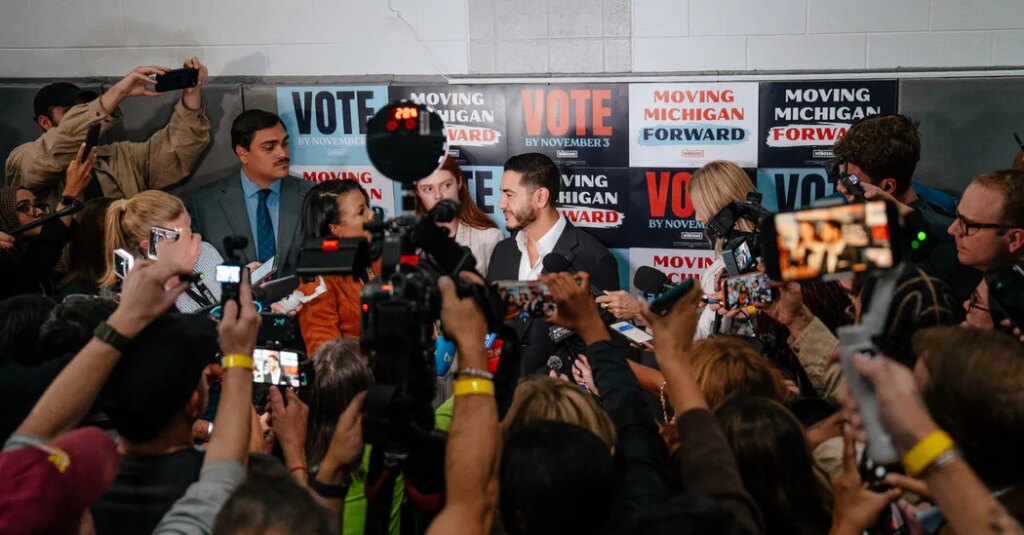
Dr. Abdul El-Sayed, the Democratic nominee, notched one of the progressive movement’s biggest wins in years when he defeated the party establishment’s choice in the primary. He faces a very different challenge now: a general-election contest that will test moderate and independent voters’ appetite for a combative brand of unalloyed progressivism.
The party’s activist class believes Dr. El-Sayed’s success next week would establish a proof point that left-wing populism is a winning message, even in swing states. He has embraced an economic agenda that sharply attacks the billionaire class and taken a clear stance against Israel. Centrist Democrats fear that a potential El-Sayed triumph in an otherwise favorable climate for Democrats could be badly misinterpreted as a mandate.
Just about the only thing both wings of the party agree on is this: Whether Dr. El-Sayed wins or loses — and by how much — will set the parameters of the ideological and political debate heading into one of the party’s most wide-open presidential races in memory.
“Bigger than big,” said Bhavik Lathia, a progressive Democratic strategist from Michigan who worked on battleground states for Kamala Harris’s campaign in 2024. “It’s about which vision of the Democratic Party enters 2028 with the wind at its back: progressive economic populism or same-old establishment centrism.”
This is exactly what worries Matt Bennett, an executive vice president at Third Way, a centrist think tank that presses for a more moderate Democratic approach.
“The danger is that the triumphal stuff coming from the left will take hold as a narrative that 2028ers believe,” Mr. Bennett said of Michigan. “I think he will win despite — not because of — the fact that he has campaigned mostly to the left.”
Mr. Bennett and others are already laying groundwork to undermine Dr. El-Sayed’s case if he wins on Tuesday.
He noted that Dr. El-Sayed is underperforming relative to other Democrats who are on the ballot in traditional red states, such as fellow Senate candidates Adam Hamilton in Kansas and James Talarico in Texas. And he pointed out that Dr. El-Sayed is polling behind Jocelyn Benson, the Democratic nominee for Michigan governor at the top of the ticket.
Dr. El-Sayed, who burst onto the scene with unusual swagger and sharp elbows — and has relished sparring with President Trump and Vice President JD Vance alike — waved off such comparisons in an interview, calling it “a bit of a fool’s errand.”
“I’ve taken more spending against me than any candidate to run for statewide office in Michigan history,” Dr. El-Sayed said, hastening to praise the “great race” that Ms. Benson is running. “I just think it’s not worth comparing the two races.”
The fact that Democrats are arguing about margins even before the election is over shows just how closely watched the contest is.
Adding to the race’s importance is the fact that Michigan is now firmly ensconced among the early states that will help pick the Democratic presidential nominee in 2028. Dr. El-Sayed has not been shy about wanting to leverage the state’s early role, especially if he wins. “I want Michigan to be the next Iowa,” he recently told Politico.
Early jockeying for the 2028 nomination will emerge from the shadows almost immediately after the midterms. One event called Crooked Con is scheduled to begin in Washington on Thursday, just two days after the election. Another conference in Denver is scheduled for a week later, called “What’s Next?” Both are expected to attract potential candidates who are trying to position themselves for an early edge.
Representative Alexandria Ocasio-Cortez of New York, who headlined rallies in Michigan for Dr. El-Sayed in the Detroit area and joined him on a bus tour across the Upper Peninsula last week, has framed his election as crucial to the “generational project” of the progressive movement.
“It starts with Abdul,” she told donors in New York this month. She followed that up with a $1 million transfer from her political account to support Dr. El-Sayed — her largest ever.
Some top Republicans agree.
“I’ll make a prediction,” Senator Ted Cruz of Texas said on Wednesday as he campaigned in Michigan for former Representative Mike Rogers, Dr. El-Sayed’s Republican opponent. “I believe if El-Sayed wins, the Democrat nominee for president in 2028 will be A.O.C.”
“In the primary, the No. 1 argument against A.O.C. is she’s too extreme to win the general,” Mr. Cruz said. “If El- Sayed wins, they’ll say nope: You can nominate a complete moonbat — and a swing state like Michigan will vote for him!”
Voters who attended Ms. Ocasio-Cortez’s events this month in Michigan said they were anxious about the Senate race’s importance.
“It’s make or break,” Justin Braman, 49, a retired veteran who lives Auburn Hills, said as he waited for Ms. Ocasio-Cortez to speak at a rally last Friday in Pontiac. “Either the progressives are able to get a foothold in this election or we are damned to establishment politicians forever.”
Notably, Dr. El-Sayed has not pivoted proactively to the political center after an expensive and bruising primary in which he beat a more moderate rival. He recently campaigned with Senator Elizabeth Warren of Massachusetts, Representative Ayanna Pressley of Massachusetts and Ms. Ocasio-Cortez — all leading figures of the left.
The stakes of his race span both specific policies and the party’s broader posture.
Dr. El-Sayed has made Medicare for All a central promise in his pitch, and he has been steadfast a critic of Israel. Most recently, he has refused to say whether Iran or Israel poses a greater threat to America.
That approach has mobilized people who supported the Uncommitted movement, the protest campaign that first arose in Michigan in 2024 to pressure former President Joseph R. Biden Jr. to stop supporting Israel’s war in Gaza. But it has also turned off some traditional Democrats who are promoting a similar “leave it blank” campaign, this time to withhold support for Dr. El-Sayed on the ballot on Tuesday.
One Republican operative involved in the Senate race in Michigan said the joke among Mr. Rogers’s supporters is that some Democrats want to defeat Dr. El-Sayed as much or more than Republicans do.
One group that combats antisemitism, the Beacon Coalition, which was previously funded in part by Third Way, has supported Mr. Rogers. Third Way has said it disagreed with the endorsement and had no knowledge of the group’s plans and was not funding the effort.
“Publicly, privately, in the deepest recesses of my heart, we want El-Sayed to win,” Mr. Bennett said. “We just genuinely do.”
But Mr. Bennett added that other Democrats are better models for the party to expand the electoral map in 2028 and beyond, especially former Gov. Roy Cooper in North Carolina, who is now favored to become the first Democrat to win a Senate seat in the state since 2008.
“He’s doing it with zero viral moments. Zero,” Mr. Bennett said of Mr. Cooper. “The guy was, like, born in a blue blazer. He is as much an establishment politician as you can possibly can get. He is not young. He doesn’t have any of the attributes that the left says you must have — yet he is winning easily.”
For his part, Dr. El-Sayed seems to enjoy fighting off both Mr. Trump and the more cautious, corporate elements of the Democratic coalition alike.
“There’s a reason the corporations and the special interests have spent a historic amount of money to beat me in the primary and will spend a historic amount of money to beat me in the general because they understand that I fight for working people,” Dr. El-Sayed said in the interview.
Ms. Warren, who battled questions about electability when she ran for president in 2020, said in an interview that she disagreed that Dr. El-Sayed’s race was somehow freighted for the left. Instead, she said an assertive brand of economic populism has already won inside the Democratic Party this year.
“Let me put it this way,” Ms. Warren said. “All across the country, Democrats in competitive races are running on economic populist ideas. They may not call them that. But that is sure as hell what they’re doing.”
She added, “We are winning the actual policy battle.”
Mercedes Chandler, a content creator who goes by Campcallout to her 1 million followers on Instagram, was in Michigan in recent days, part of a tour to raise awareness of the importance of the race.
“I might be from Arkansas, but I want Abdul to win here because I bat for the left so I’m going to come here and use my audience,” she said before a rally in Dearborn, where three founding members of “The Squad” all spoke: Ms. Ocasio-Cortez, Ms. Pressley of Massachusetts and Representative Rashida Tlaib of Michigan.
At issue, Ms. Chandler said, was the question of whether the left could win in a genuine battleground in Middle America.
“If he wins in this state, which I think is really vital, I think it sets the path for Democrats to start choosing better candidates, not just the safe DNC style candidate,” she said.
Adam Green, co-founder of the Progressive Change Campaign Committee, said: “Abdul is Exhibit A is in the case that we’re that making — that bold, shake-up-the-system economic fighters can win in swing states.”
“His win or loss will dramatically change the conventional wisdom coming out of the election,” Mr. Green explained.
At one point, Graham Platner, the gravel-voiced leftist populist, was poised to play a similar role in Maine. But his Senate campaign imploded over the summer following accusations of sexual misconduct, including rape, and he withdrew from the race. His replacement, Troy Jackson, is also a progressive, but the race has been seen as more of a test of the staying power of his Republican opponent, Senator Susan Collins, than of the left’s appeal.
There are a number of other smaller-scale test cases of populists or progressives running in red or purple House districts: Randy Villegas in the California Central Valley, Will Lawrence in Michigan, Tom Perriello in Virginia. None have the national profile of Dr. El-Sayed.
“All of those are ornaments on the tree,” Mr. Green said. “Abdul is the trunk of the tree.”
The post The Most Important Race Shaping 2028 for Democrats Is Happening Now in Michigan appeared first on New York Times.