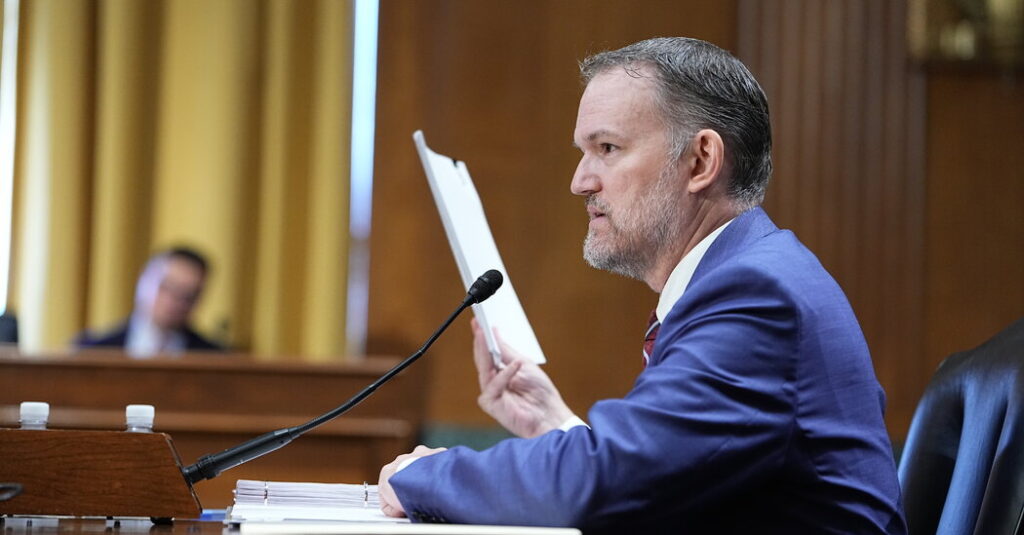
Jamieson Greer, the U.S. trade representative, told Congress on Wednesday that a “national emergency” on trade persisted and that the administration remained intent on using tariffs to transform the economy.
Testifying before the Senate Finance Committee on Wednesday, Mr. Greer said he considered President Trump’s tariff policy a success and would use whatever tools he had available to continue it.
The Trump administration is preparing to introduce another barrage of global tariffs as soon as this week, as the president tries to replace tariffs that were declared legally invalid in February.
“The specific authorities this administration is using have changed, but the trade strategy has not,” Mr. Greer said. “We are committed to continuing to use tariffs and to negotiate deals to support the reindustrialization of our economy, protect American workers and increase their wages and shrink our trade deficit.”
At the hearing, several Republican senators emphasized the importance to their states of maintaining and expanding trade ties. Democrats denounced the Trump administration for treating close allies like Canada so harshly, including with newly threatened tariffs this week.
Democrats also criticized tariffs for adding to the prices of consumer goods for American families, something Mr. Greer tried to rebuff.
“These tariffs are raising costs, and everybody seems to know that except the Trump administration,” said Senator Raphael Warnock, Democrat of Georgia.
The Trump administration has been working to repair its global tariffs after the Supreme Court in February ruled that Mr. Trump’s use of an international emergency to issue global tariffs last year was unlawful. That decision struck down tariffs Mr. Trump had announced last year on what he called “Liberation Day,” and cast into question the trade deals the administration had negotiated based on those levies.
As a stopgap measure, Mr. Trump used another legal measure to impose a flat 10 percent tariff globally. That tariff is set to expire on Friday, but the administration has already readied a replacement.
In June, the Office of the United States Trade Representative proposed imposing a tariff of between 10 and 12.5 percent on goods from more than 80 countries, using a legal authority known as Section 301. It argued that those countries’ failure to impose and enforce laws blocking goods made with forced labor from their markets had unfairly disadvantaged the United States.
It’s not clear when those tariffs will be imposed, but several people familiar with the plans said they anticipated them to be ready before the current 10 percent base line duty expires on Friday. The Trump administration is also preparing another tranche of tariffs under Section 301 that relates to other countries’ practices toward their factory sectors, and they could be put into effect in the coming weeks or months.
The administration has continued to double down on other tariffs as well. Mr. Trump on Monday signed orders to impose a 50 percent tariff on a wide range of Canadian goods, claiming that Canada had discriminated against the United States in key industries. He said on Tuesday that the United States would impose steep tariffs on generic medications in 2028.
Some analysts speculated that Mr. Trump was trying to force Canada to the negotiating table in talks over the United States-Mexico-Canada Agreement. U.S. and Mexican officials are discussing that deal in Mexico City this week, but talks between the United States and Canada have not officially begun.
Canada and Mexico are the United States’ biggest export markets, and particularly crucial for U.S. agriculture. At the hearing, both Republicans and Democrats reiterated the importance of the U.S.M.C.A. deal to their states.
Senator Ron Wyden, the top Democratic on the Finance Committee, criticized the administration for placing 50 percent tariffs on some Canadian products while rolling “out the red carpet” for China, “one of the biggest trade cheats there is.”
“It just seems to me that on tariffs, the administration has lost the plot,” he said.
Senator Peter Welch, Democrat of Vermont, said that the tariffs, whatever their intent, were “really causing a lot of harm so far in Vermont, both the tariffs and the way in which they are variable and changing quite a bit.” Canada is Vermont’s top trade customer, he added.
Mr. Greer responded that Canada had benefited from the best trade treatment, even under Mr. Trump’s trade policy since last April.
“We’re trying to balance this relationship, have as much trade, liberal trade in North America as possible while protecting our producers,” Mr. Greer said. “It’s not going to happen overnight,” he said.
Mr. Greer said that there were aspects of the U.S.M.C.A. that needed to be changed, such as adding rules that would require more auto production in the United States. But he said that the deal included certain “load-bearing pillars,” provisions that ensured agricultural market access and other areas where the United States hadn’t seen problems.
“But where we have seen issues, we’re already in process of fixing it to make sure we can get more production here in the U.S.,” he said.
Lawmakers are weighing whether to expand or restrict the president’s ability to impose tariffs. While the Constitution gives power over trade to Congress, lawmakers have written numerous laws that allow the president to issue tariffs in certain circumstances.
Mr. Wyden introduced a bill on Wednesday that would eliminate or reform various tariff authorities delegated to the president to reassert Congress’ authority over such duties. The bill would mandate Congressional approval for tariffs, establish a committee that would review the president’s tariff actions and make clear that binding trade pacts need approval from Congress.
But Congress is also considering a bill, sponsored by the late Senator Lindsey Graham, that would allow the president to increase tariffs up to 100 percent on countries that buy the largest quantities of Russian oil and natural gas. Some have warned that the bill could give Mr. Trump an even more flexible tool to impose tariffs on China, India, the European Union, Japan and others.
The post Trump’s Trade Negotiator Doubles Down on Tariffs Before Global Duties Expire appeared first on New York Times.