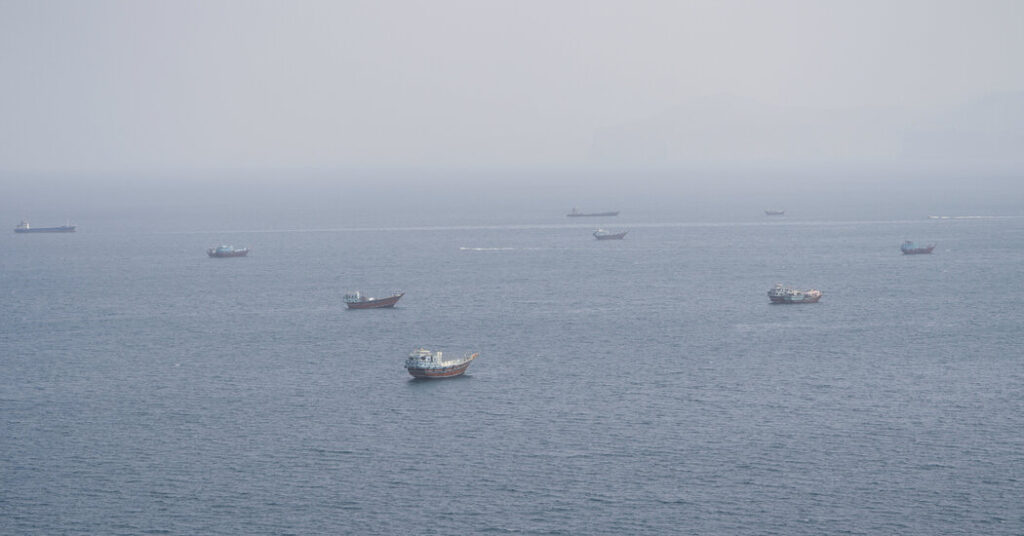
For months the U.S. military has sought to protect tankers from Iranian attacks as they carry Persian Gulf oil through the Strait of Hormuz.
But last week, a Saudi vessel trying to go through the strait was struck close to Oman’s coast, killing two of its crew members. Two other sailors died in attacks in August, making it the deadliest month in the strait for merchant seamen since March. At least 23 ships were hit in the waterway in July and August. On Saturday, the United States struck three Iranian oil tankers in retaliation for what it said were unprovoked attempts by Iran to attack two U.S. warships.
After more than six months of war, analysts said the strait remained in a lethal stalemate.
“The strait is neither fully closed nor fully opened,” said Eugene Gholz, an associate professor of political science at the University of Notre Dame and an expert on conflict in the waterway. “Iran can’t close it completely, and the U.S. can’t open it completely.”
The U.S. tanker protection effort, which involves intercepting Iranian drones and missiles before they hit ships, has helped get millions of barrels of oil out of the Persian Gulf each day and provided a measure of relief to oil markets.
But attacks from Iran have continued to deter many tankers from operating in the strait. Despite the U.S. protection, Iran has managed to keep hitting vessels. Iran struck 12 ships in August, up slightly from 11 in July, according to a New York Times analysis of public attack records.
The amount of oil going through the waterway is still significantly lower than it was before the war, analysts said.
In the seven days through Thursday, a daily average of 6.7 million barrels of oil transited the strait, nearly 60 percent less than in the months before the war began at the end of February, according to TankerTrackers.com, a maritime analysis firm.
Iran has used its ability to scare ships away from the strait — and restrict the supply of oil — as leverage against the United States. Iran now wants to formalize its influence over the waterway by charging ships fees for using the strait, something the United States opposes.
And despite the U.S. military’s efforts to fend off Iran’s attacks on tankers, many private shipping companies have not returned to the Gulf.
Industry executives said they didn’t want to risk the lives of their crews or lose a vessel for weeks if it was struck. Most of the time, Iran’s attacks don’t destroy tankers, but some do enough damage that the ships are out of action while they are repaired. Maritime insurance is expensive in war and must be purchased for the vessel, its crew members and the cargo onboard.
But the Gulf countries, whose economies are dependent on oil, seem willing to take more risks. They use government-owned tankers for their energy exports and switch off the ships’ transponders to avoid detection as they go through the strait. This also makes it harder for independent ship trackers to count all the vessels that pass through.
The Saudi vessel that was struck, called Sidr, belongs to Bahri, the state shipping company. Samir Madani, a co-founder of TankerTrackers.com, said it had been carrying around two million barrels of oil as it tried to transit in the dead of night. He said Iran could try to stop the flow of oil from the Gulf, “but that won’t stop the Arab nations from exporting.”
Bahri did not respond to requests for comment. In a social media post, the company said two Filipino sailors had been killed in the attack.
“The safety and well-being of Bahri’s people remain its highest priority, and the company remains committed to operating in accordance with the highest standards of safety, security and environmental protection,” the company added in the post.
The United Arab Emirates has sent tankers through the strait in recent weeks, but several have been hit. A spokesman for ADNOC, the state oil company, declined to comment. Two Kuwaiti tankers were also hit in late August. (The Kuwait Petroleum Company did not respond to requests for comment.)
Saudi Arabia and the Emirates are also getting oil out by sending it through pipelines that bypass the strait. The combined amount of oil going through pipelines and on tankers is equivalent to about two-thirds of the Gulf’s prewar exports, according to recent estimates by Goldman Sachs analysts.
Still, oil prices remain elevated. On Friday, the price of Brent crude, the international benchmark, was $95.50 a barrel, over 30 percent higher than it was before the war. The war has pushed up the prices of diesel — which hit a new high of $5.85 a gallon in the United States on Friday — and gasoline even faster.
One shipping executive said his company had been sending ships in and out of the Persian Gulf in recent months, but was stopping for now because the situation had become more dangerous.
The executive, who requested anonymity so his company did not become a target for Iran, added that Iran appeared to be targeting the engine rooms of ships, leaving them at risk of becoming stranded.
The U.S. military tanker protection operation, which started in mid-May, guides ships through the strait on routes close to Oman. Capt. Tim Hawkins, a spokesman for Central Command, the arm of the military behind the operation, said it had helped around 1,600 commercial vessels and about 800 million barrels of oil transit the strait.
“Commercial traffic flow continues through the strait despite Iranian aggression, and momentum is clearly building,” Captain Hawkins added. He declined to comment on the number of Iranian attacks in July and August.
But analysts say the operation could be difficult and expensive to maintain for many more months.
Resupplying warships in the Middle East with basic supplies has become more challenging since the Navy’s base in Manama, the capital of Bahrain, was effectively destroyed by Iranian attacks that began on the first day of the war.
Mr. Gholz, the professor, said the operation probably had significant costs. “We use up jet fuel. We pay people combat pay, and there’s a perennial risk of things going wrong, accidents or Iranian attacks,” he said.
While tanker companies are charging their customers a lot more for going through the strait, they must also bear higher costs when doing so. Insurance premiums for ships, crew and cargo remain high during the conflict, even though the U.S. military is offering protection. And rates can change by the hour.
Insuring a tanker to go through the strait has for the last two weeks cost an additional 4 percent to 7 percent of the value of the ship and its oil, said David Smith, an executive at McGill and Partners, an insurance broker. The total war insurance cost could amount to over $10 million per tanker, though shipping companies can get rebates for voyages without incident.
At quieter times during the war — like the period immediately after a cease-fire agreement in mid-June — that cost fell to between 1 percent and 2 percent of the ship and cargo, Mr. Smith added.
“Certainly, in my 40 years,” he said, “it remains the most dynamic shipping insurance market I’ve seen.”
And analysts say Iran is likely to keep up its campaign against tankers.
“Iran wants to show, once again, that even if regional countries try to think of ways in order to bypass the Iranians in the Strait of Hormuz, they will hit back,” said Noam Raydan, a senior fellow at the Washington Institute for Near East Policy. Iran’s goal is to obtain lasting leverage over the strait so that it has a stronger negotiating hand, she said. “This is why I do not see them letting go.”
The post Iran’s Attacks Keep the Strait of Hormuz in a Lethal Stalemate appeared first on New York Times.