Palestinians in the Israeli-occupied West Bank are routinely being terrorized by military raids and settler violence. But a more obscure menace is threatening to bring the entire West Bank economy to a halt.
Two Israeli financial institutions that have long served as partners for the 13 Palestinian banks — handling transactions that make possible imports to the West Bank of everything from food and clothing to gasoline, water and electricity — have signaled that they may abruptly end those relationships. That would cut the territory’s financial tether to Israel — and the outside world.
If the Israeli banks severed ties, officials say, it would amount to the imposition of a suffocating commercial blockade.
The banks have long been concerned they could be exposed to lawsuits over money laundering or terrorist financing, and have grown frustrated that Israel’s government is not better shielding them against these risks.
The prospect of being cut off has prompted Palestinian officials to appeal to foreign governments to intervene with the Israelis. A gathering on the subject set for Thursday in the West Bank city of Ramallah, sponsored by the Palestine Monetary Authority with the participation of officials from the United Nations, World Bank and International Monetary Fund, is titled “The Breaking Point: Sounding the Alarm Before Collapse.”
“There is a huge fear,” said Feras Milhem, who served as governor of the Palestine Monetary Authority from 2021 to 2025. “There is also a belief that this will not happen, that Israel cannot really cut the relations unless they want to push the Palestinians to anarchy.”
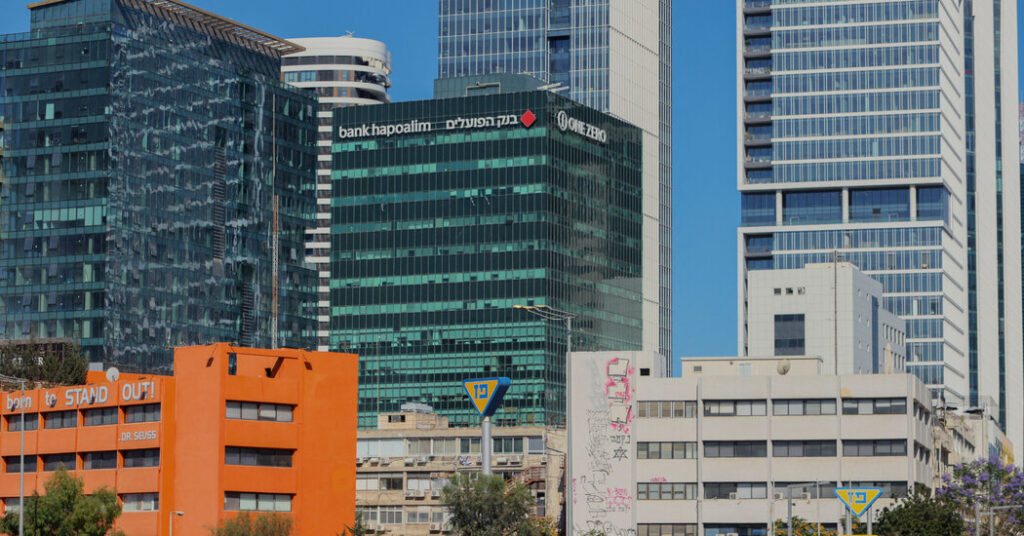
One of the two Israeli financial institutions, the Israel Discount Bank, has written to its Palestinian counterparts saying it will end its “correspondent banking” relationships with them by Sept. 1, according to a letter obtained by The New York Times. The other, Bank Hapoalim, told The Times that it was considering making the same decision.
In a statement on Wednesday, the Israeli finance ministry said the two banks had “announced their desire to cease providing correspondent services.” The ministry said that it was in talks with them to find a “safe and responsible manner” for them to continue those relationships, and that their termination could have “negative implications for economic stability in the region.”
Trade with Israel is responsible for 55 percent of Palestinian imports and 85 percent of exports, Mr. Milhem said. This commerce is handled by the correspondent banks.
The root of the potential crisis lies in the banks’ concern they could be exposed to international lawsuits alleging that they provide financing for money laundering or terrorism. The Israeli banks require that the Israeli government mitigate the risk by issuing letters temporarily indemnifying them against lawsuits, as well as immunizing them against potential prosecution in Israel. These letters come with expiration dates.
In recent years, Israeli officials have repeatedly threatened not to reissue the letters. Finance Minister Bezalel Smotrich, a staunch supporter of Israeli settlement expansion in the West Bank, has used the letters as leverage inside the government to extract concessions, including approval for settler outposts.
Each time, the government has backed down under international pressure, including a public intervention by U.S. Treasury Secretary Janet Yellen in 2024.
Since then, however, Mr. Smotrich has pressured the Palestinians by extending indemnification for shorter periods — often for as little as two weeks at a time — and waiting until the last minute to do so, officials said.
An aide to Mr. Smotrich, who spoke on the condition of anonymity to discuss sensitive matters, said in a statement that the Palestinian financial system remained involved in terrorism and money laundering.
“The demand that Israel mitigate this risk instead of demanding that the Palestinian Authority cease engaging in terrorism and meet accepted international standards reflects the hypocrisy and racism of low expectations,” the aide argued.
Other experts counter that the Palestinian financial system has taken steps to prevent Hamas and other militant groups from gaining access to it.
“The Palestinian banking system is no friend of Hamas, quite the contrary,” said Daniel L. Glaser, who was assistant secretary for terrorist financing at the Treasury Department in the Obama administration. “And the Palestinian Monetary Authority is no friend of Hamas. It’s one of the few things that works there.”
Still, the Israeli government wants the Palestinian Authority to submit to a level of financial auditing that it says it has not previously undergone.
The most recent extension of indemnification was for six months, until the end of 2026. The two Israeli banks have made clear, however, that they have grown frustrated with the uncertainty and short-term extensions and want to end the relationships sooner, Israeli and Palestinian officials said.
The Israeli banks have never wanted to be in the correspondent banking business with the Palestinians, which they entered in the mid-1990s when Israel and the Palestinians were negotiating peace deals as part of the Oslo Accords, and the firms have pushed over the years to exit it.
The Israeli government has repeatedly promised to find a permanent solution that shields the banks from liability. In 2019, the government established a company that was meant to become an intermediary between the Israeli and Palestinian banks. But that company has never gotten up and running, and Israel would need to enact legislation for it to start operations, officials said.
With Israel in the heat of a political campaign ahead of elections later this year and the Israeli Parliament in recess, it appears unlikely such legislation could be enacted soon.
In a statement, Israel Discount Bank acknowledged “the importance of economic stability” but said that it had to consider the risks of providing correspondent banking services and its responsibility to depositors and shareholders. “We remain willing to assist with the operational solution, provided that the relevant responsibility and risk are assumed by the state,” it said.
Palestinian officials have searched for a backup plan in vain. They say that currency swaps, such as in dollars or euros, would suffice only for a few weeks. And a more permanent fix, like dropping the Israeli shekel as the Palestinian currency, carries the risk that Israel could choose to interpret it as a withdrawal from the Oslo Accords, which barred the Palestinians from issuing their own currency and made the shekel the primary legal tender.
That leaves the Palestinians contemplating the potentially cataclysmic consequences of the banking relationships coming to an end. The West Bank economy is already under enormous pressure from punitive measures imposed by Israel after the Hamas-led attack on southern Israel in October 2023. Those measures include the withholding of billions of dollars in import taxes that Israel collects on the Palestinian Authority’s behalf and the cancellation of work permits for tens of thousands of West Bank residents who used to work inside Israel.
Economic experts said essential goods would become unavailable in short order if the relationship between Israeli and Palestinian banks is undone. The West Bank gets 100 percent of its fuel, 93 percent of its electricity and 35 percent of its water from Israel, according to Mr. Milhem, the former bank regulator.
Many said they expected that a black market would emerge, with Israeli trucks making deliveries in exchange for bags of cash — an environment ripe for exploitation by terrorist groups.
“It’s not only a humanitarian issue, it’s a security issue,” Mr. Milhem said.
The post Israeli Banks Threaten to Cut Off Palestinian Economy, Deepening Crisis appeared first on New York Times.