President Trump on Tuesday reiterated his threat to bomb a suspected Iranian nuclear site known as Pickaxe Mountain, telling reporters that the United States would strike that area “pretty soon, and very heavily.”
“There’s not a thing they can do about it,” he said of the Iranians during an Oval Office meeting with President Joseph Aoun of Lebanon. “Normally I wouldn’t say that. If I thought they could do something about it, I would never say that.”
Little has been confirmed about Pickaxe Mountain beyond its existence. When Mr. Trump threatened to bomb the site earlier this month, he acknowledged that “we see no activity there” but that it was still a “possible target for a nice big fat shot right in their front door.”
Here’s what to know about Pickaxe Mountain.
Where is it?
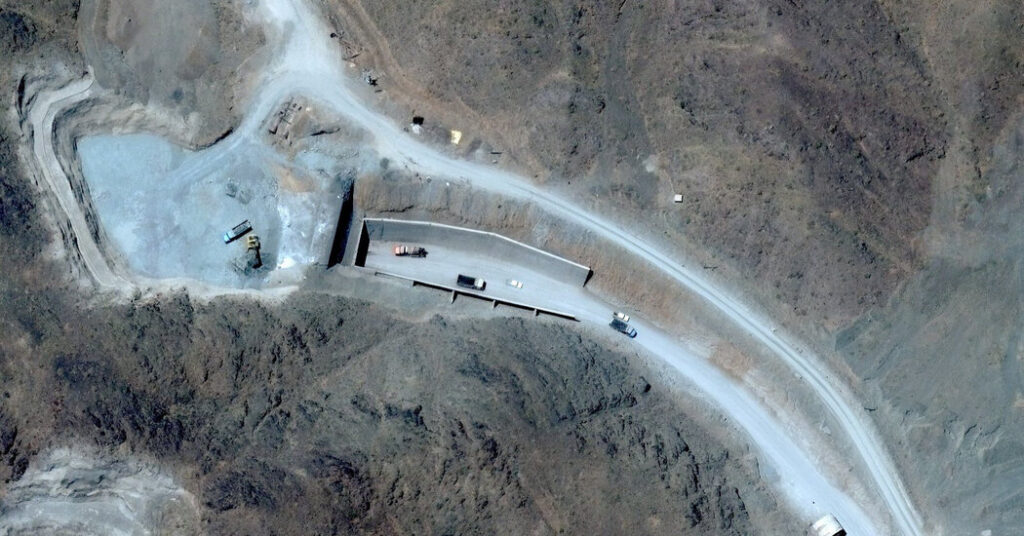
Pickaxe Mountain is in central Iran, about one mile away from the Natanz uranium enrichment facility, which was bombed by the United States and Israel in March, during the current war, as well as during the June 2025 war. The mountain is known locally as Kuh-e Kolang Gaz La.
According to the Washington-based Institute for Science and International Security, the mountain itself rises nearly 5,300 feet above sea level, and the facility is estimated to be buried more than 300 feet below it.
Experts say the site has been under construction since 2020 and is not yet operational. Satellite imagery shows that construction continued after the June 2025 bombings and that a security wall was recently built around the facility’s perimeter. Some entrances were also reinforced — possibly to protect against future attacks.
What is the site being used for?
Iranian officials said in 2020 that Pickaxe Mountain would hold a plant to build centrifuges, after one at Natanz was destroyed earlier that year in what Iran deemed an act of Israeli sabotage. Centrifuges are machines that spin uranium at supersonic speeds to enrich it and produce nuclear fuel. The uranium would need to be enriched further, with many more steps taken, in order to build a nuclear weapon.
Iran has long maintained that its nuclear program is peaceful, but it has not allowed the United Nations’ nuclear watchdog, the International Atomic Energy Agency, to gain access to Pickaxe Mountain. Rafael Grossi, the director general of the I.A.E.A., told reporters early last year that he had repeatedly pressed Iran for more information about the site at Pickaxe Mountain but to no avail.
“We’re asking them, ‘What is this for?’” Mr. Grossi said. “They are telling us, ‘It’s none of your business.’”
How might the U.S. attack?
The site at Pickaxe Mountain is buried so deep that experts say even the United States’ most powerful bunker-busting bombs, like the 30,000-pound bombs that blasted through Iran’s mountainside uranium enrichment facility at Fordo and disabled its centrifuges in June 2025, might not be effective.
The site at Pickaxe Mountain may still have weaknesses that could make it vulnerable to aerial attacks, but it “would be more suitable for ground forces to attack or sabotage,” the Institute for Science and International Security has said. Still, since the U.S. military would need to fly deep into central Iran to reach Pickaxe Mountain, troops could be left exposed to ground fire on their way in and to drone and missile attacks once on the ground.
The post What to Know About Iran’s Pickaxe Mountain appeared first on New York Times.