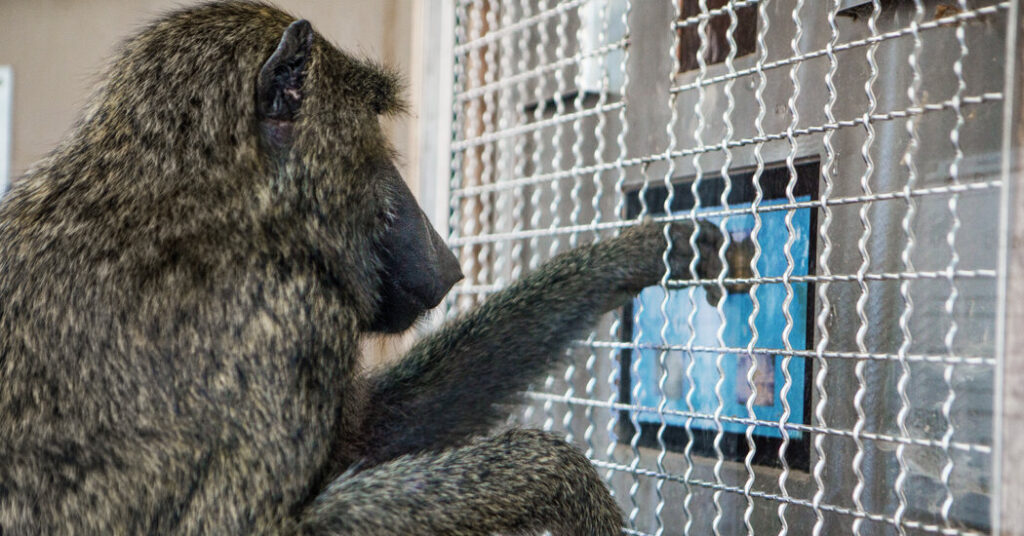
You (probably) won’t find a monkey in a geometry class, but it looks like our fellow primates can swing the basics.
Just like people, monkeys seem to grasp the abstract qualities of geometric shapes, such as whether they are symmetrical, have parallel sides or contain right angles, according to a new study published on Monday in Proceedings of the National Academy of Sciences. This ability allows the monkeys — and us — to understand when two shapes are the same, even when they’ve been rotated or resized.
This finding challenges a long-held notion that humans’ geometric abilities are part of what makes our brains one of a kind. “Our hypothesis was that humans are not that unique,” in possessing this mathematical understanding, said Jialin Li, a cognitive neuroscientist at Carnegie Mellon University and the lead author of the study.
In their experiment, Ms. Li and her colleagues decided to give monkeys (a total of eight rhesus macaques and olive baboons), preschoolers and adult humans with different education levels the same geometric task. That way, if humans truly had an innate advantage, it would show up when comparing the young children and the monkeys. And if the advantage was learned, it might show up when comparing the humans who had different levels of schooling.
It was a challenge to find a task simple enough that even preschool-aged children and monkeys could reasonably complete it, but the team eventually decided to have all the study participants do a matching task. All were shown a shape with a specific size and geometric form on a screen. Then they were asked to pick that same shape out of a group of others.
“By manipulating the similarity of the shapes, we were able to look at what kinds of rules they’re using,” said Jessica Cantlon, a cognitive neuroscientist at Carnegie Mellon University whose lab conducted the study.
For correct matches, the monkeys, preschoolers and adults received positive feedback: a treat, sticker or affirmation, respectively. But the mistakes, which were met with no reward, were just as important in order to understand what concepts were easy and difficult for the brain.
“The task certainly depends on a broad network of brain regions and circuits involved in visual and cognitive processing,” said David Freedman, a neurobiologist at the University of Chicago who was not involved in the new research. Matching tasks rely on both basic visual cues — like a shape’s edges and contours — and a higher-level understanding of shape identity and structure.
The researchers then analyzed the results alongside those from another lab’s recent experiment, in which monkeys, young children and adults had to identify a geometrically dissimilar shape in a group.
Through this analysis, researchers realized that their participants were all capable of making connections between shapes and their angles, ratios and patterns — monkeys included.
This shared foundation suggests that our geometric intuition evolved long before humans did, which isn’t a surprise to many researchers who study animal cognition.
“These are hardly the only animals on Earth that have to deal with geometry,” said Ed Wasserman, an experimental psychologist at the University of Iowa, who was not involved in the new study.
Many species have been shown to identify objects or patterns even when they are rotated or resized. Pigeons, for example, are even better than humans at some shape-matching tasks, a skill that might help them stay oriented as they fly.
“We humans tend to overestimate how special we are,” said Earl Miller, a neuroscientist at M.I.T. who was not involved in the new study. “If every new angle made an object seem completely different, life would be chaos.”
Still, these insights into the similarities between monkeys and humans might give us a better idea of just how far back in evolutionary history our specific way of understanding geometry goes.
“This is a timely and informative study that provides important insights into the evolutionary origins of geometric intuition,” said Andreas Nieder, an animal physiologist at the University of Tübingen in Germany who was not involved in the new study.
The research could also be a jumping-off point for understanding how humans manage higher-level geometric tasks, such as combining simple shapes into more complex structures, which the study didn’t test.
The study authors are already embarking on the next phase of that exploration: figuring out what shapes are the most challenging for monkeys and humans to identify. This understanding could, in turn, inform teachers’ attempts to teach particularly sticky lessons about geometry.
The post Monkeys Understand Shapes in Almost the Same Way as Humans appeared first on New York Times.