The first time I went to the Bayreuth Festival, that hallowed temple of Wagnerian opera, I nearly panicked just taking my seat.
My ticket was for a spot in the middle of the auditorium, which is wide with no center aisle. The late-July sun, and the lack of air conditioning in small-town Germany, already had me overheating in my suit and tie, and it was clear that I would have to tuck my shoulders and slightly hunch to fit in the tight space allotted each guest. If I needed to escape for fresh air, I would have to get past more than 25 people on either side. But before I could figure out how that would even work, the ushers closed the doors and locked us in.
The theater’s lights darkened, and the buzz of audience chatter fell to silence. Within this seeming void, the glinting A-major chord that opens “Lohengrin” emerged from the hidden orchestra pit like vapor, rising up the steep rake of the auditorium and seeming to hover around my head, a perfumed enchantment just for me. I had never heard anything like it.
There’s a version of this story that ends there, under the spell of Great Art, like Ruskin before the Tintorettos of Venice. And I wouldn’t be alone: People have been describing the near-religious acoustic experience of Bayreuth (pronounced “BYE-roit”) since its inauguration, 150 years ago this summer, with the premiere of Wagner’s four-opera epic “Der Ring des Nibelungen.”
But the truth is, by the end of Act I of that “Lohengrin,” my butt hurt from the theater’s wooden seats, and my sweaty shirt clung to my back. The air outside was warmer but, mercifully, less stagnant. I had to stand in a long line each break for an opportunity to buy and chug an enormous bottle of water. Before taking my seat, I splashed my face at a sink in a subterranean bathroom, and I dried off with a paper towel from Sieglinde the Toilettenfrau.
At the end of the night I gathered my tie and suit jacket, which I had shed, abandoning decorum, and followed an exodus down the Green Hill. I rode a bicycle to the center of Bayreuth, where I was renting a room from a night nurse whose cat oppressively cuddled me through the night, heating my body as I tried to cool it down with wet, refrigerated washcloths. I couldn’t say I was happy.
Yet I woke up and did it all over again for “Parsifal.” Then again for “Die Meistersinger von Nürnberg.” I went back the next year, and have kept going since. At this point, I have seen all 10 Wagner operas that make up the Bayreuth canon. Each time, I dread the trip; each time, I leave in some degree of awe. And that may always be the case. People have been complaining about and returning to this festival from the start. So why does it still have such a hold on us?
REMARKABLY LITTLE has changed about the Bayreuth Festival since its founding. It was the first musical pilgrimage of its kind, and Wagner’s fans knew it would be monumental. He had built an entire theater for the sole purpose of staging his “Ring,” and his endeavor attracted fans, including royalty, from around the world. Tchaikovsky wrote articles about it throughout the year, declaring months in advance that Bayreuth was “surely fated to become a milestone marking one of the most interesting epochs in the history of art” and “bound to leave behind a blazing trail in history.”
The New York Times regularly published front-page articles about the festival, including a detailed analysis of the “Ring.” One story observed Bayreuth as a media revolution, saying it was the first time a performance in one hemisphere could be reviewed the next day in another, because readers were so eager to read about it. The Times predicted a future in which “we shall record and judge the production of an opera in another planet, or that the very music of the spheres may be audible, and so, of course, criticizable.”
When the pilgrims arrived in Bayreuth, though, they weren’t met with much beyond the music. Wagner liked the town because it didn’t have anything to compete with his ambitions. It was isolated, and without a spa or a major theater, he could command the full attention of his audience. What he didn’t consider, it seems, was whether Bayreuth had the lodging and restaurants to support the sudden influx of travelers.
One correspondent wrote that Bayreuth had three or four inns but added, “I cannot bring myself to speak of any one of them as a hotel.” Mark Twain, who would visit in 1891, wrote in his irreverent essay “At the Shrine of St. Wagner” that “the town is littered with restaurants, but they are small and bad.” Tchaikovsky struggled to find a piece of bread; he met “a very high-ranking figure in Russia” who didn’t have lunch the whole trip. All she had to nourish herself, she told him, was coffee.
Because the Festival Theater had been under construction since 1872, and because Wagner lived in Bayreuth with his family at a villa named Wahnfried, the town was already loaded with memorabilia. A front-page article in The Times described purses, cigar cases, canes and more that had been fashioned in his likeness. There was even a cigar pipe with a bowl made to look like a bust of Wagner.
Today, you’re just as likely to be in search of a decent meal and a pleasant night’s sleep, and just as likely to be inundated with Wagneriana. Streets in Bayreuth are named after characters in his operas; there is one intersection where Siegmund Strasse meets Hunding Strasse, a city-planning nod to their clash in “Die Walküre.” I have stayed at the Hotel Rheingold (almost good air conditioning), passed a jeweler with a sale sign that says “DER RING” (up to 50 percent off) and ordered a cafe’s “Götterdämmerung” breakfast (eggs with flame-red peppers).
The theater sits atop what is known as the Green Hill, a leafy campus about a half-hour’s walk from the city center. Because performances start in the afternoon, with a recommended arrival time of 3 p.m., people who don’t come by car are made to hike the slope in gowns and suits, with little protection from the midday sun. According to a Times account from 1876, audiences members who couldn’t secure one of few carriages trudged “overheated, choked with dust and disposed already to grumble at everybody and everything.”
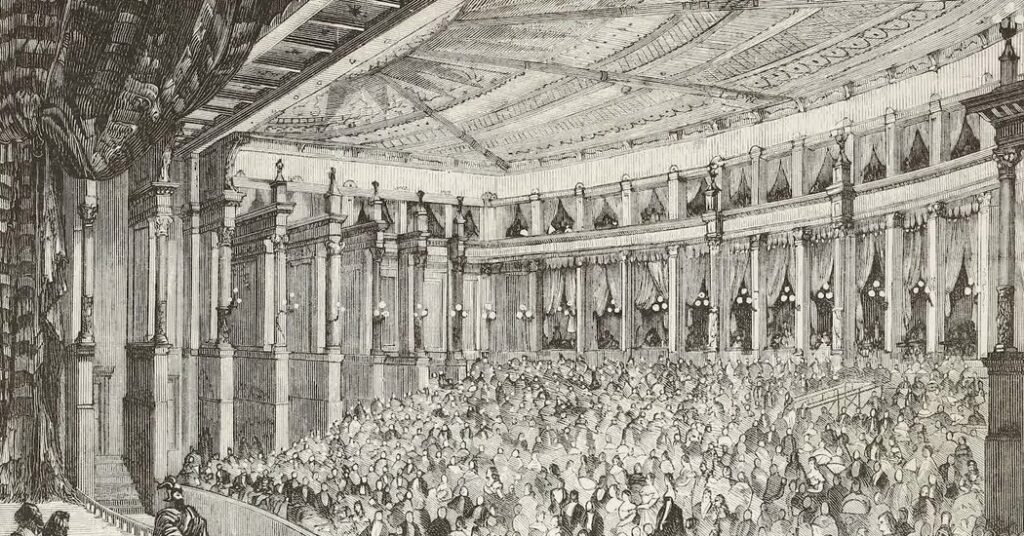
Wagner’s theater, though, was deemed worth the journey. From the outside it was ugly, often compared to a barn or beer tent. (“In that harmonic union of all the arts which Wagner aspires to, architecture has been allotted a far too modest place,” Tchaikovsky quipped.) But inside, it was a revolutionary miracle.
Everything was designed in service of the drama. The orchestra pit was hidden, covered by hoods from which the sound snakes out and into the auditorium, completely balanced as if controlled by a sound board. The stage was behind two proscenium layers, creating a telescope effect that made the singers look smaller and the sets grander; because the lights would be turned off during performances, something that wasn’t yet standard practice, the view was closer to that of a cinema.
Most important, the house’s amphitheater design and absence of boxes meant the stage would be visible from every seat. Gone, George Bernard Shaw wrote in “The Perfect Wagnerite,” was the audience pageantry of an opera performance: “The sightseeing globe-trotter no longer crowds out the genuine disciple.”
The “Ring” wasn’t a hit with audiences at first. But if it wasn’t the “artwork of the future,” as Wagner would say, then the experience of Bayreuth’s theater was at least the future of opera as we know it.
THE THEATER’S MYSTIQUE hasn’t diminished. Wagner wrote his final opera, “Parsifal,” with its sound in mind and initially didn’t allow it to be performed elsewhere, demanding a pilgrimage for the privilege of hearing it. The premiere attracted a global audience, including enough Americans to warrant notice in The Times.
When Twain made the journey, he was so indifferent, he “felt like a heretic in heaven.” But he was in awe of the festival’s culture: the famous Bayreuther Geist, or Bayreuth Spirit, of an unspoken, collective agreement to experience opera in absolute silence and respect. “I have never,” he wrote, “seen anything so great and fine and real as this devotion.”
It is a devotion that persists despite the miseries of Bayreuth as a destination. Somewhere on the hike up the Green Hill, the town’s faults fade away. And inside the theater, you can ignore the cramped wooden seats for a little while, knowing that the acoustic effect of wood is part of what makes the auditorium one of the finest in the world. There is, in the end, no better place to hear Wagner.
After Wagner died, in 1883, his widow, Cosima, moved quickly for her and their son, Siegfried, to be his legal heirs, entitled to the festival. (It has been run by a family member ever since.) The daughter of Liszt and a disciple of her husband’s work, she solidified the Bayreuth canon, directing shows herself but then reviving the old-fashioned productions until they were threadbare.
Hitler adopted Bayreuth, which for better or worse was always a beacon of nationalism, as a haven during his rise and rule. He visited Wahnfried regularly, even at the height of World War II; Siegfried’s sons, Wieland and Wolfgang, called him Uncle Wolf. The festival emerged from the war tainted by its association with the Third Reich, and had little budget to rebuild.
When it reopened, in 1951, Wieland gave the festival a much-needed reset. He abandoned past aesthetics and ushered in what is known as the New Bayreuth era, with spare stagings that emphasized psychology through suggestive lighting. In their abstraction these productions were strikingly modern, proving how interpretively elastic Wagner’s operas could be. It helped to solidify a standard for how directors approach not only his works, but also the entire opera repertoire.
In the New Bayreuth era, the festival also began what may be its finest modern feature: a workshop model in which directors, steadily outside the Wagner family at last, were hired for multiple seasons, to tweak their productions with each revival. Patrice Chéreau’s centennial staging of the “Ring,” for example, was reviled and notorious when it was new, but seen as a landmark triumph by its final year.
Through all these changes, Bayreuth’s pilgrims have remained its constant. Critics keep coming back, devoted fans still plan their summers around it, and today’s world leaders walk the red carpet; Angela Merkel is no longer Germany’s chancellor, and even she has continued to show up. Many productions flop, but with a new one promised each summer, you never have to wait long before the festival refreshes itself.
Under the leadership of Wolfgang’s daughter Katharina, who is the last Wagner to show interest in running the festival, directors have also tried to channel the composer’s ethos of adopting the latest technology onstage, like video, augmented reality and, this year, artificial intelligence.
The latest “Ring” (which opens next week, after Wagner’s “Rienzi” is presented in the Festival Theater for the first time) won’t have a director. It will have a curator, Marcus Lobbes, who has said that he will present the four-opera saga as a showcase of Bayreuth’s history, warts and all, with a constant stream of A.I.-generated imagery onstage.
When the production was announced, some Wagnerians couldn’t roll their eyes fast enough. It’s not the first time the “Ring” has had its skeptics. But one thing is certain, and telling: The entire run is sold out.
The post Hot, Uncomfortable, Matchless: Opera Pilgrims Can’t Quit Bayreuth appeared first on New York Times.