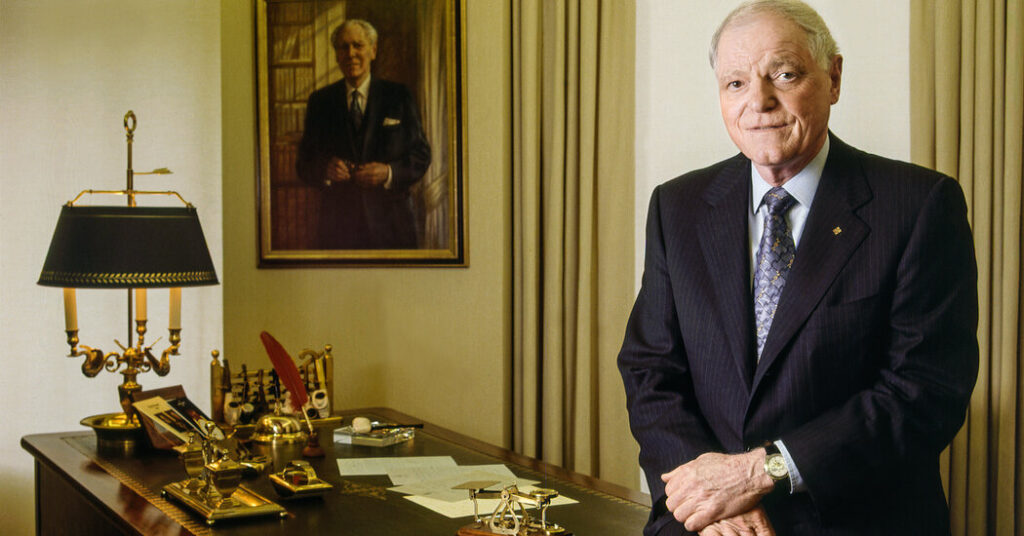
In 1963, when Philippe Stern, then the 25-year-old scion of the family-owned Swiss watch brand Patek Philippe, arrived in New York City to work at the company’s U.S. distributor, the watch trade was nothing like the high-flying luxury business it is today.
Patek Philippe, founded in 1839, had a reputation for making quality timepieces for captains of industry, but “nobody was knocking on the door saying, ‘I want this and I want that,’” said Hank Edelman, who worked alongside Mr. Stern in the mid-1960s and has been chairman of Patek’s U.S. distributor, the Henri Stern Watch Agency, since 2006. “We didn’t have a two-year waiting list for every piece that came out.”
But six decades later, Patek Philippe is one of the world’s most sought-after watchmakers. Owned by the Stern family since 1932, when Mr. Stern’s paternal grandfather, Charles Stern, and his great-uncle, Jean Stern, both dial makers, rescued it from insolvency, the brand had estimated sales in 2025 of 2.5 billion Swiss francs, or $3.1 billion. It now makes models, such as the Nautilus, that generate yearslong waiting lists, often dominate auction sales and have been name checked in song lyrics by artists like Beyoncé, Jay-Z, Cardi B and DJ Khaled, to name just a few.
Without Mr. Stern, who died June 14 at 88, none of it would have been possible, according to those who knew him.
“We lost a great man, one of the legends,” said Abdul Hamied Seddiqi, chairman of Seddiqi Holding, which owns Ahmed Seddiqi, a luxury watch retailer headquartered in Dubai, United Arab Emirates.
Mr. Seddiqi said Mr. Stern’s most important accomplishment was guarding the family ownership of Patek Philippe, ensuring that the brand continued to be independent of the big luxury groups that have largely colonized the Swiss watch industry. “It means more control over the company and also over the quality,” he said.
In a tribute posted June 16 on the website of the Hour Glass, a luxury watch retailer based in Singapore, Henry Tay, the company’s executive chairman, noted how Mr. Stern’s propensity for calculated risks — including his achievements as a downhill skier, winning the gold in the giant slalom at the 1960 Winter Universiade — served him well in the watch business.
“Over the years that followed, he applied that same calculus to decisions the rest of the Swiss watch industry considered frankly ill-advised,” Mr. Tay wrote in the post. “He was right often enough, and consequentially enough, that by the time he handed over the presidency of Patek Philippe in 2009, the company he had inherited as a workshop of 150 people producing some 5,000 watches a year had become the measure against which the entire world of fine watchmaking is taken.”
Perhaps Mr. Stern’s riskiest decision was to commit to mechanical watchmaking at a time when many doubted its future.
He became general director of Patek Philippe in 1977, just as a flood of cheap, accurate, battery-powered timepieces made in Japan threatened to decimate the Swiss mechanical industry. Rather than abandoning the trade, he set the stage for its luxury dominance by preserving the techniques, materials and artisans that would soon earn the brand a reputation as an ultimate prize among high-net-worth watch collectors.
“Philippe bought the last enamel powders and bases that were available and he employed artisans not because he had work for them, but because he knew their skills would be lost,” said Tania Edwards, co-founder of Collectability, a watch education and sales platform specializing in pre-owned Patek Philippe timepieces.
Ms. Edwards met Mr. Stern in 1989, when she worked for the public relations agency that Patek hired for its 150th-anniversary celebration that year. She said the Caliber 89, then the world’s most complicated portable mechanical watch with 33 complications — released to honor the sesquicentennial after nine years of research and development — was the catalyst for a decade of expansion at the brand.
As the 1990s unfolded, some of Mr. Stern’s bold decisions proved prescient. He decided, for example, to gather all of Patek’s production in a state-of-the-art facility in Plan-les-Ouates, which then was a village on the outskirts of Geneva. Soon, brands such as Piaget, Rolex and Vacheron Constantin followed, earning the community a nickname: “Plan-les-Watches.”
“Everyone told him it was foolhardy,” Mr. Tay wrote. But, “by 1996 the new manufacture had opened, and what had been a patchwork of scattered workshops became, in a single building, the physical expression of everything he believed independent ownership made possible.”
At the same time, Mr. Stern oversaw the introduction of watch collections that attracted new buyers to the brand, including the sporty Aquanaut, the feminine Twenty~4 range, as well as new models featuring useful complications such as an annual calendar.
“Mr. Stern saw the big picture,” said Ms. Edwards, who spent several years as vice president of the Henri Stern Watch Agency, where she worked until 2005. “He made expensive complicated timepieces but also introduced watches at a more affordable level.”
To Mr. Stern’s son, Thierry Stern, who has been president of Patek Philippe since 2009, one of his father’s greatest triumphs was the opening of the Patek Philippe Museum in 2001 in Geneva. “This is his legacy for the generations to come and for safeguarding the future of fine watchmaking,” he wrote in an email.
Philippe Stern did not limit the museum’s holdings to Patek specific timepieces. Rather, “the collection broadened beyond Patek Philippe’s own history to encompass all of European horology from the Renaissance forward,” Mr. Tay wrote.
For Mr. Edelman, who worked closely with Mr. Stern for decades, the museum has been the physical embodiment of his friend and colleague’s lifelong respect for the history of mechanical watchmaking.
“He fell in love with the company and its products at a very young age and felt it was his destiny to sustain that history,” Mr. Edelman said. “And he did it in a way that frankly, none of us could have imagined.”
The post Philippe Stern Took Risks. Patek Philippe Shows They Paid Off. appeared first on New York Times.