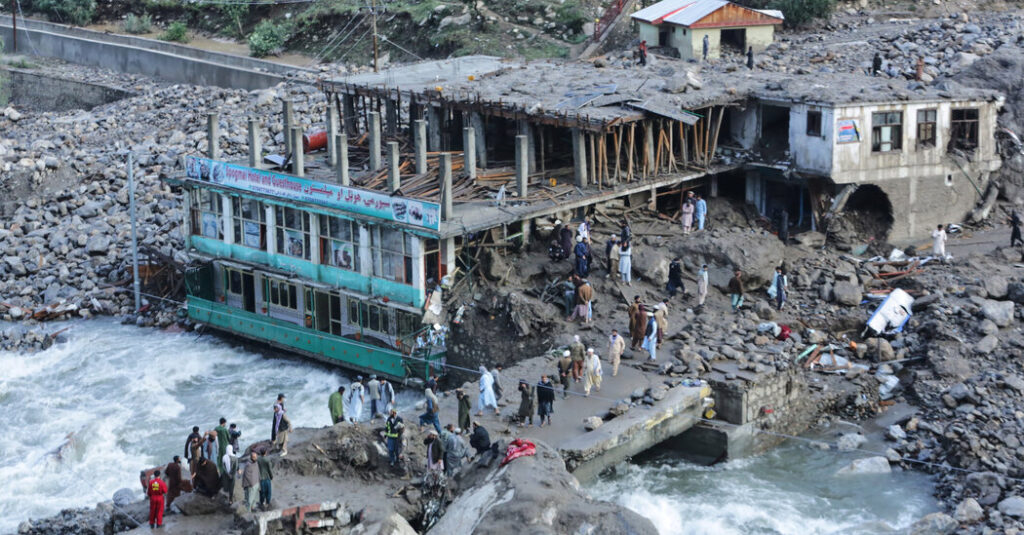
At least 23 people died and more than 80 others were injured in flash floods that struck a province in eastern Afghanistan on Monday, local officials said, adding that the death toll would likely rise as dozens remained missing.
The floods, caused by heavy monsoon rains, hit communities in Parun, the capital city of Nuristan Province on the border with Pakistan. Torrents of muddy water cascaded down surrounding mountains in the middle of the afternoon and killed Parun’s mayor, according to Faraidoon Samim, a spokesman for Nuristan’s governor.
Afghanistan, which is prone to extreme weather events, was already battling a severe humanitarian crisis compounded by U.S. aid cuts and the forced return of more than 3.5 million Afghans from neighboring Iran and Pakistan since the beginning of last year.
Only seven of the 23 bodies recovered in Nuristan had been identified as of Tuesday because they had been severely damaged by the floodwaters, Mr. Samim said. He added that because of the province’s isolation, support from Kabul, the capital, was not expected to reach Parun until late Tuesday.
Local teams from the Red Crescent, as well as the police and intelligence officers, were participating in the rescue operation, according to Mr. Samim.
Although Parun is 115 miles northeast of Kabul, it takes 10 to 12 hours by road to reach it. Nuristan is among Afghanistan’s least developed regions — most districts there are still not connected to Parun by paved roads and telephone and internet services remain limited.
Forests and shrub land cover more than a quarter of Nuristan, making it Afghanistan’s most forested province. But it has been ravaged by decades of mass deforestation, driven by illegal logging, that has slowed down absorption of water into soils. The Taliban banned illegal logging shortly after they came back to power in 2021 and even created a military unit dedicated to fighting it.
Two United Nations officials urged Western countries to remain engaged in Afghanistan on a visit to the country earlier this month, warning that isolating the Taliban-ruled nation would only push it further into instability.
“In Afghanistan, there is never a crisis just on its own,” Alexander De Croo, the head of the U.N. Development Program, told The Associated Press during his visit. “It’s always crisis on top of crisis.”
Deadly floods are an annual occurrence in Afghanistan, especially in the winter and spring. They killed at least 77 people and injured 137 others across the country earlier this year.
The post Flash Floods Kill at Least 23 in Afghanistan appeared first on New York Times.