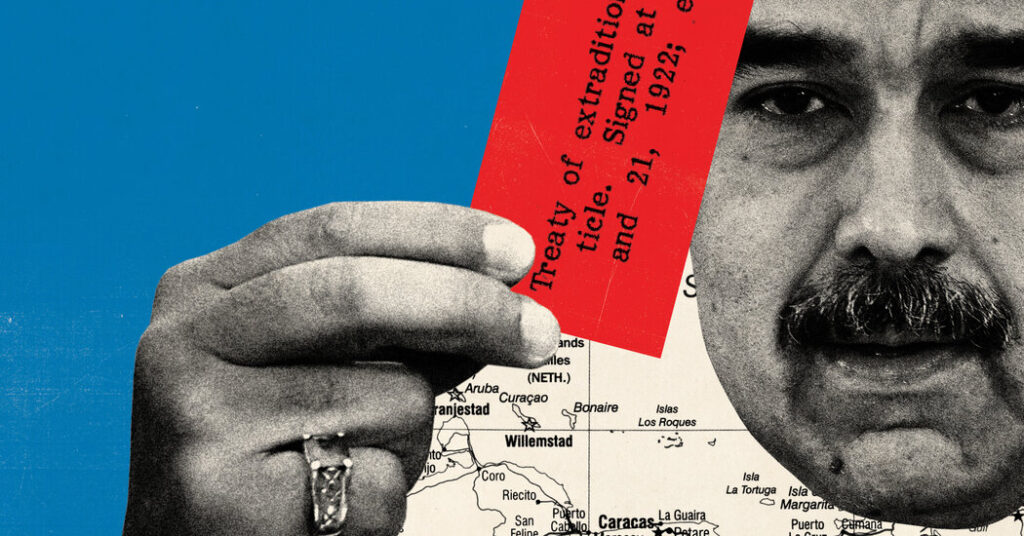
A lot has happened in the half year since U.S. Special Forces kidnapped President Nicolás Maduro of Venezuela and his wife, Cilia Flores, but if you can think back that far you might recall that the Trump administration insisted the mission wasn’t an invasion; it was an “extradition.” It was a legal matter, that is, to be followed by a criminal trial. Many legal scholars, commentators and government officials lined up to endorse that choice as lawful, despite Venezuela’s immediate insistence to the contrary. But when Mr. Maduro’s case next makes its way to court, on July 22, federal prosecutors could encounter one rather significant obstacle: Our courts don’t have the authority to handle his case. And the law that says so was signed by the United States of America.
If the United States honors its agreement, it could well be forced to release its prized captive.
The reason dates back to the first decades of the 20th century, when a topic that seems dry and legalistic today — international arbitration — was an exciting and idealistic cause, championed as a modern, rational tool of justice with the power to change the world.
President William Howard Taft felt so strongly about its promise that he spent part of his 1909 Inaugural Address extolling its virtues: “We favor every instrumentality, like that of the Hague tribunal and arbitration treaties, made with a view to its use in all international controversies, in order to maintain peace and to avoid war.” He advocated the practice throughout his presidency and, when he left the Oval Office, went on to serve as an international arbitrator. President Woodrow Wilson also took up the cause. His secretary of state, William Jennings Bryan, proposed permanent independent commissions to resolve disputes between nations. Taft, Wilson and Bryan had good reason to look for new ways to maintain peace: The world was descending into war.
Years later, when peace was restored, the United States began including arbitration clauses in many treaties. One of those was a 1922 extradition treaty between the United States and Venezuela. It states, in part, that “all differences between the contracting parties relating to the interpretation or execution of this treaty shall be decided by arbitration.” Approved by the Senate and ratified by the president, that document has the force of law.
Well, there sure are “differences between the contracting parties” today. The government of Venezuela is playing along with the Trump administration when it comes to oil exports, but it has publicly insisted that Mr. Maduro’s capture was illegal under international law — and that would include the extradition treaty.
A dispute of this nature should clearly trigger the 1922 treaty’s arbitration clause. According to its stipulations, Judge Alvin Hellerstein, who is overseeing Mr. Maduro’s trial, must suspend the proceedings and send the matter to a panel of independent evaluators to examine the treaty and decide whether it has been honored. Should the arbitrators conclude that Mr. Maduro’s capture violated the treaty, the United States would be required to release him.
Does it sound far-fetched? The Supreme Court has affirmed the principle again and again in cases spanning more than a century.
The first was in 1886, when the justices ruled that the prosecution of William Rauscher, who had been extradited from Britain, had violated the terms of the two nations’ extradition treaty, because the charges on which he was tried were not the same as those for which he was handed over. Thanks to the court’s insistence that the prosecution had to conform to the treaty, Rauscher prevailed.
The second was in 1927, when no less an authority on the matter than former President Taft — by then the chief justice — weighed in on the fate of some British men who had been arrested on the high seas. In this case he ruled against the crew, but he took time to affirm that, despite the prosecution’s claim to the contrary, “the right of the court” to hold foreign defendants “for trial” was indeed dependent on the treaty between the two nations.
A third instance was in a 1992 case in which a Mexican citizen and resident was kidnapped at the request of the Drug Enforcement Administration and taken to Texas, with the intent to try him in federal court. The question of whether his prosecution would be valid went all the way to the Supreme Court, where the justices allowed it — but reinforced the principle in United States v. Rauscher: A defendant “may not be prosecuted in violation of the terms of an extradition treaty.”
In each of these varied cases, the message was the same: When interests clash over the scope of an extradition treaty, the first step is to examine carefully the intent of those who signed the treaty. In those three cases, the treaty in question allowed the court to perform that examination. The treaty with Venezuela, however, gives that responsibility to arbitrators.
The trial cannot legally proceed without this step.
I asked David Sloss, a prominent legal scholar and the editor of “The Role of Domestic Courts in Treaty Enforcement,” how shocking it would be, from a legal perspective, if the case got bounced out of court into arbitration. He said not very. Referring the Maduro case to arbitration would track with “the approach that courts routinely apply,” he wrote me, “when they dismiss claims based on contracts that include an arbitration clause.”
Once the arbitrators have the Maduro case, the next step would be for them to determine whether Mr. Maduro’s kidnapping and extradition were lawful by the terms of the 1922 treaty.
Because treaty interpretation is a rarefied branch of the law, with different rules than might apply in individual countries, I wanted to learn exactly how these international arbitrators would handle the case. I asked Steven Ratner, one of the nation’s leading experts in this arena. He told me that unless otherwise directed, arbitrators would follow something known as the Vienna Convention on the Law of Treaties, and, in addition to considering laws that have developed between the two countries since that time, would scrutinize the treaty in terms of “the relevant rules of international law of 1922.” Those rules, adopted in the immediate aftermath of World War I, uniformly and emphatically condemned the invasion of one sovereign state by another.
It is hard to imagine that any arbitrator acting in that spirit would declare a dead-of-night kidnapping lawful under the treaty, especially since the target was a head of state.
The operation is already in violation of international law; any attempt by the United States to sidestep arbitration would make it blatantly illegitimate by the United States’ own laws, too.
Whatever the outcome of arbitration, it is that process that will give legitimacy to the case, vindicate the principles of international law and in that way reduce the potential for future conflict between the two nations — an outcome that might frustrate President Trump, but which would have greatly pleased Mr. Taft, Mr. Wilson and Mr. Bryan.
Michael Rips is a lawyer and writer.
The Times is committed to publishing a diversity of letters to the editor. We’d like to hear what you think about this or any of our articles. Here are some tips. And here’s our email: [email protected].
Follow the New York Times Opinion section on Facebook, Instagram, TikTok, Bluesky, WhatsApp and Threads.
The post The Maduro Case May Be About to Take a Hairpin Turn appeared first on New York Times.