Life was absurd. Jacinto Marques had slid out the battery tray from his bus countless times during the Arctic winter without any problems. But it was now stuck, jutting out of the side of the vehicle, on a sunny spring morning with blue skies.
The clock was ticking. The bus had to make it to the other side of town to pick up morning commuters, passing by the tiny downtown, the main hospital and a steep hill known as the Road to Nowhere.
“No time! Take the other one now!” Mr. Marques hollered, as his driver hopped aboard a backup, an old school bus painted black. “Go! Go!”
Such are the Sisyphean struggles of Mr. Marques, 36, the founder and owner of the new bus service in Iqaluit, the largest, and only city in Canada’s Arctic. He is also the company’s security guard and all-around fix-it man. An immigrant from Angola, on Africa’s sultry west coast, Mr. Marques became best friends with a local Inuit, fell in love with Canada’s Far North and is now trying to will public transportation into existence after buying the temperamental bus off eBay from a seller in Philadelphia and the backup from Edmonton.
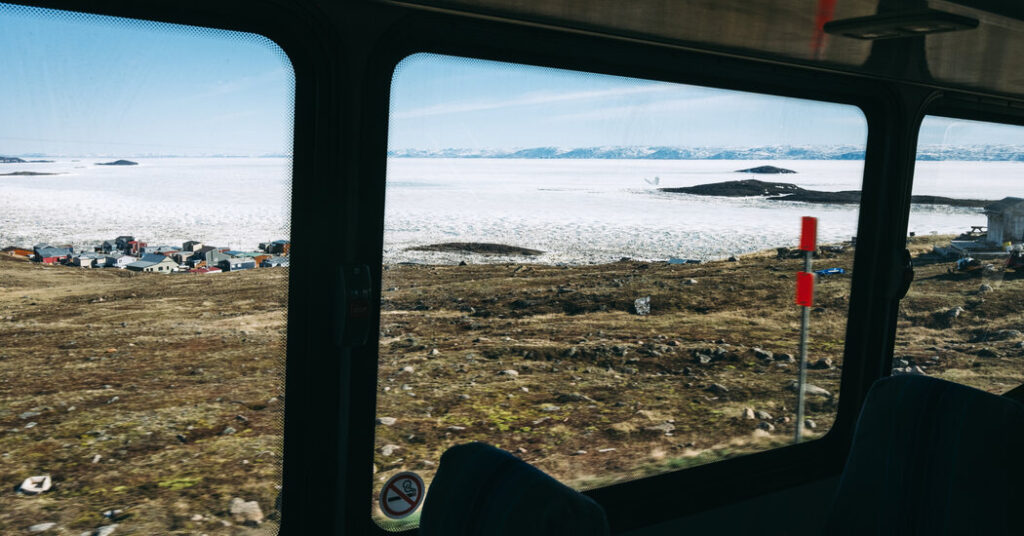
To Mr. Marques, the Canadian dream was found in Iqaluit, where ice on the nearby river and bay was melting fast in mid-June and snow had disappeared from the city’s streets but still covered its hills. A onetime U.S. air base, Iqaluit has grown rapidly since it was chosen as the capital of Nunavut, a largely Inuit territory established in 1999. The concentration of the region’s public services in Iqaluit continues to bring more government jobs and more people to the city.
The city, with 8,300 people, has also grown in diversity, with the number of immigrants more than doubling in the past decade. Its biggest supermarket is in the throes of a major expansion. Cranes tower over construction sites. Friday prayers are held at the decade-old mosque; Sunday services at African-led congregations.
As a warming Arctic has increased geopolitical rivalry over the region, the Canadian government has pledged to improve the poor infrastructure in the country’s northernmost reaches. In Iqaluit, residents without cars had to walk or pay dearly for taxis — until Mr. Marques launched Iqaluit Transit in March.
“It’s a capital city — right? — with no transportation,” Mr. Marques said. “It doesn’t make sense.”
That morning, the first passenger was Jordan Angnetsiaq, 35, who rode the bus daily from his home in Apex, the most distant neighborhood from central Iqaluit, to his government job downtown. The fare, five Canadian dollars, or $3.50, was about half the price of cabs, which charge a flat fare of nine Canadian dollars and 75 cents per person, per ride, or $6.85.
“Even in winter, I walked pretty much every day,” Mr. Angnetsiaq said, adding that the three-mile walk took him about an hour, each way. “Only when my knee felt really sore, I took the taxi a couple of times,” added Mr. Angnetsiaq, who had anterior cruciate ligament reconstruction surgery five years ago.
At a stop, Mr. Marques popped on board. He had succeeded in sliding the battery tray back into the bus and driven it over.
“We’re just changing buses,” Mr. Marques told Mr. Angnetsiaq, still the only passenger.
“I don’t need to pay again?” Mr. Angnetsiaq asked.
Reassured that he didn’t, he relaxed in the more comfortable, coach-style bus bought off eBay. His sister, another regular, didn’t get on this morning. In fact, many Inuit were away on the land this time of the year, in keeping with their timeless practice of fishing and hunting amid the melting ice.
“Did you see the river up there?” Mr. Angnetsiaq said. “It seemed a little bit deeper. When the rivers turn like that, the Arctic char go downstream. That’s why people are away camping and fishing.”
“Now arriving at KFC,” a recording on the bus announced as it neared downtown.
Low ridership led the city to discontinue a short-lived public bus service two decades ago.
Back then, Mr. Marques was a teenager living in Ottawa, where his family had settled after leaving war-torn Angola a few years earlier. His best friend was Hugh Karpik, whose family had left an Inuit hamlet called Pangnirtung so he could get a good education. The boys met when their English-as-a-second-language teacher asked Hugh to show a new kid around the school.
“Honestly, I thought I was in trouble, but she brought me outside and introduced me to Jacinto,” recalled Mr. Karpik, 36, who now also lives in Iqaluit. “We just became friends right there and then.”
After Mr. Karpik moved back to the Arctic, he invited Mr. Marques to visit to catch up and play basketball. Mr. Marques, then a university student with only 40 Canadian dollars in his pocket, was struck by the economics of the place.
“You can’t buy anything here for 40 dollars and I was, like, what is this place?” Mr. Marques recalled. “But the following year, I came back, and I’m, like, this is interesting. There’s money to be made here.”
After college, Mr. Marques came to Iqaluit, working first as a security guard at the hospital and then as a deputy sheriff at the courthouse, a job that took him to far-flung Inuit hamlets and made him understand the region’s needs.
“He was thinking just to come maybe for six months,” Mr. Karpik said, “but he grew to love it here.”
Mr. Marques started a marketing business in his spare time. Then during the pandemic — when residents had to stand outside the post office in the Arctic winter to collect their Amazon packages — he launched a delivery service to their homes.
He funneled the profits into his bigger dream of creating a bus service.
He and his business partner — his younger brother, Claudio, who lives in Ottawa — drove the buses from Edmonton and Philadelphia to Ottawa, painted them and shipped them on the annual sealift to Iqaluit. True believers in D.I.Y., Mr. Marques equipped the buses with wireless door sensors from Home Depot. Claudio set up a website where riders can track the bus live.
With no garage, Mr. Marques had to warm up his buses at 5 a.m. daily before the spring thaw, so they would be ready by 7 a.m. Mr. Marques did not voice the newcomer’s annoyance about the difficulties of living in this lost corner of Canada — open, as he was, after a decade in Iqaluit, to the tender indifference of the Arctic.
“There is always a way,” he said. “I don’t believe in, ‘Oh, this is the Arctic — it doesn’t work.’”
After a strong start, ridership had dwindled because of the good weather and the Arctic char going downstream. If Iqaluit Transit could hang on until the return of cold weather, Mr. Marques believed it would eventually thrive.
“I really hope this is sustained,” said a regular rider, Esther Usman, 65, an immigrant from the Philippines and a government worker who has lived in Iqaluit for 10 years.
Sajith Maanikkavasagam, 28, an immigrant from Sri Lanka, happened to be the only passenger on board one afternoon.
“It’s like a private bus!” said Mr. Maanikkavasagam, who moved to Iqaluit in May for a job as a manager at the expanding supermarket.
On a beautiful day of near total daylight, ridership fell to the single digits as some ventured outside in shorts and T-shirts. Mr. Marques’s bus appeared suddenly near the Road to Nowhere, which snakes up a hill to some new houses and the mosque before ending abruptly in the middle of the tundra.
The driver had 32 empty seats behind him — but also the greatness of the Arctic before him, the firmness of the Road to Nowhere under him and the bluest of skies above him. The bus went uphill, then downhill, then uphill yet again, in an endless loop around Iqaluit. One must imagine Jacinto Marques happy.
The post The Road to Nowhere Has a New Stop. appeared first on New York Times.