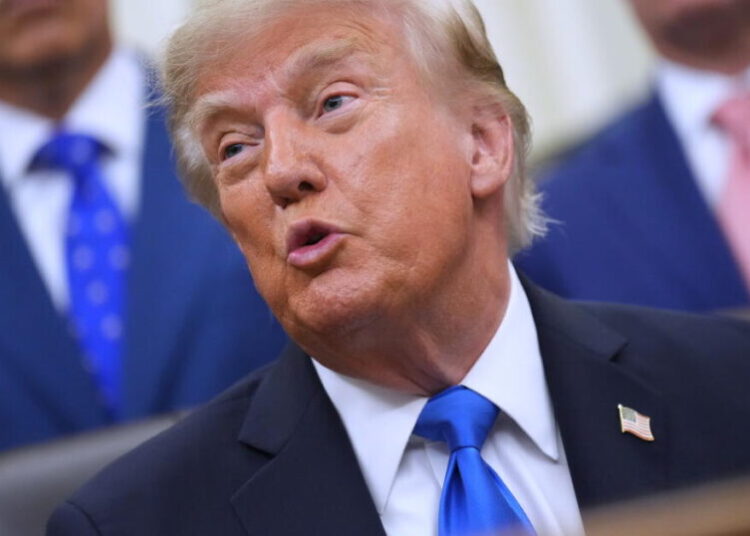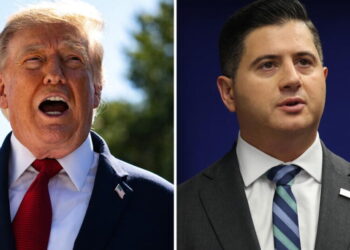
This week, “The Opinions” politics round table wrestles with the art of political compromise. Did Lindsey Graham ingratiate himself with Donald Trump to protect Ukraine — and was it worth it? Should the Senate confirm Todd Blanche to safeguard the attorney general’s office against someone like Matt Gaetz? Should Democratic leadership compromise with progressive insurgents within the party? The Opinion columnist Bret Stephens discusses these questions with the contributors Robert Siegel and Molly Jong-Fast.
Below is a transcript of an episode of “The Opinions.” We recommend listening to it in its original form for the full effect. You can do so using the player above or on the NYTimes app, Apple, Spotify, Amazon Music, YouTube, iHeartRadio or wherever you get your podcasts.
The transcript has been lightly edited for length and clarity.
Robert Siegel: Hi, I’m Robert Siegel, in conversation about politics. E.J. Dionne Jr. is away this week, so I’m joined today by two guests: New York Times Opinion contributing writer Molly Jong-Fast. Hello, Molly.
Molly Jong-Fast: Hi.
Siegel: Welcome. And Times columnist Bret Stephens. Hi, Bret.
Bret Stephens: Good to see you.
Siegel: We’re starting today — and we are recording on Thursday morning — talking about a vital element of politics: compromise.
Candidates don’t typically campaign on promising half a loaf, but often that’s the best that they’ll be able to deliver. And the uncompromising politician may end up delivering no loaf at all. But we’re seeing some of this play out in a few ways right now, and let’s start with one example from this week.
Acting Attorney General Todd Blanche has gone before the Senate Judiciary Committee for confirmation as permanent attorney general. By what standard should Blanche be judged? By the $2 billion slush fund that he used to support? Or the freedom for Trump and sons from the I.R.S.? Or should he be judged by the nominees, who would likely be waiting in the wings if his nomination were to completely fail? Bret, I suspect a lot of people would say this is a no-brainer, but a lot of people aren’t U.S. senators.
Stephens: Well, in a million years — if I were president — I would never nominate Todd Blanche. And it’s kind of a sign of the times that we are in this position where he is the nominee. The question is: What is the alternative? Or: What are the alternatives?
One is that the Senate refuses to confirm him, and out of pique or spite, Trump keeps him in his current job as acting attorney general. I think that’s damaging to the rule of law, to just have a succession of actings in the highest positions. It becomes a precedent, I think, for future administrations to essentially skirt the constitutional responsibilities of advice and consent that are given to the Senate.
The other alternative is that he pulls another Matt Gaetz-type character out of his pocket and shoves a succession of them in front of the Senate while keeping Todd Blanche as the acting A.G.
Siegel: As if to say: You think you don’t like Todd Blanche? Look at what I’ve got next.
Stephens: The best that can be said for Todd Blanche is that he was a well-regarded career prosecutor. Since then, it’s been a less reputable record.
Siegel: Molly, what did you make of what you saw of the Blanche confirmation hearings then?
Jong-Fast: It’s interesting because, if you think about it, there’s another confirmation going on at the same time: Bill Pulte is acting as our top spy for the country.
Siegel: Director of national intelligence.
Jong-Fast: Right. Bill Pulte — Donald Trump got to know him through the internet. He was an internet philanthropist, right? So Bill Pulte, a real estate guy who is sort of most famous for finding mortgage crimes — which turned out to not really be crimes — that the president’s enemies had committed, though none of those cases were ever proved to be criminal.
So there are always worse people down the pike, is a point that I’m trying to make when it comes to Trump. But what I have been struck by, so far, is that John Cornyn has ——
Siegel: Senator John Cornyn of Texas.
Jong-Fast: Yeah, Senator John Cornyn.
Stephens: Outgoing senator.
Siegel: Yes, outgoing.
Jong-Fast: He is a Texas Republican who’s very well respected within the Republican Party. My sense is that he was really one of the good guys in the Republican Party, in that world — like John Thune. Like a real establishment guy. Millions of dollars poured into his re-election, and at the 11th hour, it seems he’s still not able to keep up with Ken Paxton, and Trump comes in ——
Siegel: Yeah, this was his primary.
Jong-Fast: Yes, his primary.
Siegel: In which Ken Paxton, the attorney general, who was kind of MAGA before there was MAGA — Cornyn couldn’t beat him.
Jong-Fast: Right. And they were heading toward a runoff, and it was so close, and Trump would not endorse. And right before the runoff, he endorses Paxton, thus sort of burning millions and millions of dollars, but also ending Cornyn’s political career — at least in the Republican Party. I mean, I don’t know where else he would go.
But what I was struck by, in his questioning, was that he saw where this was going, and he saw what could really be a problem for Blanche, and he dug into it — and that was the slush fund. And so, you really saw the wheels turn, and you saw how a really smart senator could, if they wanted, just derail a nomination.
Stephens: Yeah, and look, he’s a former judge — he knows the law very well, and he has an ax to grind, rightly, because Donald Trump ended his career.
That being said — and we’re speaking on Thursday, I have to stress that — so we don’t know yet how he’s going to vote — my guess is, and I’ll have to eat crow if I’m wrong, he’s going to vote to confirm for the same reason that I suggested earlier, which is that the alternatives are likely worse.
Siegel: One of his points that he made, in questioning Blanche, was: You say that the slush fund deal is dead, but is there some way in which the government might still end up paying out part of this slush fund? It seemed to be a set of questions that could be answered with a presidential action, if Donald Trump cared to do that. My hunch is he doesn’t care to do that, but ——
Jong-Fast: I mean, the I.R.S. stuff is so egregious. The idea that Todd Blanche is going to give the Trump family — and I think it was just the sons — immunity from audits. I mean, first, clearly they had been sitting around, cooking up whatever was the most insane thing he could do for Trump and put it together. And you saw this in the testimony, when Senator John Kennedy from Louisiana — who was not trying for a gotcha, right? — says: You’re a friend of Trump’s. And Blanche says: No, I’m Trump’s lawyer.
Stephens: Was his lawyer, as he said.
But it’s been interesting to me, talking to Republicans or Republican-leaning figures who occasionally speak to the president himself — not politicians, but well-off people. The two things that have really hurt Trump in their eyes are the slush fund and the reporting by The Times that Trump or his family enriched themselves by $2.2 billion last year. That sits very ill, even among people who are his voters, and in some ways, his peers, because it reeks of a form of corruption ——
Siegel: Kleptocracy, I think.
Stephens: That reminds me a little bit of my youth in Mexico, when José López Portillo was president, and the corruption was so very much nakedly on display.
Jong-Fast: I think to go from the democracy we had — however imperfect — to, like, a full-on kleptocracy in just less than two years is pretty jarring, even for the most cynical.
Stephens: Right. Because the rule of law is something that even most Republicans value. And I don’t think that they objected so much during election years, when they could tell themselves the alternative is that much worse.
But what you have with Trump is really putting into the shade whatever might have been said against Hunter Biden and his own dealings — which, remember, were Topic A of discussion on some of the Fox News shows just three years ago. And by the way, I think absolutely valid points of contention, but this is something else.
Siegel: I’m just curious what your thought is — this is speculative: If Senator Cornyn were to vote against confirmation, and if he were to effectively block the confirmation of Todd Blanche, would he still be an extremely popular Republican in Texas? Would he be persona non grata for that? What’s the personal consequence of that?
Stephens: I don’t think it matters at this point. He’s got six months left in office.
I think the question for him is a legacy question: Does he want to go down over this, or be remembered for this vote and a note of defiance against Trump? Or, as I suspect, because he is a former judge, he cares about the separation of powers and honoring the spirit of the Constitution, and doesn’t want to see acting secretaries for the remainder of Trump’s term.
Jong-Fast: And I would add that Cornyn’s problem is that he wasn’t popular enough in Texas. I mean, you had Paxton, who had been impeached and had gone to trial with a donor, and had convinced state senators not to vote to remove him. I mean, this makes Trump look like Lincoln — at the state level anyway. So I think the problem for Cornyn was always that he just could not out-MAGA.
Siegel: Let’s move on to another case of compromise that a lot of us read about and thought about this week, which was the remarkable career of the late Senator Lindsey Graham, who had been one of the most fierce Republican critics of Donald Trump, when he, Lindsey Graham, was seeking the presidential nomination and after that. He then became an insider in the Trump administration and a friend of the president.
Bret, you wrote about this — that this was a choice that Lindsey Graham made. He could have remained in Liz Cheney land, being a prophet of “what’s wrong with this president.” And Graham was pretty open with people about this, that he was invited into the room, and he liked that.
Stephens: You know, I knew Lindsey pre-Trump, and was very fond of him. He was very funny. He was one of the three amigos with Joe Lieberman and John McCain who liked to defy partisan type, at least on a few issues. And they were united in things that, I think, mattered a lot, like the defense of the Atlantic Alliance and what we used to call the free world.
And so, when Graham flipped — especially after McCain died, in 2018 — I took it really bitterly. Maybe because I sort of set my teeth, as a conservative, against Trump, and that he had betrayed everything that I thought were his principles to curry favor with power.
After he died, it actually hit me harder than I thought it would. And in part because — say what you will about Graham’s choices — in the last week of his life, he accomplished consequential things — like a sanctions bill on Russia that the president is willing to sign; the president’s agreement that Ukraine can conduct deep strikes into Russian territory, which are changing the balance of that war and, hopefully, bringing peace a little closer. And probably saving NATO from Trump’s de facto destruction of the organization.
And I remember asking myself, after he died: Well, if that’s what he was able to do by sucking up to the president as nakedly as he did, maybe I shouldn’t scorn him or hold him in such contempt, as I had for years, after he had, as I thought, gone over to the dark side.
And so it caused a reflection or a reconsideration in a column that I wanted to be public about. I mean, I know everyone says: Well, it was a devil’s bargain. But some devil’s bargains, you might say, are worth the price.
Would Ukraine be safer today if Lindsey had gone up against Trump, gotten himself primaried six years ago and were blabbing from a seat on a CNN panel today? I’m not sure that’d be the case.
Jong-Fast: So in your column — the question was, if Lindsey Graham were a professor at Clemson writing Op-Eds, would Ukraine be safer? And it got me thinking about all of these senators who have sort of fallen from Trumpism, like the Jeff Flakes, right?
I mean, all the people, the sort of old-school Republicans, who couldn’t join him, right? And I wonder.
The problem with all of these bargains is that almost all politics is this devil’s bargain. And, I mean, we’re talking about Senator John Fetterman as another example of someone who came in, and a lot of us thought he was one thing, and he became a very different thing.
But the problem with Trump, I think — and this is the fundamental problem with MAGA, because MAGA is Trump — is that Trump is always the most reactive to the last thing that someone has whispered in his ear.
Stephens: Yeah. Look, in all politics, you do ask yourself just how slavishly you’re prepared to follow a party line. And politics does expect acts and proofs of loyalty. I mean, that’s just the nature of the game, and I think that’s true, by the way, on both sides.
You can see a lot of Democrats signing up to things they really don’t believe in because they feel that party unity demands things. And it’s always a question of whether you’re willing to partially submerge your convictions in order to curry favor, because you feel that will advance your goals.
Or when I think of, say, JD Vance — this guy is entirely plastic. His convictions are whatever suits a political moment or a perceived political opportunity. I think there’s a meaningful difference between a Lindsey Graham and a JD Vance. Lindsey never gave up on Ukraine. He never gave up on his Atlanticist convictions, his belief that America should be a force for good in the world.
And so he didn’t do what Liz Cheney did — which is essentially get himself evicted from the party but maintain a sense of moral purity — which I can respect. But you don’t succeed in politics typically by playing a martyr, and that’s the choice he made.
Siegel: I think a Cheney fan would resent “purity” and, say, “integrity.”
Stephens: OK, integrity. You know, you’re right. And I have great respect for Liz Cheney, but she’s not an influential person anymore. She’s a person who sacrificed herself on an altar of truth. And that’s great, but the world, sadly, moves on.
Jong-Fast: The operative who found Graham Platner had talked about how voters don’t want candidates who were grown in vats.
Siegel: They’re inauthentic. I mean, we’re killing ourselves on authenticity these days.
Stephens: This gets to the original premise of our conversation, which is compromise. You know, one of the tragedies, I think, of political life in America today is that it’s become a contest between the shameless and the stainless. Politics now — to enter political life — makes demands on a human being that, I think, would be very difficult for most of us who have lived normal lives.
And so, if you’re not a stainless person, if you haven’t lived an absolutely unblemished life, if no one has ever criticized you — then you’ll go into politics. I mean, Mitt Romney was in politics, very honorably, I should say. I mean, the guy never had a cup of coffee. He’s a stainless guy. But that’s a standard that very few people attain.
And then, on the other side, are people who are shameless. They don’t care what comes out about them. They’ll go for it. Graham Platner, in that sense, was a perfect emblem of shamelessness.
How do we return to a politics where normal people don’t feel inhibited from entering the political game? So that line, from the political operative who discovered Platner ——
Jong-Fast: Daniel Moraff.
Stephens: That line is one I actually endorse. We don’t want candidates who were grown in vats. We don’t want rapists, either.
And unfortunately, the choices with which we’re now typically presented, increasingly, by the way, lean to the shameless side — people who just don’t care what’s said about them. Donald Trump is a perfect emblem of that.
Siegel: And it’s my impression that authenticity can get you through almost everything in American politics. It can be: Donald Trump, that’s Donald Trump, that’s who he is. That’s what kind of guy he is.
Stephens: Well, authenticity has become a substitute for honesty. You can be an authentic liar. That’s what Donald Trump is.
Siegel: That’s right.
Jong-Fast: But Donald Trump was also a celebrity. Like, celebrity plays a huge role. I mean, part of the reason that JD Vance is unable to capture any of Donald Trump’s — whatever kind of political magic that he has — I think is partially because he is pretty smart, and partially because he’s not a celebrity.
Siegel: Keeping with the theme of compromise — the recent primary successes of a few democratic socialist candidates could soon force concessions from the Democratic Party leadership, or the D.S.A. newcomers will compromise on their values once they’re in office. Molly, what do you make of the new, new left in America?
Jong-Fast: So I think there are a couple of things happening that have opened the door to this insurgent group. I think the larger issue here is that the base is furious, and I think we’re not seeing that so much in our world. I think that the elites are not as furious.
I talk to all these different candidates for my podcast who are sort of state-level candidates, and what I hear from them is Democratic voters are furious in a way that Republican voters were furious. In 2018, Democratic voters would go along with a Chuck Schumer kind of chant. They just wanted the nightmare to be over. And I think now, fast-forward a decade, they want more. They have a laundry list of things. They are as angry about inflation as the people who voted for Trump in 2024.
Siegel: But it seems like a short laundry list, which is — it seems to be — Medicare for all and don’t give Israel any money.
Jong-Fast: So I think these candidates don’t want taxpayer dollars going to Israel for any number of things, and then I think single payer for sure. Now I think there are other things: They want housing to be less expensive. They want inflation to go down — which, by the way, is, as Trump is finding and I think you see in the polling, very hard.
I think Trump did a lot of things to make inflation worse, obviously. But even if you weren’t doing that, it’s very hard, as president, to get inflation to go down.
Stephens: You know, I understand the Democratic anger, but typically, when people are furious, they do dumb things. I mean, when Republicans were furious during the late Barack Obama years, they went and got themselves — and got us, the rest of the country — Donald Trump.
And I’m worried that the Democrats are about to fall into the parallel trap. Now I know that there are going to be people listening to this conversation saying: Oh, it’s absurd of you to suggest that MAGA has anything to do with those nice democratic socialists, who just want universal health care and peace and justice in the Middle East.
But they also, if you listen to the platform of the D.S.A., want essentially an open border, and they talk about having control over the means of production. And there are two kinds of dangers that this poses: One is that they actually get an agenda through, which — call me an old-fashioned conservative or, even, a liberal — scares me. I believe in free-market capitalism.
But actually, I think the bigger fear — and this is something I say to my moderate Democratic friends — is that these are the people Donald Trump wants to run against. There is now a soon-to-be congresswoman from New York who, if you at least credit her tweets and other brainstorms from the last five years, is kind of a communist, like in the old-fashioned sense. I’m old enough to remember this and use this C-word quite proudly.
That’s a lot to hang around the necks of the Democratic Party. And so I really think that the liberal Democrats represented — maybe not by Chuck Schumer but by younger Democrats like Jake Auchincloss or Seth Moulton, both of them from Massachusetts.
Siegel: Massachusetts, yeah.
Stephens: Andy Beshear in Kentucky. They actually should want, I don’t want to say a civil war, but a real debate in the Democratic Party: Are we Democrats or are we democratic socialists? There’s a significant difference between the two, and I’m looking for a passionate, articulate, old-fashioned, F.D.R.-type liberal to say: We are not the D.S.A. This party does not represent us.
That hasn’t happened so far, and I fear that those Democrats are making the same mistake that Jeb Bush Republicans made in 2015, saying Trump and all of this anger will subside, and we will once again nominate a normal Republican.
Jong-Fast: I both agree and disagree with you. There certainly are people who will be elevated, and this has always been true. Let’s remember the squad. Like, we’ve seen Alexandria Ocasio-Cortez go from outlier to bridge builder. I mean, she gets a lot of criticism from the left for being too centrist.
So there are politicians who come into office and learn how it works, and then there are politicians who don’t. One of the things that I’m struck by, when we talk about this, is that there’s a school of thought that there are people who are angry that Liz Cheney campaigned with Kamala Harris and do not think that they were able to grow the tent. The Venn diagram for Democrats and Liz Cheney is, you know — let the audio show that I made a strange hand gesture.
But the question is: Did Liz Cheney grow the party, or did Liz Cheney alienate the base? And is this the base fighting back to some extent?
Stephens: I think the evidence — and I’m sure someone is going to contradict me — still shows that elections are won at the center, not by growing your base on the extreme right or extreme left.
Harris lost for a number of reasons. She would say she got in too late. I think she was a bad candidate. I don’t think she should have just been coronated. There should have been a better nomination process. But I do not think that she lost because she was insufficiently appealing to the Gaza protest types of people.
I think they are loud, but they’re not hugely representative, and I think the Democratic Party would make a big mistake lunging to its left, trying to replicate what Trump did. Because remember, too, that the far-left voters that some Democrats think are winnable and stayed home: They live in New York. They live in California. They’re not swing-state voters in Wisconsin or Michigan or Georgia or North Carolina. Those are the voters that you have to win over by playing to middle-class concerns of people who have voted for both parties in their past.
Jong-Fast: I do want to just add — just because Trump did something that’s interesting, which is he got these low-frequency nonvoters to vote for him, which is why his victories were so strange, right? And I don’t think that those voters are Gaza voters.
Siegel: I would just add here about where these socialists have been elected or nominated. I’m a New Yorker who has been living out of town for 60 years.
And when I was a kid, my father told me about Meyer London. Who was Meyer London? Meyer London was the socialist congressman from New York in the 1920s for a couple of terms. About Vito Marcantonio. Who was Vito Marcantonio? Core of the American Labor Party and a progressive New York City congressman. After the Republican Party was won over by the Goldwaterites, New York City nominated the most liberal Republican you could possibly find, John Lindsay, to be its mayor, and he was elected, so ——
Stephens: But it’s not just New York. I mean, you also have a primary in Denver, won by a D.S.A.-backed candidate. The D.S.A.-backed candidate for the Wisconsin Democratic gubernatorial primary is in the lead. It’s happening outside of the usual red-diaper-baby precincts of American politics.
Siegel: We have a practice here — to wrap up these discussions after we’ve been hearing about the horrors that lie in store for us, in our politics or in foreign wars sometimes — to just close on a note of joy, some joy you’ve experienced recently that you would like to share with us.
Molly, why don’t you kick things off?
Jong-Fast: I have a rescue dog, a naked Chinese Crested rescue dog named Incitatus. We call her Inky. Just to have a rescue dog, and to bring them into a little pack of tiny dogs that are running around and frolicking, is really wonderful, and it’s bringing me a lot of joy.
Siegel: Hear, hear.
Stephens: I’m not embarrassed to say that the greatest section of The New York Times is not Opinion or Foreign. The best desk is the Obit desk, far and away. It’s the first thing I turn to, and not just because I’m looking for real estate, as the old joke has it. It just has such great obituaries of people, of improbable figures.
And last week, The Times ran an obituary for the singer Bonnie Tyler, who passed away, sadly, at the age of 75. A Welsh singer known to anyone who came of age in the 1980s, on 1980s MTV, for her song “Total Eclipse of the Heart,” better known to a friend of mine as Total Eclipse of All Art.
But, the obituary for her in The Times, which is just kind of one for the ages, is from Alex Williams, and I just have to read these two paragraphs, if you don’t mind, on the song “Total Eclipse of the Heart”:
Slowly and inexorably, momentum builds to climax after climax, during which Ms. Tyler’s surging vocals, dancing on the edge of camp, seem like they could melt the microphone: “Together we can make it to the end of the line — your love is like a shadow on me all of the time.”
The accompanying video, extravagant even by 1980s standards, was shot in a former asylum in Surrey, England. Conjuring a mood of Gothic horror with ninjas, half-clad football players and altar boys with glowing eyes mixed in — “Turn around, bright eyes,” indeed — it seemed to play once an hour on MTV, at the height of the network’s influence.
And I just want to say thank you to Alex for absolutely making my morning with such a wonderful obituary.
Siegel: And for me, I just have to confess that, once again — as it happens every four years, even though I think I don’t care — I have been totally sucked into the World Cup, and have enjoyed it tremendously.
Stephens: Who are you cheering for in the final?
Siegel: Well, I keep on losing all the teams that I cheer for. I started out being a good U.S.A. fan, and then the Francophile in me came out. It’s great stuff.
And even though the craziness of the U.S. red card — which reminds one that something that involves the Trump administration and FIFA has the ethical possibilities of a professional wrestling match or something. It’s quite a combination. I guess I hope Lionel Messi does well and wins it for Argentina. But I don’t have a strong preference. Do you?
Stephens: I am rooting for Argentina, but for reasons that are so abstruse that I’ll leave them for another conversation.
Siegel: On that note, Bret and Molly, thank you both very much for a wonderful conversation.
Stephens: Thanks a lot.
Jong-Fast: Thank you for having me.
Thoughts? Email us at [email protected].
This episode of “The Opinions” was produced by Derek Arthur. It was edited by Alison Bruzek and Jillian Weinberger. Mixing by Efim Shapiro. Video editing by Julian Hackney and Kristen Williamson. The postproduction manager is Mike Puretz. Original music by Pat McCusker and Carole Sabouraud. Fact-checking by Julie Beer, Michelle Harris and Mary Marge Locker. Audience strategy by Shannon Busta and Kristina Samulewski. The director of Opinion Video is Jonah M. Kessel. The deputy director of Opinion Shows is Alison Bruzek. The director of Opinion Shows is Annie-Rose Strasser.
The Times is committed to publishing a diversity of letters to the editor. We’d like to hear what you think about this or any of our articles. Here are some tips. And here’s our email: [email protected].
Follow the New York Times Opinion section on Facebook, Instagram, TikTok, Bluesky, WhatsApp and Threads.
The post The ‘Devil’s Bargain’ at the Heart of American Politics Now appeared first on New York Times.