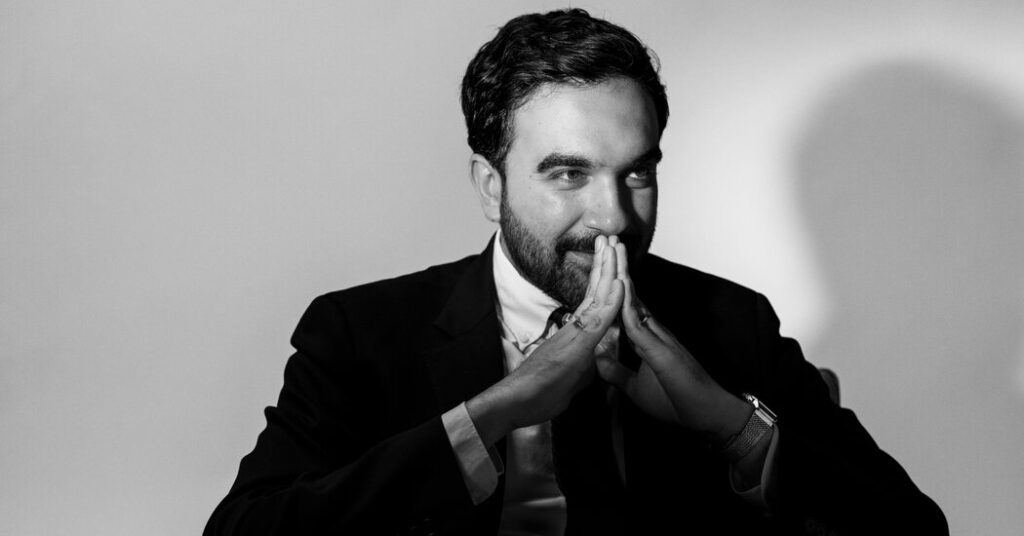
Mayor Zohran Mamdani of New York City is riding high. In an era when the public is sour on politics, recent polls show him actually becoming more popular among New Yorkers. It’s fair to say that some of that is vibes: As the Knicks won the N.B.A. championship, Mamdani became one of the team’s main hype men, basking in the reflected glow of their victory; the World Cup has been a raging success with New York City awash with celebrating fans; Taylor Swift got married in a secret celebration in the most visible of New York venues.
As his star rises, Mamdani, a democratic socialist, has also been flexing his political power in new ways — his endorsement of three progressive candidates for the House of Representatives gave them the edge against establishment-backed incumbents and contenders, and cemented his role as a kingmaker in the Democratic Party. Mamdani, of course, also has many detractors, on the right but also among Democratic leaders in Washington who worry about his influence and his aims in pulling the party further to the left.
I sat down with Mamdani earlier this week to talk about what has turned out to be a fascinating, and controversial, experiment in what democratic socialist governance can do in America’s most important capitalist city.
Subscribe: Apple Podcasts | Spotify | YouTube | Amazon | iHeart
I was going to do this whole interview without mentioning President Trump. But he tends to enter the chat, and he recently shared a video by Michael Savage, a pro-Trump pundit, calling for you to be criminalized and deported. What does it mean when the president of the United States shares a sentiment like that? I think that it’s part of the corrosion of political and public life. This is, frankly, something that I don’t even blink at anymore because it’s become, in many ways, a norm over the last few years.
I can hear you deliberately not trying to personalize it, not trying respond to it — but does it impact you and your security? I am lucky in that I’m protected by the best of the best in our N.Y.P.D. What is so terrifying about the normalization of political violence is what it makes acceptable toward any “other” in this city, in this country.
We’re talking a few weeks after some pretty big political victories for you. You endorsed several democratic socialist candidates who then won their primaries. And after they won, you said you wanted to send a national message. Why? For too long, it has felt like our party, the Democratic Party, the only answer we have is to say that we are not the Republican Party. The only answer we have is a response to the cruelty of the federal administration. But we also have to have a vision of what comes after this administration. And I think that at the heart of that has to be a vision for that working person, and that’s why it is so critical to speak about that not just here in New York City but anywhere those people are struggling.
And you feel like, because of your position in the party — you are, at this point, one of the most visible people — that you’re the person to impart that? I think that message is coming from New Yorkers themselves, and we should listen to them when they vote for Darializa [Avila Chevalier], for Claire [Valdez], for Brad [Lander]. When they vote for all five of the state legislative candidates that I endorsed that won their races.
So much of what has often been discussed as if it is an intellectual debate is in fact something that can change the material reality of working New Yorkers. And that’s what’s so incredible about being able to serve as the mayor of the greatest city in the world — it’s a chance to show that you can fight for the people that the right has left behind.
Do you see yourself as a Democrat or a democratic socialist? Because you said “our party,” and obviously you ran as a Democrat. I am both. I’m a Democrat and I’m democratic socialist. So much of what makes me proud to be a Democrat is looking at what our party used to stand for. You think about the Four Freedoms, you think F.D.R., you think the New Deal. Those are at the core of what our party’s identity is, and yet it feels like to experience it, you have to read about it. You can’t see it around you anymore. And that isn’t something that I’m willing to accept, and I know that many feel similarly.
I’m curious how you’re planning to use your political capital. Are you planning on getting involved in races outside of New York? My focus right now is on New York City.
If you’re wanting to send this message beyond New York, the question obviously is how and when. I am still seeing the world like that cover of The New Yorker where it’s New York, it’s New Jersey, and then it’s the rest of the world. But I also think that New Yorkers have sent a message, and we’ve seen these kinds of victories in New Jersey, in Colorado, in California.
After those endorsements, you said: “2028 begins now.” What role would you like to play in 2028? You know, sometimes politics feels like it’s a hobby only some can afford. And I don’t want it to be that way. Politics determines what people can afford, and we need to see a recognition of that and an actual platform of how we will deliver that affordability. Cities have often been discussed as the laboratories of democracy — we can actually show that this isn’t a fantasy.
One of the people who is rumored to be considering a run for president is Alexandria Ocasio-Cortez, and there’s been reporting that you coordinated with A.O.C. in your New York endorsements. Do you consider that to be a partnership? Absolutely. I consider it to be a partnership, and I also consider her to be an inspiration. I had the privilege of having been represented by her in Congress. Before I was the mayor, I was an assembly member in an overlapping part of her congressional district in Astoria and Long Island City. And I think she has shown what it looks like to fight for working people.
Do you consider an alliance, going forward, that she would endorse, you know, Abdul El-Sayed in Michigan, and you endorse here in New York? I think that she makes her own decisions. I’m excited to continue to work together, because for a long time, politics has been understood as if it is about individuals. And at the heart of that partnership is a belief in the collective. The greatest mayor, I would argue, in New York City’s history is Fiorello La Guardia. He could not have achieved what he did without the partnership of F.D.R. That dream of having partners is also what drove me to endorse those three congressional candidates, because you can’t fulfill an affordability agenda for the most expensive city in the country without partners at every level of government.
It’s interesting that you mentioned that partnership with F.D.R. Would you endorse A.O.C. for president if she runs? That obviously would be a very clear partnership. I’m excited to see what decision she makes. In terms of endorsements, the ones that I’m focused on are the ones I’ve just made.
You think she’d make a good president? I think she’d make a good anything.
We’ve talked about your endorsements. And I would like to talk in particular about Darializa Avila Chevalier, who ran successfully against Adriano Espaillat, the head of the Hispanic caucus. He’s a former undocumented immigrant. He has strong progressive credentials: dismantle ICE, supportive of Medicare for All. Did you privately promise him that you were going to support his re-election campaign during your campaign for mayor? I told him that I appreciated his support when he endorsed me in the general election after I won the Democratic primary. And the promise that I made to New Yorkers was to use any tool that I had to further that affordability agenda. And in Darializa, I see a congressional candidate, soon to be a congresswoman, who really has built a campaign on a vision of babies, not bombs. And I think that that speaks to what it means to invest in affordability, and also reckons with the bankruptcy that has typified a lot of our politics, especially when it comes to our foreign policy.
You were asking me earlier about political capital. I think the point of political capital is to spend it to deliver material change. And these are not intellectual arguments. When it comes to Darializa’s district, this is one of the poorest congressional districts in the United States of America. And as I walked that district with her, we were discussing the amount of money that our federal government sends, billions of dollars, to the Israeli military, and as we were doing so, a man came out of a bodega with his hands full with two packages of Huggies. And you see what the priorities are of people living in the district, and yet you see what the priorities are of the federal policy that represents the district. And you see this chasm. And the more that you tolerate that kind of chasm, the more you tell people that politics is something to tune out, as opposed to something to be a part of.
Is the reason you didn’t endorse Espaillat his relationship with AIPAC, the pro-Israel lobby, his longtime support of Israel? I think these are all important factors. I think the need for moral clarity in our politics, to quote Congresswoman Ocasio-Cortez, is something that also applies to our foreign policy when it comes to the funding of the Israeli military. And you saw, in the final weeks of that race, AIPAC spending a significant amount of money to try and stop Darializa. It’s hard to explain to a New Yorker why their needs are not even being discussed, and yet we have billions of dollars to kill civilians halfway across the world.
I want to understand your point of view on what political weight you give the Israeli issue. You are very clear about where you stand. But I’m wondering how you apply it to how you look at other political actors. The left-wing streamer Hasan Piker recently said: “Someone who will not say the truth about Israel’s genocide will not stand with you and fight for you, for your health care, for your housing. It’s that simple.” Do you agree with that? I think what we have seen from New Yorkers, what we’ve seen from Americans, when we talk about this hunger for a new kind of politics, it’s a hunger to move beyond the bankruptcy that characterizes a lot of politics today. And it is hard to find a more bankrupt policy approach than what our country has done to Gaza and to Palestine and how it hasn’t been specific to any one party. It’s been, again and again, an insistence to tell New Yorkers, and to tell Americans, that what they are seeing is not something they should in fact either be concerned by or believe in. It is hard to then turn to another issue and say, Believe me here. And too often you’ll find that there are far more congresspeople who will privately tell you that something is a genocide than publicly announce it to be so. And so long as there’s an understanding of a difference in what people believe and what they’re willing to say, there will be a skepticism and, frankly, a despair among those considering whether or not to engage themselves in politics.
So should the litmus test for a politician who wants to be part of your coalition be their views on the Gaza war and their commitment to calling it a genocide? I think it’s an important part. I wouldn’t say that there’s a specific litmus test as to creating a cookie cutter of a person that I would endorse in any one seat. What I would say is that you have to have a clear vision of being able to describe things as they are, and being able to fight for that which working people have been denied.
But can it include those who support Israel and support America’s support of Israel? When you asked me earlier, What is my party? I said: the Democratic Party.
I’m asking you, though. Not what’s in the Democratic Party, but — — My point is that the importance of a big tent, it’s critical that we can work with those with whom we might not have agreement on every single issue. And you can even see in the administration that I’ve put together, it’s not an administration where at every job interview I ask someone, “What are your thoughts about Israel and Palestine?” Frankly it has very little to do with most of the things that I’m hiring for. You are looking for expertise. You are looking to deliver on the ambition of your policy platform and to build a team that’s able to do so. And when it comes to my endorsements of congressmembers or those running for state legislative seats, they have to show a vision of the world that speaks to that despair, and also addresses how you would actually deliver something different.
And you felt that Espaillat didn’t do that? No.
Former Vice President and presidential candidate Kamala Harris called you recently. She’s reportedly reaching out to pro-Palestinian groups or people with pro-Palestinians views. She’s considering another run for president, reportedly. As Biden’s V.P., she is closely associated with America’s support of Israel during the Gaza War. Do you think she can regain trust on that issue? I think that the first step for anyone looking to run is to be honest about what we see today and what it would take to change that. And when I say what it will take, one of the common features between all of the people that I endorsed for Congress was that each one of these candidates spoke about how they would sign on to the Block the Bombs legislation [which would restrict the sale or transfer of specific weapons to Israel]. It speaks about an unwillingness to continue to be complicit in a genocide. And we’re talking about billions of dollars in material support. So I think the first step for any presidential candidate looking to earn the trust of people across the country is a recognition of what our policy has wrought and what a different policy would deliver.
Did you hear that from her? I truly appreciated the vice president reaching out, and I think it is a critical part of this early stage.
Pro-Palestinian voices were not allowed to speak at all during her 2024 Democratic convention. I heard from people in the activist community around that. They felt betrayed by the fact that they were not allowed to engage publicly — that their voices, they felt, were silenced. How damaging do you think that was for her? I think what people wanted in that moment was to know that their voice, too, belonged in this party that we call home. What I’m thankful for is that now — today — that voice is being heard. And it’s being heard not only because there are those who have it that are entering into the halls of Congress but also because those who’ve long stood up for the belief in a universality when it comes to human rights are now being treated as core parts of a political conversation, whereas before it wasn’t even a conversation that was often permitted to be had.
Do you think the Democratic Party can become the party of Palestinian rights? I think it can become the party of human rights for all people, and that must also include Palestinians. I think people are tired of exceptions being drawn.
Israel’s prime minister, Benjamin Netanyahu, is perhaps planning to visit New York for the U.N. General Assembly. You pledged during your campaign, and after you won, to order his arrest to comply with the International Criminal Court warrant. What will happen if he comes in September? I believe that Prime Minister Netanyahu belongs in The Hague. He’s a war criminal who has been charged by the International Criminal Court. And what you will find is that is an opinion that is held by many purely because of what his actions have wrought over these last many years. I’ve also said that I will follow the laws that we have here in New York City because I believe that there is an importance in following the law as a leader who presides over our city.
I’m sorry, I don’t understand what that means. Meaning that whatever the law allows me to do in New York City, that’s what we will do, but we won’t be writing our own laws to that end.
What does the law allow you to do? That’s an active conversation with our legal department. However, what we’ve seen at the national level is a desire sometimes to write your own laws, to go outside of the bounds of legality. That’s not something we have an interest in.
One of the things I wanted to ask you about was your broader vision for your coalition now that you’re getting involved in federal races. Darializa Avila Chevalier has a particular view of immigration. She rejects all deportations, even of violent criminals. She called borders a philosophical concept. How do you view the issue of border security? What border policy should America have? Should immigrants be able to claim asylum at the U.S.-Mexico border? I believe that you should have a border policy that both is secure and one that is also defined by some humanity. When we talk about immigration, it’s often bandied about as just a political subject for debate. ICE is an agency that has terrorized Americans across this country and others that live in this country. Just the other day, a man said goodbye to his wife and his child, and moments later was shot by ICE agents in Maine. And this was not even a month after a man was killed in Texas.
I went to a Dominican barbershop in Harlem, and the owner was telling me that everyone in the barbershop had status. And yet most of them were terrified to come to work because they know that for so much of ICE’s operations, it has little to do with legality. It has to do profiling, and it has to do with a vision of creating the largest deportation machine this country has ever seen, and of a notion of this country where so many of us who call it home would have no place in it any longer.
The Democratic Party has struggled in gaining support over its border policies, considering what happened under the Biden administration, where you had the border, as some would describe it, being overrun. And that had impacts here in New York City. And it made people very unhappy. So I would like to understand what a humane border policy is for you. I don’t believe that “secure” and “humane” are at odds. I don’t believe that the only way to provide immigration enforcement is through ICE. I think oftentimes we are forced into these false choices.
But would you have asylum seekers be able to, for example, ask for asylum at the U.S.-Mexico border? What is the law today? What are they legally entitled to do?
Under President Trump, the law today is that they’re not. And that has meant that the border has seen a dramatic drop in illegal crossings. That is the tension that a lot of people see. I think that what we’ve found from the Republican administration has been a desire to make any and all immigration illegal. And I sit before you as one of the first immigrant mayors of our city in generations. I lead a city where, of eight and a half million people, more than three million are immigrants. And so when we’re talking about legitimate claims to asylum, I think those should be honored. I talk about our pride in being a sanctuary city in terms of the policies that we practice. I’ll give you an example of those policies: We are willing to work with the federal government on more than 170 serious crimes if someone has been convicted of them. What we are unwilling to do is to participate in civil immigration enforcement with a federal government that has said openly it wants to deport a vast majority of people for crimes that we will never even know. That is where I see the tension.
Have you ever been to the U.S.-Mexico border? No.
You’ve been in office for half a year. You have very high approval ratings — 58 percent in New York City, according to the most recent Siena poll. And that is a number that has actually gone up, which is unusual in our current political moment. You’ve made strides on two out of your three central campaign promises: a start on universal child care, the rent freeze. Free buses are not there yet, but you’ve just launched a whole new project on making the buses faster. Yes — 175 routes. Up to six minutes saved per way.
I think people find it heartening that you nerd out on this stuff. Because it makes a difference. I think it’s oftentimes overlooked, but more than a million New Yorkers rely on the bus.
As I was thinking about the ambitions that you have laid out, I was wondering, and I know this is a little bit of an absurd question, but if you had a magic wand, if money was no object and you could enact anything, what would you do? I’d be doing the same things I’m doing now.
Oh, come on. It would just be a lot easier.
One thing I’m very passionate about is universal child care. That would be the thing. And the reason that would be the thing is, right now in our city, to afford child care for a 2-year-old, as a family you need to make $334,000. That is an extraordinary amount of money. And if you as a family are making $300,000, you’re still not hitting it. If that is unable to meet the bare minimum of what it means to raise a family in this city, that’s a real problem.
This year, we secured $1.2 billion. We’re going to make child care free for 2,000 kids this fall, 12,000 next fall, every single 2-year-old by the end of four years. But if I had a magic wand, and I could say “wingardium leviosa” or whatever spell, yes, I would love to make it free in an instant. How about you, what would you do?
What would I do if I could absolutely do anything? It’s a hard question, isn’t it? Live in my shoes for a minute.
I mean, personally, more park space, more outdoor space. I thought I couldn’t get that question wrong, and now I feel like I did! [Laughs] What’s your favorite park in New York City?
Central Park. Come on! Try a little harder.
No, I’m not going to try a little harder. This is me interviewing you, and not vice versa. Apologies, I should know my lane! [Laughs]
Stay in your lane, Mayor Mamdani. I want to talk about New York’s economy, because much of it is built around Wall Street, finance, real estate. How important is it for you to have a good relationship with those sectors? And how would you say your relationship is with those sectors? I think it’s important. And what I have in common with leaders of those sectors — even amid disagreements, because I believe that we can raise taxes a little bit more on the wealthiest New Yorkers — what brings us together is both a belief in the city and a commitment to its continued vitality.
The other day I went to the announcement of the new American Express headquarters at Two World Trade Center. And one thing that stood out to me was that these business leaders, they’re not just making decisions on the basis of dollars and cents; they’re also making decisions on the basis of investing in the city and in what the city represents.
I think everyone who has heard you talk about American Express and other big organizations that are going to be employing people — Anthropic, et cetera — has wondered, How does a democratic socialist like yourself view the role of business and private industry? What does socialist economic development look like? Because the way you’re talking, you sound like any capitalist mayor. Oh, my god. [Laughs] Look, I think we have to go beyond the typical indicators of what makes a strong economy. Yes, it’s the wealthiest city. And it’s also a city where one in four are living in poverty. So I will always celebrate continued investment in this city. And I’ll also look to ensure that more and more New Yorkers can be a part of those benefits. Because when we talk about our vision for this city, the affordability agenda, it’s that those who help build it can also live in it.
And right now, so many working people, if you ask them where they live, they won’t tell you a neighborhood across the five boroughs. They’ll tell you a neighboring state. They’ll tell you they live in Jersey City. They’ll tell you they live in Connecticut. They’ll say they live in Pennsylvania. I think that’s how a city becomes a museum; not a living, breathing testament to the possibility of working people. In the first five months of this year, we had an addition of more than 21,000 jobs. Of any metro area in the country, it’s the fastest growing one.
I mean, the city’s recent job numbers aren’t particularly strong. The unemployment rate is comparatively high. You haven’t appointed a head of the Economic Development Corporation, which is an important tool that New York City mayors have for development and job creation. And there has been a sense that perhaps that is sending a message to the business community that you aren’t as interested in those public-private partnerships as other mayors have been. I’m incredibly interested in them, and we are in the final processes of interviews for that role. I want them to bring a set of skills that can deliver on economic development in a way that goes beyond what we’ve seen in recent years. And I will say that even amid the search for a new head of our economic development corporation, the E.D.C. continues to do the work. Especially when it comes to our agenda of delivering city-run grocery stores. That is work that is currently within the portfolio of E.D.C., and they’ve done a very good job in moving forward.
Let’s talk about policing. Murders and shootings are now at historic lows. But there is — — I knew there was a “but” coming!
There is another tension there that I think people are trying to understand. The D.S.A. has been very vocally skeptical of the tactics of the N.Y.P.D. and of your police commissioner, Jessica Tisch. She stayed on from the Adams administration, and she’s a pro-Israel billionaire. She’s a technocrat. She’s been very successful at her job. You have been publicly very supportive of her, but you also just nixed 600 new police officers. And it has been reported that part of the reason for that was because of complaints from the D.S.A. Do you see a tension between your organization and your police commissioner? In the many words that you were describing our police commissioner with, the two most important, I think, were “very successful.” When it comes to the question of the size of our police force, I’ve said time and again that the police force that has delivered these kinds of record lows is the one that I trust to continue delivering that kind of public safety, and that we’re going to be able to do that within our authorized head count that also comes as part of a focus across city agencies on how to deliver on savings at a time of inheriting a $12 billion fiscal deficit.
How committed are you to Commissioner Tisch being part of your administration? Because you are very different philosophically. Yes, and I think part of what it means to be a New Yorker is to work with those with whom you may have a disagreement on one or two issues. And anyone who works for me at this point, they’re someone that I want to continue to work with tomorrow, the day after that.
You want to make New York the model nationally. And so how you think about policing, how you think about the partnerships with the economic class, has much more resonance because of your own interest in having that resonate beyond the confines of New York City. When I was running for this office, I would hear time and again what a catastrophe it would be if I were to win, when it came to capital flight, when it came to crime. And what we’ve seen is so much of what is fearmongered around has very little relationship to reality.
Part of this discussion, of course, is the organization that you are part of, which is the D.S.A., and it’s having a moment, right? They are being discussed in both good ways and bad, to put it mildly. And at the heart of it is this idea that they are fighting for the working class. And it made me wonder: How do you define the working class? I think if you have to work to pay your bills, I think that that is one definition of being a part of the working class.
So someone making $250,000 a year is working class? I haven’t asked myself where it starts and stops. What I would say is those who are working to try and afford the basic dignities of life and aren’t able to do so, I think that that is also working class. Oftentimes we’re asked how we divide this country. I think there’s only one majority in this country — it’s the working class.
That just doesn’t ring true to me. What do you think?
It just seems a very easy answer to what is a complicated question. Because politically, if you’re saying everyone is the working class, or anyone that gets a salary is the working class, yes, that opens up your tent. But practically speaking, we are divided by income — and especially if you want to tax people, where you draw those lines matter. I’ve drawn it at about a million dollars a year.
So anyone under a million dollars a year in income is working class? [Laughs] That’s not what I’m saying. I’m just saying, in terms of fiscal policy, I think a lot of our politics has been a debate over who you leave out. And I’m more interested in debates of how you bring more in. But yes, I do want to raise taxes on people who make more than a million a year.
Someone who is a janitor is going to feel some kind of way about that description if you’re lumping them in with someone who’s a lawyer. That feels like a distinction that might matter. When I was running, a question I would face was: What does it mean to be a democratic socialist? And I only bring that up because I think sometimes there’s a fixation on a definition of something. And what I found is, when I would knock on New Yorkers’ doors, they would just ask, Am I part of your vision? It’s not that everyone is making the same amount of money or facing the same amount of struggle, but that they just want to know, is there any way for them to actually be able to work this hard and afford a good life in the city?
I’ve noticed that when I’m trying to get specifics, you deflect to talking about what New Yorkers do and don’t want. And I have found that politicians, in my own experience — — Oh, no.
When I ask questions of them — — Am I one of them?
Well, you are the mayor of New York City. When I try to get them to define something and they don’t want to do it, they use a very broad brush. Look, I think I’ve defined it to you as someone who works to afford their life. I also think, no matter how you define it, we have an understanding that those who are struggling to afford the rent, struggling to afford their groceries, struggling to afford child care, are the people who should be at the heart of our vision for what comes next.
The other issue that has been brought up a lot about the D.S.A. is, of course, the vetting. We’ve just seen Graham Platner’s campaign in Maine implode over sexual assault allegations. And your top adviser, Morris Katz, was instrumental in running Platner’s campaign. It’s been a pretty huge mess. Has your faith in Katz diminished? Do you blame him in part for what happened? No. First, I’ll just say, when I heard of the incredibly serious accusations that came forward and I was asked about what should happen next for that campaign, I said that it should come to an end. And I think when it comes to Morris, he’s someone who puts together a way to help candidates who are fighting for that same vision of dignity for working people. And he, I and so many others agree that there is no room, there’s no tolerance for sexual violence or sexual assault within that kind of vision.
But there were a lot of signs along the way that Graham Platner had a problematic past. And so someone who was so instrumental in his campaign and in his rise — shouldn’t he be judged for that? I think he should be judged by his decision at the end of it, which is to walk away from that campaign as soon as it could be wrapped up.
There are moderates in the Democratic Party who’ve called to expel the D.S.A. from the Democratic coalition. And I want to flip that around. Is there room in the party you want to create for moderate Democrats? Yes. Full stop. I’m not interested in expelling people from parties. I think that’s what you do when you can’t win the debate within the party.
Even if they work with AIPAC? If they are Democrats and they run as Democrats and they win as Democrats, then they should be a part of the Democratic Party. There are people with whom I have vehement disagreements with on any number of topics. But if we can find a place of agreement, that’s what I’m going to focus that relationship on. If you’re just looking for people who you agree with on everything, then you might as well just stay home and look at a mirror.
I have a big question inspired by my colleague’s interview of Mick Jagger. I didn’t see the segue coming.
In that interview, Jagger said you have to have a big ego to be a rock star. And it made me wonder, after having interviewed many politicians, what personality traits you think you need to have to be a successful politician. Because you are considered now to be one of the most successful politicians. Especially in an era where politics is pretty brutal. I think there is some level of absurdity that you have to have as a part of yourself to believe that it should be you.
What I think is critically important, especially now, is an honesty. An honesty about what you believe, what you’re fighting for, and that you can hold that honesty, especially with people with whom you disagree. Because I think that what New Yorkers and what Americans are looking for is that they can trust you, whether or not they like you or agree with you. They can trust what it is that you stand for. And I found that there were a lot of people when I was running for mayor who would name a few things that they disagreed with me on, but they also appreciated that they could rattle off exactly what my campaign was about. You have to be able to explain what it is that you’re doing and why you’re doing it. Oftentimes it seems like the only answer is power. That’s not a good answer. It can’t be a good answer. It has to be, Who are you fighting for? And why? And how? Those are questions that too often trip people up.
You know, if I think about you and President Trump — — Mick Jagger.
Mick Jagger, President Trump. These are people who have power, charisma, have been successful. President Trump has a particular persona that is about vengeance and anger and fighting for his followers. You’re known for smiling a lot, which I can attest to in this interview. And I wonder about the political philosophy behind that. Apart from the personality trait, perhaps you’re just a naturally optimistic soul. Both successful models, but different. I wish I could say that I adopted this as part of a political project, but I have to credit my parents and my grandparents, because it was something that they encouraged as I was a kid. And I think in both of these instances, what you’re describing is that you are showing something to the world about who you are. Oftentimes it feels like politicians are blank canvases and everyone else is supposed to paint them in. I think it’s time to show people: “This is who I am. Maybe you don’t like it, maybe you do like it, but this is me.”
I want to understand a little bit of the personal side of what it means to be mayor. Your wife, Rama Duwaji, is only 29. You’re only 34. You met on Hinge. You got married just last year. Now you’re both living in Gracie Mansion. What has the first year of navigating being newlyweds, being recently married, and also — — It’s a lot. And I wouldn’t want to do it with anyone else. To be married to the love of my life while leading the city that I love, I can’t really ask for more. And in her I’ve found someone who is … an oasis.
Do you think the scrutiny she’s getting is fair? No. I think this goes back to what I think in many ways is an antiquated understanding of what a politician’s wife is supposed to be. She is her own person. She’s an incredible artist, and yet so much of how she engages with the world today is framed through her being my wife. And some of the most joyous moments I have are when people come up to me and tell me that they love Rama’s art. Yes, she’s my wife, but that’s what she does. I’m someone she loves.
You’re presiding over a real vibe shift in New York City. As one New Yorker said to me, it’s a little more fun to live here now. The Knicks won, Taylor Swift’s wedding, the World Cup. Were you invited to Taylor Swift’s wedding? No.
You weren’t even invited. I think it’s OK!
You’re New York’s main hype man now. How do you keep it going after the parties end? We have to make this a place where people want to live here because of what they feel like when they do live here. It’s an honor to be someone who gets to share what makes the city so special with the rest of the world, and we say, Welcome home.
This interview has been edited and condensed. Listen to and follow “The Interview” on Apple Podcasts, Spotify, YouTube, iHeartRadio or Amazon Music. Follow us on Instagram and TikTok.
The post Zohran Mamdani Knows He Has Political Capital. And He Intends to Spend It. appeared first on New York Times.