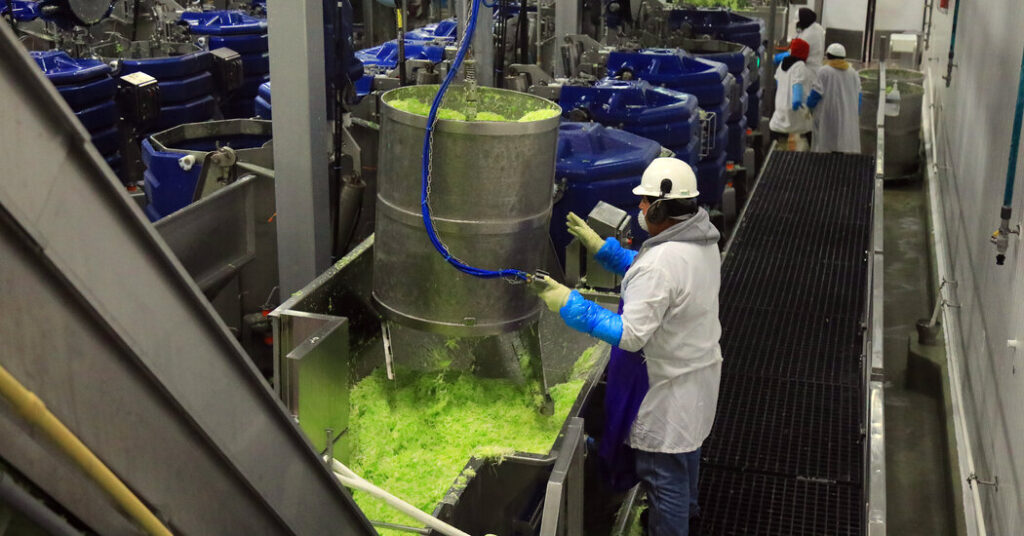
Taylor Farms, one of the nation’s largest producers of leafy greens and fresh vegetables, said on Friday that it would remove its products at the center of a cyclosporiasis outbreak that has sickened more than 1,600 people.
Based in California, the family-owned company is in the spotlight after the Centers for Disease Control and Prevention linked an outbreak of cyclosporiasis to iceberg lettuce that Taylor Farms supplied to certain Taco Bell restaurants, according to two federal officials who declined to be named Thursday night.
The company said in an email Friday that it had “promptly initiated a voluntary removal of product” based on information provided by the Food and Drug Administration this week. “We are committed to taking proactive actions,” the company said.
Taylor Farms was founded in 1995 by Bruce Taylor, the third generation of an agricultural family in California’s Salinas Valley, the so-called salad bowl of the world.
Today, Taylor Farms is a vegetable behemoth, selling more than $7 billion worth of produce each year to grocery stores and restaurant chains. It grows food in more than a dozen states, as well as in Mexico and Canada, and has 30 processing facilities and 25,000 employees. Last year it said it made more than 40 percent of all salad kits sold in American groceries and provided 265 million servings of fresh vegetables each week.
But much of its sales to grocery retailers and restaurants are a mystery. The company — like other food producers — does not disclose which grocery stores or restaurants use its leafy greens or other vegetables.
Adding to the confusion, Taylor Farms sells most of its products to food distributors, who, in turn, sell it to restaurants and grocery stores.
For consumers, that uncertainty made them look at their lunchtime meals a bit differently this week. Was it safe to eat an arugula salad at lunch? Could shredded lettuce be added to a burrito?
“I’m not taking chances. It’s not worth it,” said Caren Bordowitz, who works in marketing at Western Illinois University in Macomb, Ill., as she passed on her usual purchase of a bag of lettuce from her local supermarket.
The C.D.C. is advising consumers to not eat the lettuce served at Taco Bell restaurants in Indiana, Kentucky, Michigan, Ohio and West Virginia. The agency has stated that iceberg lettuce at grocery stores or served in other restaurants is not impacted.
“Consumers rarely know where their fresh produce comes from, and cannot discern between romaine grown here or grown there,” said Joelle Mosso, the associate vice president of science programs at the Western Growers Association, an industry group.
On Thursday night Taco Bell said it was removing “potentially impacted lettuce from a supplier in select states.” It did not name the supplier or the states. Shares of Yum Brands, which owns the restaurant chain, slid nearly 9 percent this week.
Yum Brands did not respond to additional requests for comment.
Illness from cyclosporiasis is seasonal and tends to peak during the summer months. However, the United States is on track to have more cyclospora cases in 2026 than in any previous year.
And while much of the current investigation is focusing on the outbreak involving iceberg lettuce sold to some Taco Bell locations, health officials are also investigating illnesses and outbreaks in other states that are unrelated, the C.D.C. said in its notice posted Thursday night.
For years, Taylor Foods has emphasized the importance of safety in the lettuce and the other produce it grows, knowing one incident can quickly wipe out consumer trust.
“Our whole industry relies on consumer confidence in the health and safety of our products,” Mr. Taylor said in an interview published earlier this year in Western Farm Press, a trade publication that focuses on farmers and ranchers. “All we can do is make sure we’re taking the steps that we know to take to ensure we’re producing safe food for our fellow Americans.”
The F.D.A.’s investigation into the outbreak appears to be focused on a farm in Mexico that grew the iceberg lettuce, and a facility nearby that shredded it, according to administration officials.
Taylor Farms has two processing facilities in Mexico, one in Baja California and another in Guanajuato.
Food and safety experts said this cyclosporiasis outbreak demonstrated the difficulty in completely eliminating risk from a food supply chain that often stretches across multiple countries and a number of growers, packagers, distributors and sellers who operate under different laws and with different food safety standards.
Over the years, Taylor Farms has been linked to previous outbreaks of food-borne illnesses. In 2013, following three recalls, the company was investigated by health officials in connection with an outbreak of illness that sickened hundreds of people in 22 states that involved greens used at Olive Garden, Red Lobster and possibly other restaurant chains.
More recently, health officials considered the company a likely source of an E. coli outbreak linked to onions served at McDonald’s in 2024 that resulted in 104 illnesses, 34 hospitalizations and one death. In October of that year, Taylor Farms recalled yellow onions.
Mr. Taylor, the company’s founder, has played a powerful role in the fresh produce industry. When two major produce associations joined forces in 2022 to form the International Fresh Produce Association, he was the inaugural chairman.
He has helped shape rules and regulations for the leafy greens industry. After an E. coli outbreak in 2006 killed three people, Mr. Taylor and other growers helped create the California Leafy Greens Marketing Agreement, a food safety coalition funded by growers but administered by the California Department of Food and Agriculture.
Members of the agreement must adhere to food safety practices that go beyond what is required by the federal Agriculture Department or the F.D.A., including scheduled and unscheduled audits of their fields and processing systems.
The post Taylor Farms to Remove Some Products After Link to Cyclospora Cases appeared first on New York Times.