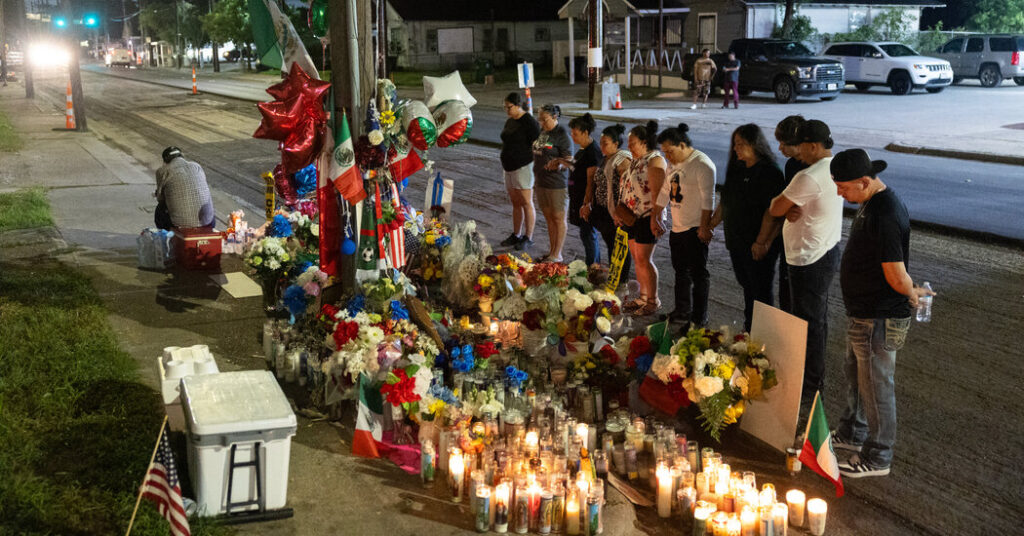
In Magnolia Park, one of Houston’s oldest Latino barrios, a makeshift memorial for Lorenzo Salgado Araujo sits on a torn-up street near the spot where he was killed.
Since Mr. Salgado Araujo, a Mexican home builder and father of three, was fatally shot by an Immigration and Customs Enforcement officer last week, construction workers and landscapers in work shirts and dusty boots have often come alone to stand in silence.
Neighborhood residents have dropped off rosaries and candles. Many have worn Mexico soccer jerseys in tribute to one of Mr. Salgado Araujo’s favorite teams.
His killing has hit hard, another immigrant’s life taken by agents carrying out President Trump’s mass deportation campaign.
Yet, the mourning feels different in Magnolia Park.
In parks, shops and backyards in the neighborhood, people have voiced their grief in hushed tones. There are no shrill whistles or clashes with agents. There have been fewer news cameras and demonstrations than in cities like Chicago or Minneapolis.
At a restaurant, television screens alternated between clips of World Cup matches and news footage of federal agents wrestling migrants to the ground in confrontations across the country.
Maria, 52, a cashier who spoke on the condition that her last name not be published because she fears retaliation from immigration authorities, said she had lived and worked in Houston without legal status since she had left central Mexico with her daughter some 30 years ago.
She had never seen staff and customers so scared or concerned over immigration enforcement — or so angry, she said. “It could have been any one of us,” she said. For now, she added, there is little she can do but stay inside as much as possible and check her social media accounts for reports of ICE before she goes out.
Magnolia Park, home to more than 14,000 residents, has been a center of Mexican American life in Houston for generations. Many live in families where some people have legal status and others don’t.
So while there are rosary beads draped on plastic flowers and Mexican flags projecting out from telephone poles in Mr. Salgado Araujo’s honor, Magnolia Park residents say their response has been muted in a community conditioned by a painful history of discrimination that has taught residents to be cautious about using their voice.
The road now called Canal Street, where the memorial has sprung up, has been woven into the fabric of the neighborhood since it was mapped out in 1890 and adorned by more than 3,000 newly planted magnolias.
Germans, Greeks and Italians were some of the first immigrants to settle into the city’s surrounding East End. Mexican Americans from South Texas arrived in Magnolia Park more than two decades later, along with Mexican migrants fleeing the revolution convulsing their homeland.
In the 1950s, Mexicans found themselves caught up in the mass deportation campaigns under the Eisenhower administration. Local and state law enforcement officers helped U.S. Border Patrol round up Mexicans and Mexican Americans believed to be living in the United States without legal status.
Joaquin Martinez, a City Council member who represents Magnolia Park, said his father recounted life growing up in the neighborhood during that era, being bullied for being Mexican and spanked or hit with rulers in school for speaking Spanish. His father, like many Mexican and Latino elders of his generation, learned that the way to survive in Magnolia Park was this: “Keep your head down, focus on your family, work hard,” Mr. Martinez said.
But the mourning in Magnolia Park over the last 11 days has at times been pierced with sound.
On many afternoons, day laborers in white work vans, like the one in which Mr. Salgado Araujo was killed, have driven down Canal Street honking horns, fists raised out the windows. Lowriders have rolled down the road in homage, blasting cumbias, Norteñas and corridos, Mexican ballads that immortalize stories, including Mr. Salgado Araujo’s life and death:
Trembling with fear
I cried for help
Nobody could hear me
To Jesse Rodriguez, 56, a local artist who goes by Magnolia Grown, that loud, defiant public sorrow is baked into his neighborhood’s history, but one that is deeply buried. As a teenager, he and his friends drew inspiration from Pachucos, Mexican American rebels who embraced their bicultural duality through a distinct style and love of music.
Mr. Rodriguez and his wife, JoAnna, have since transformed the 100-year-old bungalow once owned by her great-grandfather into an art space and Mexican American history school. Over the past two years, their students have been learning about deportation campaigns that preceded the one unfolding under Mr. Trump.
A class last summer painted canvas pieces in response to the sweeps in Los Angeles that deck the walls. Last week, a cohort channeled its grief over the ICE killing just down the street. “We’re teaching the past, but now it’s here, not just in Houston, but right in our own neighborhood,” Mrs. Rodriguez said.
On Thursday, residents from Magnolia Park and across the Houston area packed into a chapel in the East End for Mr. Salgado Araujo’s public viewing.
For people who know the neighborhood’s painful history, the killing last week stirred memories of the 1977 death of José “Joe” Campos Torres, a Mexican American Army veteran.
In May 1977, a group of white Houston police officers pulled Mr. Campos Torres, 23, out of an East End bar and charged him with disorderly conduct. They beat him up so severely that local jailers told the officers to take him into the hospital. Instead, they pushed him into the bayou, where he drowned. His body was recovered days later.
Activists from the neighborhood marched down Canal Street in protest, over red bricks that had largely been laid by Mexican and Mexican American laborers. Months later, when news hit radio stations that an all-white jury had let the officers off on misdemeanor convictions, tensions ultimately erupted into violence the following spring.
Some residents said there was no reckoning for the officers involved, and the killing and protests faded from the city’s memory. Houston seemed to bury the episode when it poured asphalt over Canal Street’s red bricks.
What Janie Torres, Mr. Campos Torres’s sister, said she wants for Mr. Salgado Araujo — for her brother — is accountability. There was a time when she could not bear the grim details of her brother’s death. “But then I realized I could draw strength to keep fighting by putting myself in his shoes,” she said.
In the days before Mr. Salgado Araujo was killed, construction crews had stripped Canal Street to resurface the road. Some of the old red bricks were visible, and some of the mourners found themselves walking amid them as they made their way to his memorial. A worker who lived nearby helped craft wooden shelves to hold some of the candles spilling onto the street. Another hammered a saw, a yardstick and other tools into it to honor Mr. Salgado Araujo’s labors.
One night late last week, a couple of residents were lighting candles and debating whether to relocate the memorial. The rains had stopped, and construction crews were expected on Canal Street any day to pave back over the red bricks.
The post In Houston, a Different Kind of Mourning After Fatal ICE Shooting appeared first on New York Times.