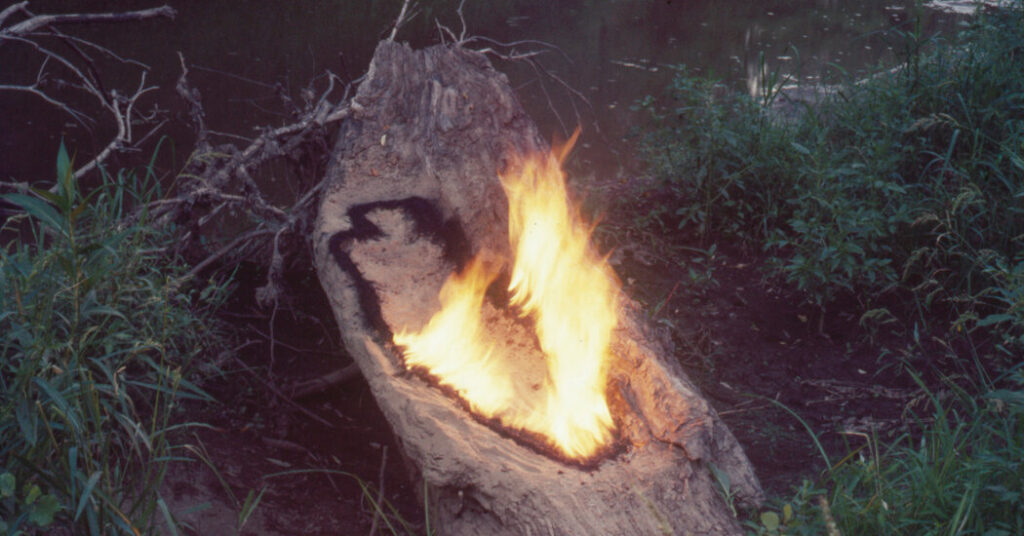
How to show, inside the typically staid and static walls of an institution, artworks that bleed, burn, breathe, ooze, stream, smoke, take flight, disappear? How to present a lifelong oeuvre that eschews linear time?
A survey of Ana Mendieta’s work, at Tate Modern in London through Jan. 17, shows how this Cuban American artist pushed against — and sometimes quite literally exploded — conventional boundaries of making, exhibiting and understanding art.
“My work is basically in the tradition of a Neolithic art,” she told the art critic Channing Gray in 1984, distinguishing herself from predominantly male peers involved in Land Art, a movement that involves permanent and frequently drastic interventions in the environment; and the summoning of a sense of deep time beyond the confines of Western art history.
“I’m not interested in the formal qualities of my materials,” she continued, “but their emotional and sensual ones,” hinting at the wider, immaterial language that she often used to describe her creative ambitions — “power,” “energy,” “spiritual,” “magic” — and to convey the sense that an image or an object could transmit a force that exceeded itself.
The Tate display avoids relying on the chronological format so frequently applied to retrospective exhibitions, declining to present the biographical information that has at times overshadowed Mendieta’s work since her death in 1985 at age 36. Instead, the exhibition is organized thematically, taking its cues from her interest in the natural world.
We enter through the first section, “The Cave,” a grotto-like room whose low concrete overheads often make it an awkward exhibition space. Here, it seems suddenly apt, the surrounding walls covered with black-and-white prints of a 1981 series that the artist called her “Rupestrian” sculptures. The term, meaning “inscribed on rocks” and often used to describe ancient cave drawings of dwellings, refers to the abstracted female figures of varied shape and size that Mendieta carved into the limestone rocks of Jaruco State Park just outside Havana, where she was born in 1948.
This room tells us, immediately, of Mendieta’s interest in bringing the outside in — an assertion that art and nature are not, in fact, separate spheres. From a window in the corner, you can also see, on a grassy area outside the museum’s back entrance, one of the artist’s outdoor sculptures that bring the inside out: “Mother of All Things” (1982), originally made for the Lowe Art Museum in Miami and reconceived for Tate in a process overseen by her estate, according to archival documentation.
Like the Rupestrian sculptures, the work is all curves and overtly female: three bulging ovals covered in sphagnum moss and affixed to either side of the trunk of a plane tree like a sprouting body that has burst from within the organism.
At the exhibition’s opening on Monday evening, another work was recreated: “Anima, Silueta de Cohetes (Firework Piece)” (1976), for which the artist, traveling in Mexico, hired an Oaxacan firework maker to create the outline of her silhouette. Mounted on a pole, when lit it would flame and burn, then fade and flicker, leaving the heart to flame last.
Previously, this work would have been experienced only by Mendieta herself, as one of her “Siluetas” — actions performed alone in the landscape, in which she recorded an ephemeral presence of her own outline. She also called them “earth-body works.”
This might be a kind of additive process, in which a body is made of berries, shells, flowers, cloth, sticks, ice, rocks, moss, red pigment; or a subtractive one, with a body dug, burned, exploded, carved, washed away at a shoreline.
In each case, Mendieta would preserve the “Silueta,” destined to fade and disappear with time, on photographic Super 8 or 16-millimeter film, an image of an image, an action of an action that would then exist in a different form in a gallery space — a work at once permanent and impermanent.
Many of these are on display at Tate, including a handful of films seen for the first time in Britain since the Mendieta estate remastered them. In a section called “The River,” five films that span 1973 to 1978 highlight how enigmatic and unusual, confident and muscular the artist’s practice was.
In one, a silhouette flames in the grass and then burns out, leaving behind a blackened outline and a haze of smoke. In another, the grass itself breathes, up and down, as we realize that the artist is somewhere beneath — not buried alive, but showing us just how full of life is the earth beneath our feet.
Other standout pieces about nature are both tender and theatrical: A 1982 series of leaves with primordial figures drawn onto them are like small relics. A recreation of “Untitled: Silueta Series” (1978), a room-size installation carpeted with leaves and spotted with bare trees, a moss figure glowing on the ground at its center, is eerie and transfixing.
Is this is an elegant but slightly polite account of an artist who said, “My art comes out of rage and displacement”? Who passionately and notoriously argued about art and life, yelled at critics who wrote lukewarm review of her shows and flipped off Italian drivers while at the American Academy in Rome in 1983? Who also made many rageful and erotic, violent and discomfiting works?
There is much that you will not find in the Tate exhibition — primarily an artist biography with the usual details, including about Mendieta’s family life or economic background, and why or how she left Cuba, although her “exile” is frequently referred to. (She and her sister were part of “Operation Peter Pan,” in which many Cuban youths were relocated, with refugee status, to the United States to escape Fidel Castro’s regime.)
Nor is there much insight into her many international travels, an exhibition history or critical responses to her work during her lifetime (she was ambitious and well-received), or the date or reason for her death, when she fell from the 34th-story apartment that she shared with her husband, the artist Carl Andre.
When I asked Valentine Umansky, one of the show’s curators, about the absence of biography in the exhibition, she bristled and asked what my “angle” was. This was perhaps with good reason: With Mendieta, “biography” has become shorthand for the focus on her untimely death and its status as an infamous true-crime story that has often overtaken, or skewed interpretations of, her creative and life-affirming practice.
Her family has spent decades working to change the narrative, often finding itself not entirely able to — a thankless but also impossible task, because interpretation cannot be controlled. Still, the practical facts and wider contexts of a life do shape a person and therefore their work (I did not invent historical materialism).
“What do we do with the idea of a chronology when an artist was extremely prolific and talented but only had 20 years to make work?” Umansky offered. It was a beautiful prompt for undoing the idea that linear narrative is sufficient for lives that don’t have the luxury of time, and for mounting an exhibition that asks viewers to let the work organize its own categories.
It also results in a kind of formalism. To foreground the art, do we need to avoid the life and exclude certain works — for instance, those that reference death or sexual violence, as some of Mendieta’s most powerful early pieces do — lest they somehow take over the whole narrative? This is an either/or that seems to be applied only to women and should end up in the dustbin along with phrases like “in her own right.”
Meanwhile, we can hope for intelligent and sensitive viewers, which Tate’s “Ana Mendieta” quietly does, even as they will have to look elsewhere for the other multitudes that she, like every person, contained.
Ana Mendieta
Through Jan. 17 at Tate Modern in London; www.tate.org.uk.
The post The Burning, Bleeding, Breathing Art of Ana Mendieta appeared first on New York Times.