
This is an edition of The Atlantic Daily, a newsletter that guides you through the biggest stories of the day, helps you discover new ideas, and recommends the best in culture. Sign up for it here.
An IMAX-film-camera system looks like the kind of device that could give you an X-ray. Weighing hundreds of pounds, it emits a constant, deafening mechanical roar that must be muted with a large encasement known as a sound blimp. The complete setup is big enough to block actors’ line of sight, sometimes preventing them from keeping eye contact with their scene partners. Shooting a movie this way is a cumbersome, expensive process; no filmmaker undertakes it lightly.
Christopher Nolan’s big-budget adaptation of The Odyssey, opening this week in thousands of movie theaters across the United States, is the first commercial feature shot entirely with these cameras. But only about two dozen domestic theaters are playing the movie the way its director intends it to be seen. The rest will be showing slightly different versions, which may be cropped into smaller aspect ratios or projected without the clarity and texture of the original film stock. As contemporary filmmakers and studios continue to push premium formats, some audiences are ending up excluded.
Marketing for The Odyssey has relentlessly emphasized the fact that the movie was shot in IMAX. During the 2023 rollout for Nolan’s Oppenheimer, which was partially shot with IMAX cameras, the director made clear that the IMAX 70-mm format represented the “best possible experience” of the film. This time around, IMAX is being touted as the way to see Nolan’s creation. Matt Damon, who stars as Odysseus, says in a short advertisement that IMAX 70 mm offers the “full impact of how it was shot.” One of the themed popcorn buckets tied to the movie is a miniature IMAX camera with a light-up viewfinder. And IMAX 70-mm viewers get an exclusive perk not shown in other theaters: a glimpse at footage from Dune: Part Three, another upcoming film shot with IMAX cameras.
This insistence on the primacy of IMAX can send the message that there’s only one true way to see the movie—which has made some filmgoers feel like they’re losing out on the full experience. The Odyssey is intended to be projected in IMAX 70 mm’s 1.43:1 aspect ratio, a far squarer format than the typical widescreen. Just a few dozen theaters in the world are equipped to show the movie in these dimensions, with this exact film stock. When a movie with those measurements is projected onto a different-size screen, theaters excise parts of the frame. Exactly how much is cropped out depends on the screen: Some theaters dispense with as much as 40 percent of the image. Many viewers won’t care, especially when most of the action is happening in the middle of the frame, but they also might not realize what they’re missing. At a key moment in last year’s Sinners, some viewers watched the screen slowly elongate, transitioning from widescreen to a taller aspect ratio. How tall it got—and how dramatic that moment felt—depended on whether the theater was equipped with an appropriate IMAX projector.
In the United States, IMAX 70-mm projectors are concentrated in a few metropolitan areas, and availability is even more limited in other countries—there’s only one of these projectors in the entire Southern Hemisphere. IMAX obsessives are reportedly flying cross-country to see The Odyssey at certain theaters; others are paying high premiums for resale tickets (some have been listed on eBay for hundreds of dollars). Then there are screenings that aren’t true 70-mm, 1.43:1 experiences but that nevertheless carry the IMAX branding. These have been annoying moviegoers for years, and today’s film buffs have a name for them: LIEMAX.
The scarcity of IMAX-projection setups stems from a real logistical challenge. The screen must accommodate these specific dimensions while retaining their characteristically epic feel, and many theaters’ ceilings aren’t high enough. Only certain projectors can show The Odyssey in its intended format, and IMAX CEO Richard Gelfond has recently said that there aren’t enough of them to meet demand. On top of that, the reels weigh hundreds of pounds and need to be loaded with a forklift. Projectionists need to be trained to use the equipment. Still, this system works for IMAX: Because some filmgoers believe that these screenings are a way to get closer to the art, the tickets can command higher prices. Last year, IMAX ticket sales reached a record high of $1.28 billion globally.
Not everyone is insisting on seeing The Odyssey in 70 mm. The standard experience—a digital version, presented in a traditional widescreen aspect ratio—suits many people just fine. The fans who care a little more can pay to upgrade to a bigger screen. The ones who don’t care enough to pay for a movie ticket can wait to see it at home, or on an airplane as they fall asleep.
The movie industry has been finding ways to accommodate aspect-ratio shifts for generations. When talkies usurped silent films, in the late 1920s, theaters scrambled to adapt to a new, squatter format. In the ’50s, when Cinerama and CinemaScope introduced new formats to mainstream filmmaking, Hollywood started trying to replicate the effects—a phenomenon that became known as “ersatz widescreen.” These aren’t the kinds of substantive trade-offs we typically associate with other kinds of visual art—if the Louvre decided to crop the Mona Lisa, museumgoers would probably want their money back.
The Odyssey won’t be the last movie to tie its marketing strategy to IMAX. As these cameras are adopted by more and more auteurs, discussions around formats and aspect ratios are being built into how today’s big-budget films are advertised. Dune’s director, Denis Villeneuve, has said that IMAX is “the future of cinema,” and Ryan Coogler, the director of Sinners, affirmed that the 1.43:1 aspect ratio offers “the full impact of every image how we intended to see it.” When so few theaters can deliver the true IMAX experience, that language can start to chafe. If this is cinema’s future, not everyone will get to share it.
Related:
- An Odyssey deserving of the biggest screen possible
- Christopher Nolan on the promise and peril of technology
Here are four new stories from The Atlantic:
- The biggest takeaway from Todd Blanche’s confirmation hearing
- How the Smithsonian could fall
- Pete Hegseth wants YOU to test your testosterone.
- J. D. Vance’s own alien abduction
Today’s News
- President Trump is expected to deliver an address tonight at 9 p.m. eastern time on election security and voting machines, in which he is likely to revive unsupported claims about election fraud and reference newly declassified documents.
- At least one person has died as flash flooding sweeps through Texas Hill Country, where rivers rose rapidly following heavy rainfall and rescue operations remain under way.
- Wildfire smoke from Canada is expected to worsen air quality across the Northeast and the mid-Atlantic through tomorrow, potentially exposing more than 115 million people to unhealthy conditions. Smoke has already reached the Washington, D.C., area and parts of North Carolina, and is expected to increase and spread farther south.
Dispatches
- Time-Travel Thursdays: The point of a classical education is to teach you something about being human, Elias Wachtel argues.
Explore all of our newsletters here.
Evening Read
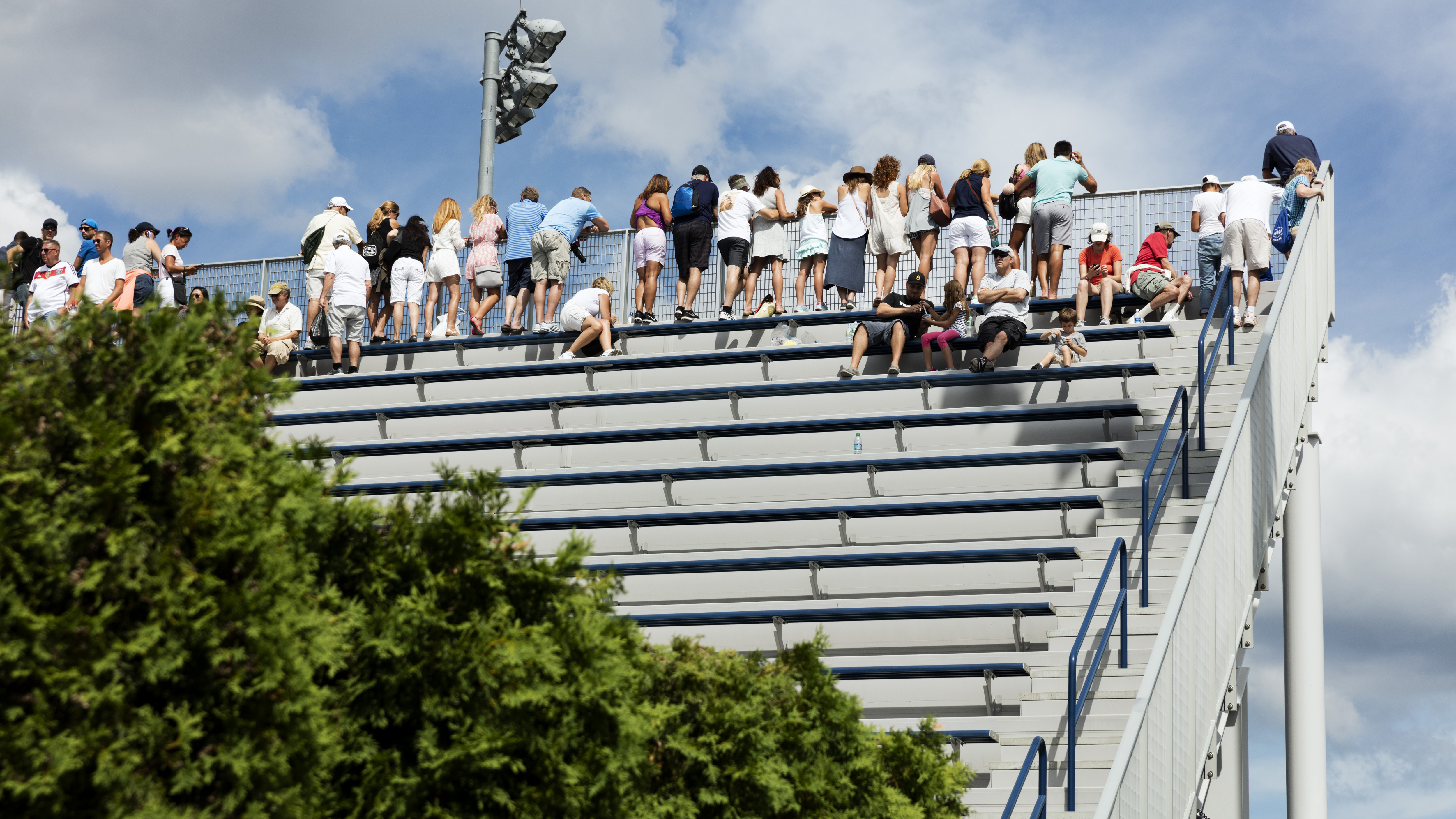
The Sports Overload Is Here
By Jacob Stern
If it feels like there are more sports to watch than ever before, that’s because there are. This year’s World Cup is the biggest ever, the tournament having jumped from 32 teams to 48. It may come around only every four years, but the sports calendar no longer stops. The MLB, NHL, and NBA have all added games over the past few years. In 2020, the NFL tacked on two extra playoff games; the following year, the league added an extra regular-season game for the first time in nearly 50 years. Since then, it has colonized ever more calendar territory, rescheduling games from its standard Sunday slate to the Wednesday before Thanksgiving, Black Friday, Christmas Day, and a number of late-season Saturdays …
If you’re a sports fan like me, more games to watch can seem like a good thing. You don’t get the tiny African island nation of Cape Verde holding out for a miraculous draw against the mighty Spain without a 48-team World Cup. When leagues expand their playoffs—as, say, the MLB did in 2022—they give more teams a chance to qualify and more fans something to root for. But the glut of games can also be overwhelming, even if you aren’t someone who binges three different leagues. There’s simply too much.
More From The Atlantic
- The opening after Netanyahu
- The lessons about Ebola the U.S. wants to forget
- Explaining sex to an anthropologist
- The truth about AI’s water use
- Radio Atlantic: The election deniers are in charge now.
- Inside Trump’s reversal on ICE
Culture Break

Reflect. The Odyssey is not, strictly speaking, a children’s book. Chris Moody decided to try reading it to his 3-year-old son anyway.
Read. Colson Whitehead’s Harlem Trilogy, which concludes with his new novel, Cool Machine, is both unapologetic crime fiction and a grand statement on the laws of the universe, David Hajdu writes.
Rafaela Jinich contributed to this newsletter.
When you buy a book using a link in this newsletter, we receive a commission. Thank you for supporting The Atlantic.
The post The Problem With The Odyssey’s IMAX Hype appeared first on The Atlantic.