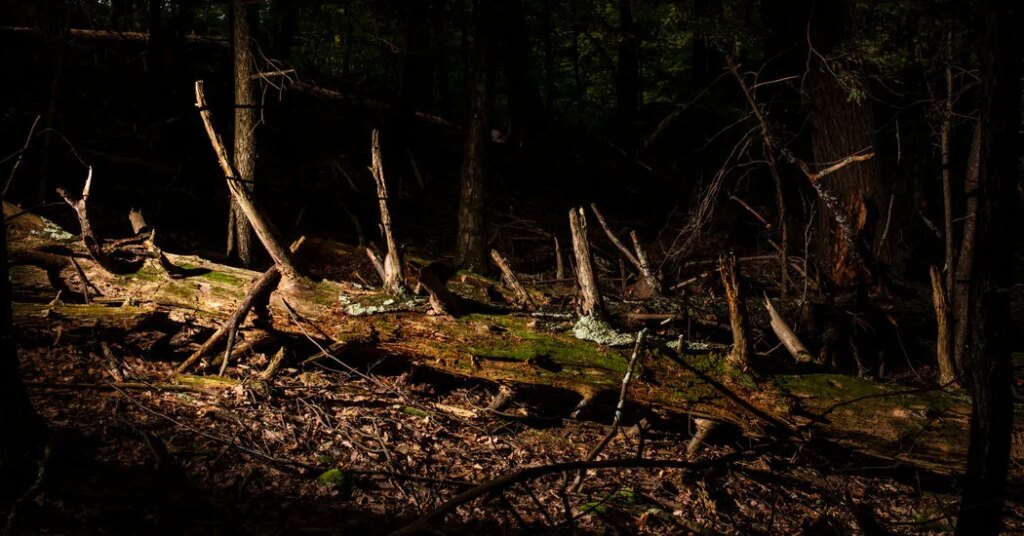
America’s trees are not OK, my colleague Catrin Einhorn writes this week.
Beset by numerous plagues spread by pests and pathogens, billions of trees have died since the turn of the 20th century, and many more are sick.
In a single grove she visited in upstate New York, a beech tree had been struck by two invasive scourges; aphid-like insects were attacking Eastern hemlocks; and ash trees had been killed by the emerald ash borer, an invasive insect.
Read the full article here. In the meantime, here are five tree takeaways.
Overlapping pandemics
It’s been more than a half-century since the woolly adelgid began attacking American hemlocks, and beech bark disease was first documented in North America before 1900. What’s accelerating is that new diseases are entering the region while old diseases continue their spread.
“We’re moving insects and microbes around the world through trade very rapidly, and basically running an experiment” to see which ones will take hold, Bernard Slippers, a forest pathologist at the University of Pretoria in South Africa, told Einhorn.
In some of the worst cases, that means American forests are filling with fallen trees and desiccated trunks, leaving invasive vines and brambles to take over.
Driving this is international trade
As global trade has accelerated in recent decades, so too has the global exchange of insects and pathogens, which hitch rides in the wood packaging on cargo ships and make new homes after landfall. They also arrive in live plants.
The climate in the northeast United States closely matches the climate in northeast Asia. That means insects and microorganisms can survive in both places. When new pests meet trees that have never encountered them, the collision can be catastrophic. And the exchange goes both ways: The pinewood nematode from North America is attacking East Asia and Europe just as an East Asian insect kills American hemlocks.
As the presence of highly destructive pests ticked upward in the 1990s, U.S. regulators stepped up efforts to catch them at ports of entry. But the problem is overwhelming. An Agriculture Department official told Einhorn that they intercept shipments almost every other day.
The epicenter is in the Northeast
The northeastern United States is home to many majestic, diverse forests. It’s also a trade hub. So perhaps it’s no surprise that the region has emerged as a hot spot for tree diseases.
Einhorn visited a hemlock grove where 80 percent of the trees had died by 2023. Ash trees have been so devastated by the emerald ash borer, she wrote, that six of the most prominent species are now classified as endangered or critically endangered.
I asked Einhorn how it felt to visit the forests and absorb the changes she was seeing.
“Walking in the forest with biologists really opened my eyes to the scale of the problem,” she said. “Areas that looked pretty at first glance were actually full of sick and dying trees.”
Scientists are racing to find solutions
Traditional tree-saving methods, like injecting each affected plant with insecticides, are expensive and often not practical on a whole-forest level.
One way to kill an insect is to introduce a predator. Researchers have released four species of Asian wasps in Eastern and Midwestern states. In the Catskills, Einhorn joined scientists as they released a plastic bottle filled with tiny flies they hoped would prey on the hemlock-attacking adelgid.
Elsewhere, researchers have found that some ash trees have a natural resistance to beech bark disease. They’ve begun crossbreeding these “lingering” trees in hopes of “helping Mother Nature along,” as Jennifer Koch of the Forest Service put it.
The future will look different
I asked Einhorn what this all means for forests where I hike in the Northeast. Are we headed for a world with no trees?
“Again and again, I asked scientists what these epidemics mean for forests,” she said. “No one thinks all the trees are going away. Some suggested that Northeastern forests may have fewer species in the future, like forests in Europe.”
That would mean a lot of loss — of trees, and of species that depend on them.
Read “The Overlapping Plagues Quietly Devastating American Forests”
America’s utility bill crisis
As fall sets in across the country, the bill is coming due for the hottest summer on record in the United States. The past three months were about three degrees Fahrenheit above average, hotter than the Dust Bowl summer of 1936 and the heat dome of 2021, and tens of millions of people can’t afford to pay for the air-conditioning that helped keep them safe in the deadly heat.
About one in six U.S. households is already behind on its utility bills, according to federal data. More than a dozen hot-weather states like Arizona, Georgia, Virginia and Oklahoma restrict utilities from turning off the power for unpaid bills during the most dangerous heat, so disconnections tend to peak in October, when a climate crisis turns into a collection notice.
In Oklahoma, families are struggling to keep the lights on and the AC running. Genia Weitz, 58, owed $1,340.96 on a recent bill, far more than her monthly income. State rules prevented the power company from shutting off someone’s electricity when the heat index was above 101 degrees, but once it dropped to 99 in September, Weitz had nine days to pay. — Eli Saslow
More climate news from around the web:
-
Supersized heat waves used to be rare, Reuters reports, but that’s no longer the case. Its series exposes the profound consequences of stifling temperatures blanketing the planet.
-
Travel into the Alaskan wilderness to explore the front lines of permafrost research with MIT Technology Review.
-
On The World, Carolyn Beeler speaks with psychologist Samia Akhter-Khan, who studies climate change and loneliness at Brandenburg Medical School in Germany, about how the changing global environment is affecting people’s feelings of isolation.
-
International collaboration and government support made floating wind farms possible. Those partnerships have been tested under the Trump Administration, but so far are surviving, according to Inside Climate News.
Read past editions of the newsletter here.
If you’re enjoying what you’re reading, please consider recommending it to others. They can sign up here.
Follow The New York Times on Instagram, Threads, Facebook and TikTok at @nytimes.
Reach us at [email protected]. We read every message, and reply to many!
The post Overlapping Plagues Are Killing American Forests appeared first on New York Times.