Under cover of night is when firefighters perform some of the most essential work of starving a wildfire. They can lay out sprinklers, directly attack smaller fires and run heavy equipment with less risk that it will overheat.
But Canadian firefighters are observing a trend of high overnight temperatures that have brought on a new hardship: the 24-hour fire cycle.
“It is relentless,” said Randy Schroeder, a fire chief in the western province of Alberta. “The fires grow and last a lot longer than they would have normally done in the same fuel, in the same period of time, years ago.”
Ordinarily, when temperatures drop and humidity rises after dark, fires burn less intensely and spread more slowly, giving firefighters a window to control flames, as well as time to rest before fire activity picks back up the next day.
But climate change is turning that on its head. As fire intensity increasingly remains high overnight, fire teams have been forced to rethink how they work.
Maintaining the same schedule through the night also drives up the cost of fighting wildfires, said Mr. Schroeder, former president of the Alberta Fire Chiefs Association. And if crews can’t attack the fire after dark, he said, “We have to basically get out of its way.”
More than 850 wildfires were burning in Canada on Thursday, with the most active ones north of Lake Superior in Ontario. About 15 communities there have been evacuated near Thunder Bay.
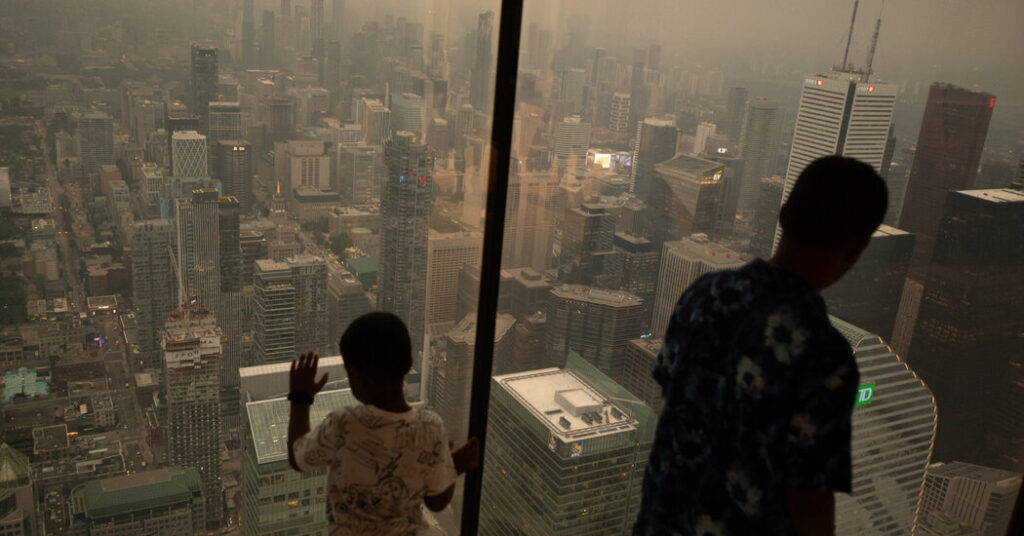
Smoke from the fires has spread across the region and into the United States, pushing the Air Quality Index well above 500 in parts of Ontario and the Midwest. The scale runs from 0 to 500, and anything above 300 is considered hazardous.
“Cool nights are so key to help get on top of some of these fires,” said Liam Buchart, a fire weather meteorologist based in Edmonton. “Whereas some of these nights — in this heat wave that’s just moved through the region — have remained incredibly warm,” he said. Overnight temperatures have at times hovered at 91 degrees Fahrenheit.
Wildfires are typically most active during the hottest parts of the day. But research has shown that across North America, they are increasingly burning earlier in the morning and later into the night, a side effect of the hotter, drier weather that fuels them.
Xianli Wang, a fire research scientist for the Canadian Forest Service, was the coauthor of a 2026 study that used satellite data and computer modeling to estimate that potential burning hours in North America increased 36 percent from 1975 to 2024. Most of that increase came at night.
“The problem is that under increasingly extreme fire conditions, this nighttime slowdown is becoming less reliable,” Mr. Wang said. “Fires can remain active well into the night, reducing the time firefighters have to contain them and leaving communities with less time to prepare or evacuate.”
The Jasper fire, which tore across much of Jasper National Park in 2024, is an example. The fire burned significantly overnight largely because a heat wave and lack of rainfall in the preceding month had left the landscape highly flammable.
It has been a hot summer across much of Canada, with multiple heat waves since May. The overnight temperatures have been unusually high in many regions, particularly across Ontario.
In Toronto, the average overnight low in the first two weeks of July was 68.7 degrees, compared with a normal 63.1 degrees for that time of year, according to Brian Proctor, a meteorologist at Environment Canada.
Those extra degrees “can have a tremendous impact,” Mr. Proctor said.
This is not a short-lived trend. Over the last century, overnight lows have warmed and in some regions they are rising faster than daytime highs.
On Thursday, the heat was focused over western Canada, with scattered warnings across the region. It was the first day without any heat warnings in Ontario this week, in part because of the wildfires.
“The smoke is limiting the incoming solar radiation so the temperatures aren’t quite as high,” Mr. Proctor said.
The post Wildfires Are Burning Through the Night. Firefighters Are Running Out of Time. appeared first on New York Times.